


How to Choose the Right Lens for Professional Architectural Photography
After selecting a camera, the next question every aspiring real estate photographer asks is:
"What is the best lens for real estate photography?"
Unlike camera bodies, which evolve every few years, lenses are long-term investments. A quality lens can remain in your camera bag for a decade or more and influence every photograph you create.
In fact, lens selection often has a greater impact on image quality than upgrading your camera body.
That's because a lens determines far more than simply how much of a room fits into the frame. It affects perspective, sharpness, distortion, contrast, color, and ultimately how a prospective buyer experiences a home.
The challenge is finding the balance.
Choose a lens that is too narrow, and rooms feel cramped.
Choose one that is too wide, and the home begins to look unnatural.
Professional real estate photography isn't about making rooms appear larger than they are. It's about presenting them honestly, beautifully, and in a way that encourages buyers to schedule a showing with confidence.
In this guide, we'll explore what makes a great real estate lens, how professionals think about focal length, and how to choose the right lens for your budget and camera system.

Why Wide-Angle Lenses Matter
Real estate photographers are often working in spaces that simply cannot be captured with a standard lens.
Bathrooms.
Laundry rooms.
Hallways.
Small bedrooms.
Walk-in closets.
A wide-angle lens allows you to include more of the room while maintaining a comfortable viewing perspective.
However, more is not always better.
Professional photographers don't strive to capture everything.
They strive to capture what matters most.
The objective is to communicate:
- The size of the room
- Its architectural character
- The relationship between adjoining spaces
- The craftsmanship of the home
- The natural flow of the floor plan
A great photograph helps the viewer understand the home—not just admire the picture.
Understanding Focal Length
Focal length determines how much of a scene your camera records.
Shorter focal lengths capture a wider field of view.
Longer focal lengths capture less of the room while appearing more compressed.
For real estate photography, we spend the overwhelming majority of our time at the wide end of the spectrum.
Recommended Focal Lengths
APS-C Cameras
An excellent working range is:
10–18mm
This provides enough width for most interiors without introducing excessive distortion.
Full-Frame Cameras
An excellent working range is:
16–24mm
Many professionals spend most of the day between 16mm and 20mm.
Only occasionally is anything wider required.
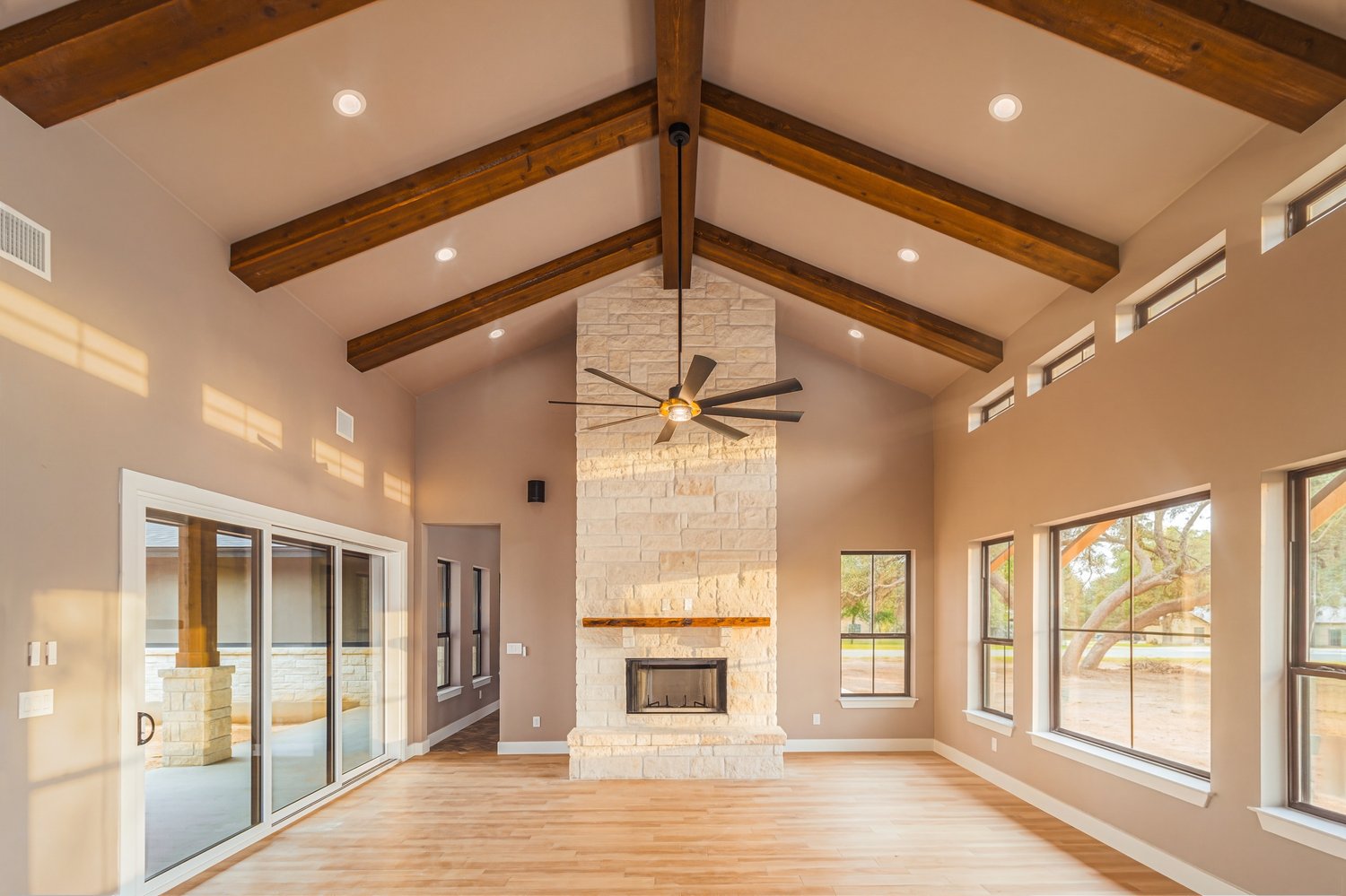
Wider Isn't Always Better
One of the most common beginner mistakes is believing the widest lens produces the best photographs.
It rarely does.
Ultra-wide lenses exaggerate perspective.
Objects near the camera become disproportionately large.
Furniture stretches.
Walls appear farther apart.
Rooms begin to look unrealistic.
Although these images may initially appear impressive, they often disappoint buyers during in-person showings because the home feels noticeably different than expected.
Professional photographers strive for credibility.
The goal is to create images that invite buyers into the home—not mislead them.
The Fisheye Mistake
Fisheye lenses produce an enormous field of view.
They also produce obvious curvature.
Straight walls bend.
Cabinets bow outward.
Door frames curve.
These lenses have creative applications, but they are generally inappropriate for professional real estate photography.
If a buyer immediately notices the lens rather than the architecture, the photograph has failed.
Professional Tip
Instead of reaching for a wider lens, try moving the camera to a better position. Small adjustments in camera placement often produce stronger images than switching focal lengths.
Zoom or Prime?
Another common question concerns zoom lenses versus prime lenses.
Both can produce outstanding results.
Zoom Lenses
Advantages:
- Flexible framing
- Fewer lens changes
- Faster workflow
- Ideal for varying room sizes
Disadvantages:
- Slightly larger
- Often more expensive
Prime Lenses
Advantages:
- Excellent optical quality
- Lightweight
- Wide maximum apertures
- Lower cost in many cases
Disadvantages:
- Fixed focal length
- Less flexibility on-site
Which Do Professionals Prefer?
Most professional real estate photographers prefer quality wide-angle zoom lenses.
The ability to move quickly between 16mm, 18mm, 20mm, and 24mm significantly improves efficiency during long shooting days.
Lens Distortion
Every wide-angle lens introduces some distortion.
Fortunately, modern editing software corrects much of it automatically.
However, software cannot fully compensate for poor lens selection or poor camera placement.
This reinforces an important principle:
Capture the image correctly in-camera whenever possible.
Editing should refine your work—not rescue it.
Sharpness Matters—But Maybe Less Than You Think
Lens reviews often become obsessed with sharpness.
Corner sharpness.
Center sharpness.
Edge performance.
While these characteristics matter, nearly every modern quality lens is sufficiently sharp for MLS listings, brochures, and online marketing.
Composition, lighting, and editing contribute far more to the success of a photograph than microscopic sharpness differences.
Aperture for Real Estate Photography
Many photographers assume they need extremely fast lenses.
In reality, most real estate photography is captured between:
- f/7.1
- f/8
- f/9
- f/11
Because the camera is mounted on a tripod, wide maximum apertures are rarely necessary.
Rather than paying significantly more for an f/2.8 lens, many photographers achieve outstanding results with lenses that are smaller, lighter, and more affordable.
Should You Buy Expensive Professional Glass?
Only if it aligns with your business.
Luxury lenses often provide:
- Better build quality
- Improved weather sealing
- Faster autofocus
- Slightly better contrast
- Improved flare resistance
However, these advantages are often subtle for interior architectural photography.
Invest first in:
- Education
- Lighting
- Editing skills
- A quality tripod
Those improvements typically produce greater returns than purchasing premium lenses.
Common Beginner Mistakes
Using the Widest Setting for Every Room
Different rooms require different perspectives.
Sometimes zooming in slightly creates a more balanced composition.
Photographing Too Close to Furniture
Wide-angle lenses exaggerate nearby objects.
Allow space between the camera and foreground furniture whenever possible.
Tilting the Camera Upward
Tilting introduces converging vertical lines that make walls appear to lean.
Keep the camera level and correct perspective during editing.
Believing Every Room Must Fit Into One Photograph
Sometimes two carefully composed photographs communicate a room better than one exaggerated ultra-wide image.
Professional Tip
Buyers don't need to see every inch of a room in one photograph. They need to understand the space naturally and confidently.
Frequently Asked Questions
What's the best focal length for real estate photography?
For most photographers:
- APS-C: 10–18mm
- Full-frame: 16–24mm
These ranges provide an excellent balance between coverage and realism.
Should I buy a prime lens?
Most professionals prefer wide-angle zoom lenses because they offer greater flexibility throughout an entire property.
Do expensive lenses make better photographs?
They can improve image quality slightly, but composition, lighting, and editing have a much greater impact on the final result.
Can I use the kit lens?
Many kit lenses are capable of producing excellent work, particularly while you're learning. Master your technique before assuming better equipment is the solution.
Should I always shoot at the widest focal length?
No.
Choose the focal length that best communicates the room while maintaining natural perspective.
Continue Learning
Choosing the right lens is only the beginning.
Understanding how to compose rooms, balance natural light, capture HDR brackets, and edit professionally will have an even greater influence on your photography than any equipment purchase.
Complete Training Course
Real Estate Photography Training Course
Comments ()