

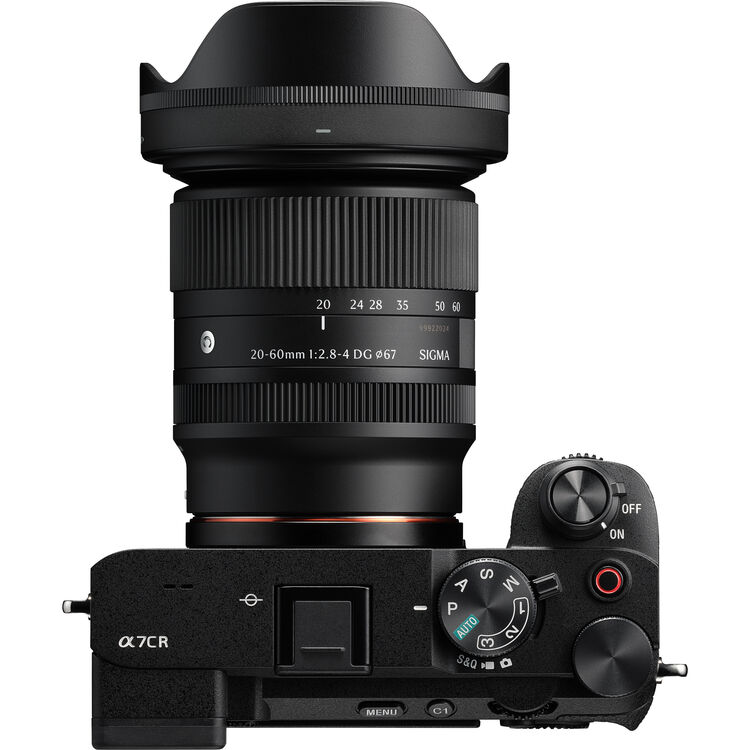
Sigma announced an unusual new lens on September 8, 2026: the 20–60mm F2.8–4 DG | Contemporary.
Most full-frame standard zooms begin at 24mm.
Most lenses that reach 16mm or 17mm stop somewhere around 28mm, 35mm, or 40mm.
Sigma has moved the dividing line.
The new lens begins at 20mm, reaches all the way to 60mm, weighs only 375g in Sony E-mount and 385g in L-Mount, uses a normal 67mm filter thread, focuses unusually close, and starts at F2.8 on the wide end. Sigma Corporation of America says it will sell for $849 in the United States beginning October 6, 2026. Sigma’s global announcement lists a September 30 launch in other markets.
For a real estate photographer, that focal range deserves more attention than the aperture specification.
A 20–60mm zoom could cover an enormous portion of a property-media assignment without changing lenses:
Larger interiors
Kitchens
Open living areas
Exteriors
Architectural details
Builder finish work
Community amenities
Agent-led video
Property walkthrough video
Detail photography
Lifestyle content
There is one question that decides whether it can become your main lens:
Is 20mm wide enough for the homes you actually photograph?
For some photographers, yes.
For others, absolutely not.
My current recommendation is:
TEST the Sigma seriously if you shoot full-frame Sony E-mount or L-Mount and your work includes builders, higher-end homes, commercial properties, exteriors, details, or video.
BUY WITH A WIDER BACKUP if you like the range but still encounter small bedrooms, bathrooms, laundry rooms, or narrow residential spaces.
KEEP A 16–28mm OR 16–35mm AS YOUR PRIMARY INTERIOR LENS if tight residential interiors make up most of your workload.
SKIP IT AS A PRIMARY INTERIOR LENS ON APS-C, where 20mm produces roughly the field of view of a 30mm full-frame lens.
This may turn out to be one of the more useful hybrid property-media lenses of 2026.
I would not call it a universal real estate lens.
That missing 4mm between 16 and 20 can be enormous inside a small room.
Table of Contents
What Sigma Announced
Why 20–60mm Is an Unusual Real Estate Range
Is 20mm Actually Wide Enough?
Why 16mm and 20mm Feel So Different Indoors
The 20mm Limitation Is Mostly About Physical Space
Perspective Distortion Needs a More Careful Explanation
Where 20mm Works Very Well
Kitchens and Open Living Areas
Larger Bedrooms and Primary Suites
Exteriors
Builder and Architectural Work
Why 60mm Is More Useful Than It Sounds
Detail Photography
Community and Amenity Content
Agent Branding and Portrait-Type Images
Video May Be the Strongest Use Case
The F2.8–4 Aperture Matters More for Video Than Listing Stills
Variable Aperture and Zooming During Video
Close-Focus Capability Is Surprisingly Useful
Weight Could Make This an Excellent Gimbal Lens
Focus Breathing and Autofocus
Weather Resistance and Field Use
The Mount Limitation
APS-C Users Should Be Careful
Sigma 20–60mm vs. Sigma 16–28mm F2.8
Sigma 20–60mm vs. Sony 20–70mm F4 G
Sigma 20–60mm vs. Tamron 20–40mm F2.8
Sigma 20–60mm vs. Sony 16–35mm F4 PZ G
Which Type of Photographer Should Buy It?
A Practical Two-Lens Real Estate Kit
A Practical One-Lens Builder Kit
What I Would Test Before Using It on Client Work
What I Would Buy
What I Would Keep
What I Would Delay
Frequently Asked Questions
What Sigma Announced
The Sigma 20–60mm F2.8–4 DG | Contemporary is a full-frame mirrorless zoom currently offered in:
Sony E-mount
and:
L-Mount.
Sigma lists the following specifications:
Specification Sigma 20–60mm F2.8–4 DG
Format Full frame
Focal range 20–60mm
Maximum aperture F2.8–4
Mounts Sony E, L-Mount
Weight 375g E / 385g L
Filter thread 67mm
Lens construction 15 elements in 13 groups
Angle of view 94.5°–39.6°
Minimum focus As close as 15.8cm at 28mm
Maximum magnification 1:2.3 at 35mm
Autofocus HLA linear motor
Video design Focus breathing minimized
Weather design Dust/splash-resistant structure; water/oil-repellent front coating
Sigma says the U.S. retail price will be $849, with U.S. dealer availability beginning October 6, 2026.
The size is one of the unusual parts.
The Sony version is only 88mm long and weighs 375g.
That puts a 20–60mm full-frame zoom into roughly the weight class of some small ultrawide lenses.
For a photographer carrying several bodies, flashes, drone equipment, tripod, 360 camera, and video gear through properties all day, that has practical value.
Why 20–60mm Is an Unusual Real Estate Range
Traditional lens categories create a problem for property photographers.
A 16–35mm is excellent inside the house but often feels short outside.
A 24–70mm handles details, exteriors, people, and general photography well but is usually too tight for residential interiors.
A photographer carrying both has plenty of flexibility, but also changes lenses more often.
The Sigma takes another approach.
It gives up the widest portion of the traditional architectural zoom and gains much more reach.
That means the lens moves seamlessly from:
20mm room photograph
to:
28mm kitchen composition
to:
35mm architectural detail
to:
50mm design vignette
to:
60mm exterior detail
without leaving the camera.
For many builder, commercial, hospitality, and higher-end residential assignments, that is a genuinely useful range.
For a 1,400-square-foot suburban listing containing two small secondary bedrooms and a narrow hall bath, the calculation changes.
Is 20mm Actually Wide Enough?
Sometimes.
I have always preferred thinking about focal length as a tool for the room rather than a number that every listing must be photographed at.
There are properties where 20mm is plenty.
There are rooms where 16mm barely gives you enough room to work.
That distinction usually depends on:
Room dimensions
Doorway location
Furniture
Camera position
Desired composition
Whether you need two walls or three
How much floor and ceiling you want visible
The Sigma gives a 94.5-degree diagonal field of view at 20mm. Sigma’s own 16–28mm F2.8 reaches 107 degrees at 16mm.
That sounds like a fairly small numerical difference.
Inside a bathroom, it does not feel small.
Why 16mm and 20mm Feel So Different Indoors
A useful way to understand this is through simple geometry.
With the camera in the same position and the same full-frame sensor, scene width scales roughly in inverse proportion to focal length.
So a 16mm lens captures about 25% more horizontal scene width than a 20mm lens from the same position.
Another way to say it:
A 20mm frame captures about 80% of the scene width that a 16mm frame captures from the same spot.
Imagine a camera position where 16mm lets you frame roughly 12 feet of a wall.
From that same position, 20mm would frame roughly 9.6 feet.
That 2.4-foot difference can determine whether:
The vanity fits
The shower fits
The entire bed fits
The second wall makes the frame
The doorway blocks the composition
This is why saying:
20mm is only four millimeters tighter than 16mm
understates what happens at the wide end of a lens.
Four millimeters between 50 and 54mm barely changes how most real estate photographers work.
Four millimeters between 16 and 20 can change the shot.
Professional Tip
Before buying this lens as your only real estate zoom, look through your last five ordinary residential jobs. Ask how many interior photographs were genuinely made below 20mm. Your own Lightroom metadata may answer the buying question better than a specification sheet.
The 20mm Limitation Is Mostly About Physical Space
If you can move backward, 20mm becomes much easier to work with.
If the wall is behind you, focal length becomes a hard constraint.
This is why the lens looks more attractive to:
Builder photographers
Luxury residential photographers
Commercial photographers
Vacation-rental photographers
Architectural photographers
Video-first media companies
These properties often contain larger spaces or assignments where every small room does not need to be represented with one wide corner photograph.
A photographer working heavily in starter homes, apartments, small rentals, or compact tract housing will encounter the 20mm boundary more often.
Perspective Distortion Needs a More Careful Explanation
There is a common statement in real estate photography:
Longer lenses have less perspective distortion.
Technically, camera position controls perspective.
The focal length controls framing from that position.
That distinction matters.
If you stand in exactly the same spot and photograph a room at 16mm and 20mm, the perspective relationships remain essentially the same. The 20mm image simply crops more tightly.
But in the field, changing focal length often changes where the photographer stands.
If 20mm encourages you to move farther back, center the composition more carefully, or leave some peripheral content outside the frame, the finished photograph may feel calmer and less exaggerated.
The improvement came from composition and camera position.
The number on the lens gave you a reason to make that decision.
That is one thing I like about a 20mm starting point.
It is wide enough to work in many interiors while making it harder to fall into the habit of photographing every living room at 14–16mm simply because the lens allows it.
Where 20mm Works Very Well
A lot of real estate photography does not require 16mm.
In a larger property, I might spend most of the assignment somewhere between roughly 18 and 35mm anyway.
The new Sigma puts the rest of the range on the same lens.
That could make it particularly effective in several situations.
Kitchens and Open Living Areas
Large kitchens often look better when photographed with a little restraint.
At 20–28mm, you can show:
Island
Cabinetry
Appliance relationship
Dining connection
Living area
without necessarily pushing every foreground object toward the edges.
A 20mm starting point should be comfortable in many open-plan spaces.
Then the lens can move immediately to 35–60mm for:
Range hood
Fixture detail
Cabinet hardware
Stone
Pendant lights
Custom millwork
That is where this range begins to make sense as a builder lens.
Larger Bedrooms and Primary Suites
A generous primary bedroom usually does not need 16mm.
Using 20–28mm can create a more natural-looking representation of the bed and furniture.
Again, the constraint comes when the room becomes small.
A 10-by-10 secondary bedroom with a queen bed, dresser, and poorly positioned door may still demand the wider lens simply to create a useful photograph.
I would not want to discover that after leaving the 16mm lens at home.
Exteriors
The 20–60mm range may be excellent outside.
At 20mm, you have enough width for many front elevations.
At 28–40mm, you can create more controlled architectural compositions.
At 50–60mm, you can isolate:
Entry
Stonework
Gables
Outdoor living
Windows
Builder details
Landscape relationships
That kind of range can be much more useful than finishing every exterior at 35mm because the interior zoom ends there.
Builder and Architectural Work
This may be the strongest still-photography case for the lens.
Builder assignments often involve more than documenting every room.
The photographer may need:
Full spaces
Material details
Fixtures
Cabinetry
Fireplace
Exterior
Elevations
Outdoor living
Design details
Product or manufacturer images
The 20–60 range fits that type of storytelling extremely well.
Sigma’s close-focus specification strengthens the case further.
The lens reaches a maximum reproduction ratio of 1:2.3 at 35mm, with a minimum focusing distance as short as 15.8cm at 28mm.
That is unusually useful for a normal property zoom.
Why 60mm Is More Useful Than It Sounds
Real estate photographers tend to think about the wide end first.
The long end can change the quality of a gallery just as much.
At 60mm, you can create photographs of:
Faucet and stone
Hardware
Custom cabinetry
Fireplace material
Lighting
Millwork
Tile
Appliance detail
Exterior architecture
Pool details
Landscaping
Community signage
Those images give a property gallery rhythm.
A sequence containing only wide photographs can begin to feel repetitive.
The 60mm end gives you a reason to look for smaller compositions.
Detail Photography
The close-focus capability makes the Sigma especially interesting for:
Interior designers
Builders
Product manufacturers
Cabinet companies
Tile companies
Fixture companies
Sigma lists a 1:2.3 maximum magnification at 35mm, approaching half-macro territory.
I would not replace a true macro lens for dedicated product photography.
For normal builder and real estate detail work, this is probably more than enough.
A photographer could move from a 20mm room overview to a close photograph of a cabinet pull without changing lenses.
That is real production efficiency.
Community and Amenity Content
A media company working for builders or multifamily properties may photograph:
Clubhouse
Pool
Fitness center
Streetscape
Entry monument
Model home
Sales center
Nearby lifestyle features
The 20–60mm range is nearly ideal for that type of assignment.
The photographer rarely needs 16mm constantly.
The extra reach becomes useful much more often.
Agent Branding and Portrait-Type Images
Sixty millimeters can also work for environmental photographs of the agent or builder representative.
You could photograph:
the property
and then:
the agent in front of the property
with the same lens.
That is valuable when media packages increasingly combine listing coverage with social and personal-brand content.
Video May Be the Strongest Use Case
The lens becomes even more interesting when the company shoots both stills and video.
Sigma specifically says the optical design minimizes focus breathing and uses its HLA linear motor for fast, quiet autofocus.
A real estate video workflow could use:
20mm
for a moving room reveal.
Then:
28–35mm
for kitchen and living compositions.
Then:
50–60mm
for details.
One lightweight lens could stay on the camera through most of the property.
That matters on a gimbal.
Every lens change can require:
Rebalancing
Filter changes
Rechecking focus behavior
More equipment handling
The Sigma’s 375g Sony weight also keeps the camera package light.
The F2.8–4 Aperture Matters More for Video Than Listing Stills
The F2.8 headline sounds attractive.
For bracketed still real estate photography on a tripod, I would not buy the lens primarily for aperture.
A photographer may spend much of the job around:
F6.3
F7.1
F8
depending on camera, room, technique, and desired depth of field.
The difference between F2.8 and F4 therefore has little effect on a normal tripod-based HDR or flambient exposure.
For video, the story changes.
F2.8 can help with:
Handheld interiors
Natural-light footage
Twilight
Agent-led video
Shallower detail shots
It also gives autofocus more light in dim spaces.
Variable Aperture and Zooming During Video
The lens is F2.8–4, rather than constant F2.8.
That creates one practical video issue.
If you begin a take wide open at F2.8 and zoom toward 60mm, the lens cannot maintain F2.8 through the entire range.
Exposure will need to change.
If you intend to perform an actual zoom during a recorded shot and want consistent exposure, one simple approach is to set the lens to F4 before recording.
For normal real estate video where each shot uses a fixed focal length, this is much less important.
Close-Focus Capability Is Surprisingly Useful
Close focusing often sounds like a product-review specification that has little relationship to real estate.
Here, it does.
Builder and design work regularly includes small subjects:
Handles
Fixtures
Counter edges
Tile
Controls
Material transitions
Custom trim
The ability to move extremely close without switching to another lens can make the property shoot faster.
It also makes the lens more useful beyond listings.
Weight Could Make This an Excellent Gimbal Lens
The Sony E-mount version weighs 375g.
The L-Mount version weighs 385g.
For comparison:
Sigma 16–28mm F2.8 DG DN: 450g.
Sony 20–70mm F4 G: 488g.
Tamron 20–40mm F2.8: 365g.
Sony FE PZ 16–35mm F4 G: 353g.
The Sigma 20–60 therefore sits in a very attractive weight range.
Before declaring it perfect for a particular gimbal, I would still test balance through the zoom range and with the actual camera body, filter, microphone, and accessories used in production.
Focus Breathing and Autofocus
Sigma says the lens uses its HLA linear autofocus system and has been designed to minimize focus breathing.
Those are video-friendly decisions.
Focus breathing can become visible when an agent walks toward the camera or when focus shifts from a foreground detail to the room behind it.
Reduced breathing helps the composition remain more stable.
The real-world performance still needs field testing.
The design direction makes sense for property media.
Weather Resistance and Field Use
Sigma describes the lens as dust- and splash-resistant and applies a water- and oil-repellent coating to the front element. Sigma is careful to say the lens is not waterproof.
For real estate photographers, this matters more than it might sound.
Exterior assignments happen in:
Light rain
Dust
Construction sites
Coastal air
Landscaping spray
Muddy development sites
The lens is meant to be used, not kept on a studio shelf.
The Mount Limitation
At announcement, the Sigma 20–60mm is available only for:
Sony E-mount
and:
L-Mount.
There is no Canon RF or Nikon Z version announced.
That immediately excludes a large portion of REPT readers.
Do not plan around a future mount that Sigma has not announced.
APS-C Users Should Be Careful
This is a full-frame DG lens.
You can physically use the Sony E version on many Sony APS-C cameras, but the crop changes the useful field of view.
On a 1.5x APS-C camera, 20–60mm behaves roughly like:
30–90mm equivalent.
That is far too tight for a primary residential interior lens.
The Sigma makes sense as a full-frame property-media zoom.
It is not an APS-C substitute for something like a 10–20mm or 11–20mm ultrawide.
Sigma 20–60mm vs. Sigma 16–28mm F2.8
The Sigma 16–28mm F2.8 DG DN Contemporary is the safer real estate interior lens.
It reaches 16mm.
It keeps F2.8 through the entire zoom.
It is available in the same Sony E and L-Mount ecosystems.
It weighs 450g and uses 72mm filters.
The decision is straightforward.
Choose the 16–28mm if:
Small residential interiors are central to your business.
Choose the 20–60mm if:
You can live with 20mm and want a much broader working range.
Carry both if:
You shoot enough builder, commercial, video, and mixed property work that lens changes are still justified.
That two-lens kit would cover 16–60mm with substantial overlap.
For a professional property-media company, that is an extremely versatile range.
Sigma 20–60mm vs. Sony 20–70mm F4 G
Sony already has a similar concept.
The Sony FE 20–70mm F4 G covers 20–70mm at a constant F4.
Sony lists it at 488g with a 72mm filter thread and 0.39x maximum magnification.
The Sigma gives up 10mm on the telephoto end.
In exchange, the Sony E version is 113g lighter, uses a smaller 67mm filter, and reaches F2.8 at the wide end.
Both begin at the same basic 20mm field of view.
For a Sony photographer who already owns and likes the 20–70 G, I would not automatically replace it.
The new Sigma becomes compelling if:
Lower weight matters
F2.8 at 20mm matters
Close-focus capability matters
The $849 launch price fits the budget
If 70mm is useful to your work and the existing Sony performs well, keep earning money with it.
Sigma 20–60mm vs. Tamron 20–40mm F2.8
The Tamron 20–40mm F2.8 Di III VXD is one of the closest existing concepts.
Tamron lists:
20–40mm
Constant F2.8
365g
67mm filter
Sony E-mount only
The Tamron is slightly lighter and keeps F2.8 through its range.
The Sigma reaches an additional 20mm on the long end.
For real estate photography, I think that extra 40–60mm range is more significant than it first appears because it turns the lens into a much more complete exterior, detail, and builder tool.
For someone doing low-light video constantly, the Tamron’s constant F2.8 remains attractive.
Sigma 20–60mm vs. Sony 16–35mm F4 PZ G
Sony’s FE PZ 16–35mm F4 G weighs only 353g and adds power zoom, making it particularly attractive for video. It also reaches the critical 16mm focal length.
The trade is reach.
The Sony stops at 35mm.
The Sigma reaches 60mm.
For a photographer whose job is:
interiors first
the Sony focal range is safer.
For a photographer whose job is:
hybrid property production
the Sigma’s extra 25mm may eliminate many lens changes.
There is no universal winner.
The property mix decides.
Quick Comparison
Lens Range Max Aperture Weight Mount Best Real Estate Strength
Sigma 20–60 F2.8–4 20–60mm F2.8–4 375g E E / L Hybrid stills + video
Sigma 16–28 F2.8 16–28mm F2.8 450g E / L Tight interiors
Sony 20–70 F4 G 20–70mm F4 488g E Broad general-purpose range
Tamron 20–40 F2.8 20–40mm F2.8 365g E Lightweight low-light hybrid
Sony PZ 16–35 F4 G 16–35mm F4 353g E Interiors + power-zoom video
Specifications from the respective manufacturers.
Which Type of Photographer Should Buy It?
Residential Listing Photographer — Small to Mid-Size Homes
BUY ONLY WITH A WIDER BACKUP
The lens will work for many rooms.
Eventually, a hall bath will stop you.
Luxury Residential Photographer
STRONG TEST CANDIDATE
Larger spaces make 20mm much easier to use, and 60mm adds valuable detail capability.
Builder Photographer
VERY STRONG TEST CANDIDATE
The range may cover most of the project from whole-room views through product details.
Commercial Property Photographer
STRONG TEST CANDIDATE
Large interiors, exteriors, amenities, details, and people all fit the range well.
Vacation Rental Photographer
DEPENDS ON THE PROPERTY TYPE
Large vacation homes: attractive.
Small apartments and urban rentals: keep the ultrawide.
Real Estate Videographer
VERY STRONG TEST CANDIDATE
Light weight, 20–60 range, F2.8 wide end, HLA autofocus, and focus-breathing control all point in the right direction.
Sony APS-C Photographer
SKIP AS YOUR PRIMARY INTERIOR LENS
The crop is too tight for normal residential interior use.
Canon RF or Nikon Z Photographer
NO CURRENT NATIVE OPTION
Wait for an actual announcement rather than assuming another mount is coming.
A Practical Two-Lens Real Estate Kit
For Sony or L-Mount, one combination is especially interesting:
Sigma 16–28mm F2.8
Use for:
Bathrooms
Small bedrooms
Tight kitchens
Narrow residential interiors
Sigma 20–60mm F2.8–4
Use for:
Larger interiors
Exteriors
Builder work
Details
Video
Amenities
Together they cover nearly every normal property-media focal length from 16 through 60mm.
The combined lens weight is approximately 825g for Sony E-mount.
That is still lighter than some individual professional zooms from previous generations.
A Practical One-Lens Builder Kit
For builder work, I could imagine leaving the 20–60mm on the camera for almost the entire assignment.
Start with:
20mm
for the room.
Move to:
28mm
for a stronger architectural composition.
Then:
35–50mm
for fixtures and finishes.
Finish at:
60mm
for exterior details.
If the property is large enough that 20mm covers the required whole-room images, the lens-change count could approach zero.
That is exactly the kind of boring efficiency I want from professional equipment.
What I Would Test Before Using It on Client Work
Specifications do not tell us everything that matters for architecture.
Before adopting the Sigma as a production lens, I would photograph one difficult property and inspect:
Corner Sharpness at 20mm
Especially around F6.3–F8.
Distortion
Straight walls, cabinets, door frames, and windows make optical and software correction easy to evaluate.
Lightroom Lens Profile
Confirm the RAW workflow applies the expected correction properly.
Flare
Shoot toward large windows and exterior sun.
Chromatic Aberration
Inspect bright window frames and backlit architectural edges.
Focus Consistency
Test wide and telephoto positions.
Gimbal Balance
Try the actual video rig through the zoom range.
Focus Breathing
Use an interior detail and shift focus toward the room.
Close-Focus Detail Quality
Photograph fixtures and materials at 35–60mm.
Editing Time
The real question is whether the lens makes the job faster.
Common Mistake
Buying a real estate lens because the focal range looks good on paper without checking your own completed-job metadata. If 30% of your delivered interior images are below 20mm, that is useful information.
What I Would Buy
If I were building a Sony E-mount or L-Mount system around builder photography, hybrid stills/video, or larger properties, I would take the Sigma 20–60mm seriously at $849.
The range solves a real production problem.
What I Would Keep
If I already owned a reliable 16–35mm or 16–28mm that handles tight interiors, I would keep it.
The new lens does not make 16mm unnecessary.
It gives you another way to organize the job.
What I Would Delay
I would delay selling existing lenses until real-world architectural files are available and the complete RAW correction, corner performance, flare behavior, and video workflow have been tested.
The lens was announced yesterday.
There is no prize for being the first photographer to rebuild a working kit.
REPT Buying Recommendation
The Sigma 20–60mm F2.8–4 is one of the more interesting property-media lenses announced this year because the range matches the way many photographers actually move through a larger assignment.
The 60mm end adds meaningful capability.
The 375–385g weight is excellent.
The close focusing is genuinely useful.
The video-oriented design choices make sense.
The $849 U.S. price is competitive for a professional full-frame zoom.
The question remains 20mm.
If 20mm fits your properties, this could become the lens that stays on the camera most of the day.
If your business regularly needs 16mm, carry the ultrawide.
That is the buying decision.
Frequently Asked Questions
When was the Sigma 20–60mm F2.8–4 announced?
Sigma announced the lens on September 8, 2026.
How much will it cost?
Sigma Corporation of America lists a U.S. retail price of $849.
When will it be available?
Sigma’s U.S. announcement says authorized U.S. dealers will have the lens beginning October 6, 2026. Sigma’s global launch notice lists September 30, 2026 for the broader launch schedule.
Which mounts are available?
Sony E-mount and L-Mount.
Is there a Canon RF version?
Not currently announced.
Is there a Nikon Z version?
Not currently announced.
Is the Sigma 20–60mm a full-frame lens?
Yes. Sigma designates it DG, meaning it is designed for full-frame cameras.
Is 20mm wide enough for real estate photography?
It is wide enough for many full-frame interiors, especially larger rooms, kitchens, open living spaces, commercial properties, and builder projects. It may be too tight for small bathrooms, secondary bedrooms, narrow kitchens, and compact residential spaces.
How much wider is 16mm than 20mm?
From the same camera position and on the same sensor, 16mm captures roughly 25% more horizontal scene width than 20mm. That difference becomes very noticeable in tight rooms.
Is 20mm better than 16mm because it creates less distortion?
Perspective depends primarily on camera position. A longer focal length may encourage a different camera position or tighter framing, which can produce calmer-looking room photographs. The focal length alone does not change perspective when camera position remains identical.
Can this replace a 16–35mm lens?
For some photographers, yes.
For photographers who regularly shoot small residential interiors, I would keep the 16–35mm or another ultrawide available.
Can it replace a 24–70mm?
For property work, possibly. You gain substantial width and give up 10mm of telephoto reach.
For general photography outside real estate, whether that trade works depends on the subjects you shoot.
Is F2.8 useful for real estate photography?
It is useful for video, low-light work, details, and handheld shooting. For tripod-based bracketed interior stills, maximum aperture is less important because the lens is normally stopped down.
Is it constant F2.8?
No. The lens is F2.8–4.
Will exposure change if I zoom during video?
If you are shooting wider than F4, the maximum aperture will narrow as you move toward the telephoto end. Setting F4 can avoid an aperture-driven exposure change during a zoom move.
How much does the lens weigh?
Sigma lists 375g for Sony E-mount and 385g for L-Mount.
What filter size does it use?
67mm.
How close can it focus?
Sigma lists a minimum focusing distance as short as 15.8cm at 28mm and maximum magnification of 1:2.3 at 35mm.
Is it good for builder photography?
Potentially very good. The 20–60 range covers room views, exteriors, architectural compositions, and close details without requiring constant lens changes.
Is it good for real estate video?
The range and weight are promising. Sigma also specifically designed the lens to minimize focus breathing and uses a quiet HLA autofocus system.
Is it good on a gimbal?
The low weight makes it promising, but test the complete camera-and-lens balance through the zoom range before adopting it professionally.
Should an Insta360 or drone photographer care about this lens?
Only if you also produce conventional still or video media. The lens does not replace a drone or 360 camera; it strengthens the normal full-frame camera kit.
Is it good on APS-C?
For general photography, it can be.
For real estate interiors, 20mm on a 1.5x crop body gives roughly a 30mm-equivalent field of view, which is normally too narrow.
Which is better for interiors, the Sigma 20–60 or Sigma 16–28?
For tight interiors, the 16–28.
For a broader still/video property workflow, the 20–60.
Which is better, the Sigma 20–60 or Sony 20–70 F4 G?
They serve a similar role. The Sony reaches 70mm and maintains F4. The Sigma is lighter, reaches F2.8 at the wide end, focuses very close, and launches at $849. The best choice depends on whether those differences matter to your workflow.
Which is better, the Sigma 20–60 or Tamron 20–40 F2.8?
The Tamron is slightly lighter and constant F2.8. The Sigma adds substantial 40–60mm reach, which is useful for property details and exterior work.
Should I preorder it?
If you already know that 20mm covers your work and the range solves an existing paid-production problem, it is a reasonable lens to consider.
If you are unsure whether 20mm is wide enough, test your current lens at 20mm for several actual properties before purchasing.
Continue Your REPT Training
Build a dependable real estate photography workflow with the complete REPT course and products: https://payhip.com/RealEstatePhotographyTraining
Browse the REPT Knowledge Base: https://payhip.com/RealEstatePhotographyTraining/blog/get-started-real-estate-photography
Visit Real Estate Photography Training: https://rephototraining.com/
Sources
Sigma Corporation of America announcement: https://press.sigmaphoto.com/product/09/sigma-announces-20-60mm-f2-8-4-dg-contemporary/
Sigma global launch schedule: https://www.sigma-global.com/en/news/2026/09/08/012102/
Sigma America product page: https://www.sigmaphoto.com/20-60mm-f2-8-4-dg-c
Sigma 16–28mm F2.8 specifications: https://www.sigma-global.com/en/lenses/c022_16_28_28/
Sony FE 20–70mm F4 G specifications: https://www.sony.com/electronics/support/lenses-e-mount-lenses/sel2070g/specifications
Tamron 20–40mm F2.8 specifications: https://www.tamron.com/global/consumer/lenses/a062/spec.html
Sony FE PZ 16–35mm F4 G: https://electronics.sony.com/imaging/lenses/all-e-mount/p/selp1635g