

Few bother themselves with the daily economics of that grandmother running a market stall at an informal market or her growth strategy over the years.
My degree would claim that her business is more about survival and rotted in poverty. Most still claim her success to the “black magic muti” they believe made her successful. Few see the pivots of her daughters and sons in Diaspora and nearby South Africa sending through cash via remittances plus more “product” to make her diversify her product range nor do they recognise the “mupenzanhamo” stall expansions she now runs as well or the increase in stalls she is renting out and making a monthly income bigger than some office clerks/managers without the high taxation on business or PAYE.
The suffering of fellow pensioners including herself has made her realise that its better to have these businesses than bank the cash or look forward to any pension income. She once laughed that “its more expensive to go collect the pension money from the bank with all those charges you face, so why bother. Zimbabwe has taught us well.”
The data says she was running a 90% margin, zero-debt, hyper-liquid business that survived 5 economic collapses.
Who was actually right?
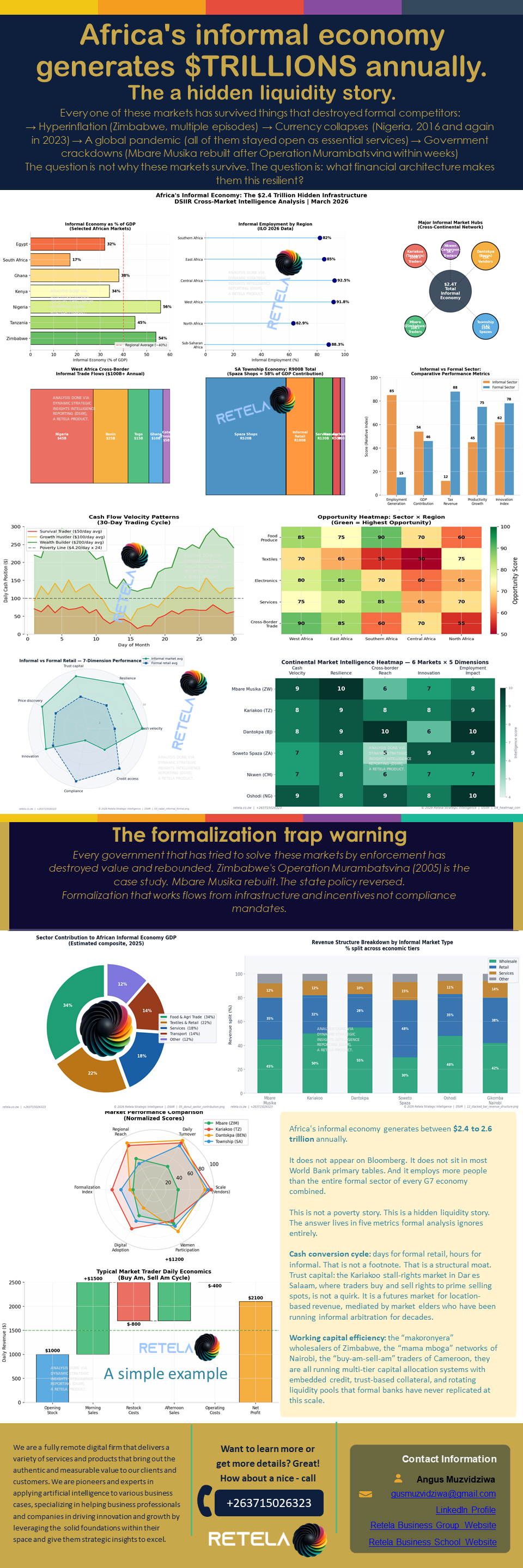
Africa’s informal economy generates $2.4–2.6 trillion annually. It does not appear on Bloomberg. It employs more people than the formal sector of every G7 economy combined. This is not a poverty story. It is a hidden liquidity story.
From Mbare Musika (Zimbabwe) to Kariakoo (Tanzania) to Dantokpo (Benin), these markets survived hyperinflation, currency collapses, and pandemics—while formal competitors failed.
Five metrics formal analysis ignores
-Cash conversion cycle:days for formal retail, hours for informal.
- Trust capital:In Kariakoo, stall‑rights trade like a futures market, mediated by elders with decades of arbitration experience.
- Working capital efficiency:Makoronyera wholesalers, mama mboga networks, and “buy am sell am” traders run multi‑tier capital allocation with embedded credit and rotating liquidity pools.
Three signals for 2026
1. Fintech bridge – The platform that integrates with informal trust networks captures the largest unbanked wallet on earth.
2. Cold chain arbitrage – Post‑harvest losses (30‑65%) are an investable gap. 24% IRR, 3.2‑year payback in Zimbabwe cold chain data.
3. AfCFTA implementation layer – Informal cross‑border networks (like Dantokpa’s Benin‑Nigeria corridor) already move goods. Work with them.
The formalization trap
Enforcement destroys value. Mbare Musika rebuilt after Murambatsvina. Formalization works when it flows from infrastructure and incentives, not mandates.
The question for 2026 is not how to bring these markets into the formal economy,it’s how fast the formal economy can build on top of what they already are.
Comments ()