

I keep noticing something strange about Nike...
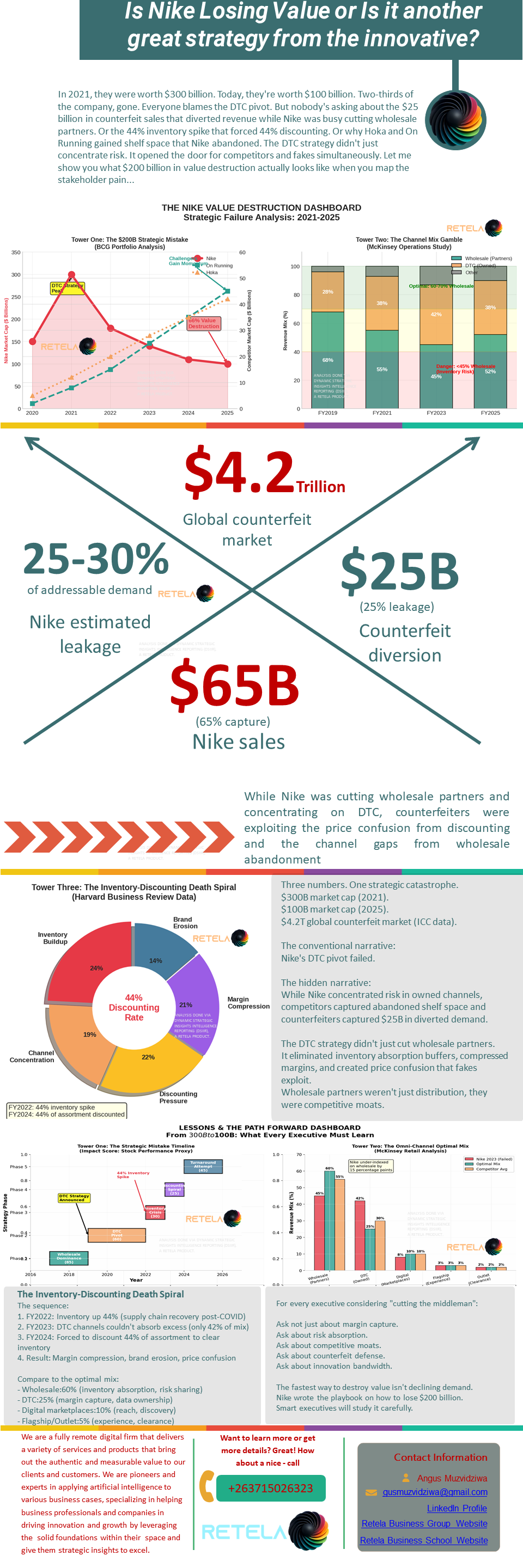
In 2021, they were worth $300B.
Today: $100B. Two-thirds gone.
Everyone blames the DTC pivot.
But nobody’s asking about the $25B in counterfeit sales that diverted revenue while Nike cut wholesale partners.
Or the 44% inventory spike forcing 44% discounting.
Or why Hoka and On Running gained shelf space Nike abandoned.
DTC didn’t just concentrate risk. It opened a two‑front war: competitors and fakes simultaneously.
The Value Destruction
- 2021: $300B market cap
- 2025: $100B
- Meanwhile: On Running $2B → $45B; Hoka $5B → $42B.
The Channel Gamble
2019: 68% wholesale, 28% DTC
2023: 45% wholesale, 42% DTC
Second-order effects:
- Inventory concentration (DTC held 42% of load)
- No wholesale buffers → 44% of assortment discounted
- Competitors captured abandoned shelf space (Nike lost 7pp premium shelf)
The Counterfeit Leakage
Global counterfeit market: $4.2T. Nike leakage: ~$20‑25B annually.
DTC created price confusion and channel gaps that fakes exploit.
Stakeholder Pain
- Wholesale partners: lost allocation, trust frayed
- Employees: 775+ layoffs, 401(k)s crushed
- Investors: $200B market cap wiped
- Consumers: price confusion, authenticity risk
Recovery Scenarios (Recommended)
Hybrid omni‑channel: 60% wholesale, 25% DTC, 15% other.
NPV upside: +$25B vs. status quo.
Executive Lessons
1. Channel concentration risk – never >40% in one channel.
2. Inventory absorption – wholesale partners buffer demand shocks.
3. Wholesale partnerships = competitive moats. Shelf space is expensive to reclaim.
4. Innovation discipline – channel complexity diverted R&D; Nike’s innovation score dropped 25 points.
5. Counterfeit defense – distribution breadth deters fakes.
The $200B Lesson
DTC isn’t inherently risky. Concentration is.
Distribution is strategy. Channel mix is risk management.
Before cutting middlemen, ask:
- Risk absorption?
- Competitive moats?
- Counterfeit defense?
- Innovation bandwidth?
What’s your channel concentration risk?
Comments ()