

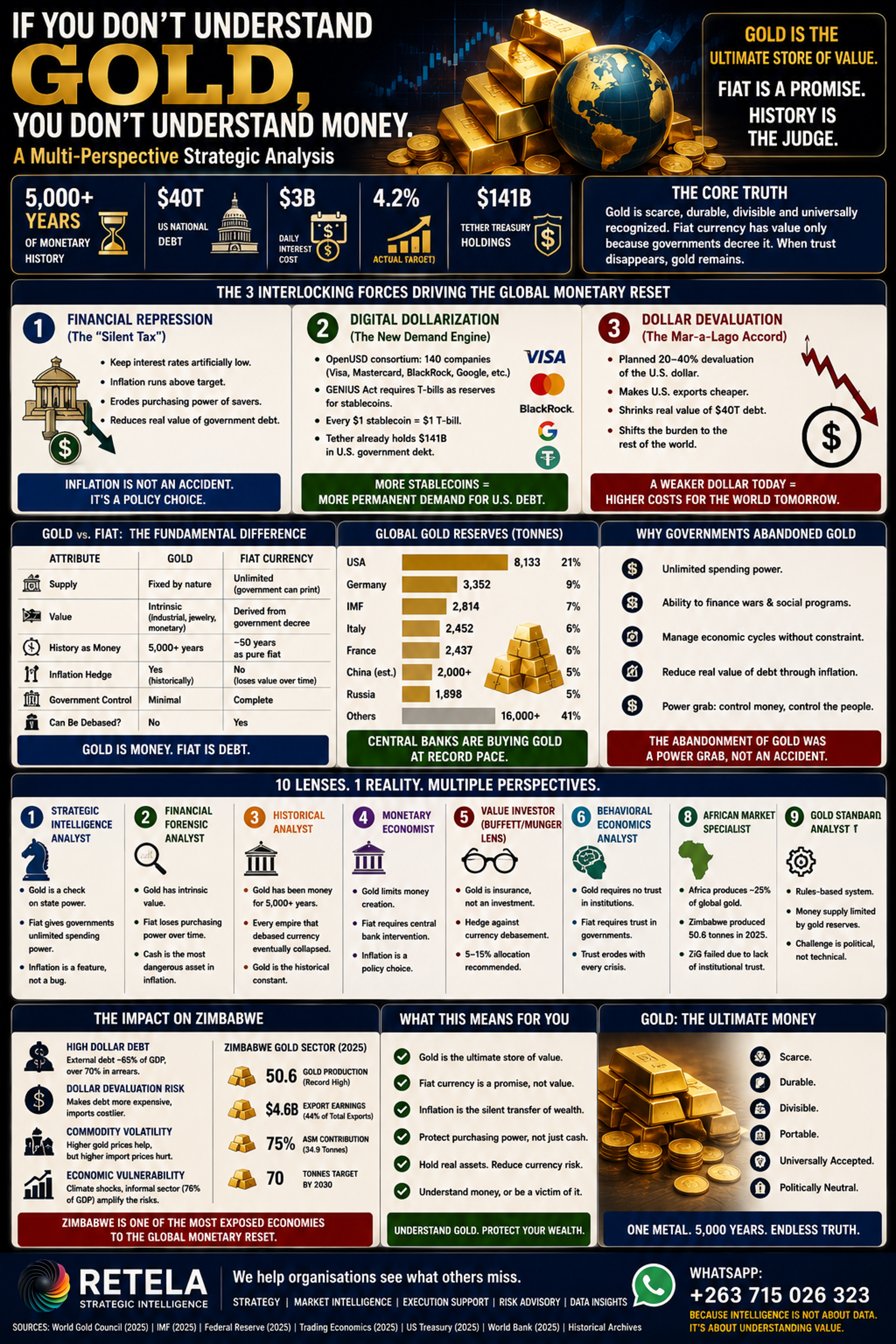
Gold isn’t simply an investment; it is the benchmark against which every currency is ultimately judged.
As central banks buy gold at record levels, sovereign debt rises, and confidence in fiat currencies weakens, executives, investors, and policymakers face one question:
Is money still what we think it is?
Most people think money is paper.
History says otherwise.
For over 5,000 years, civilizations have risen and fallen.
Empires have collapsed.
Currencies have disappeared.
Governments have changed.
One monetary asset has survived every single one.
Gold.
Not because it generates dividends.
Not because governments promote it.
But because every monetary crisis eventually forces societies back to one uncomfortable question:
What actually holds value when trust disappears?
Gold Is Not About Wealth.
It Is About Trust.
Money performs three essential functions:
• Medium of exchange
• Unit of account
• Store of value
Modern fiat currencies perform the first two remarkably well.
The third?
Increasingly less so.
Since the United States abandoned the Bretton Woods gold system in 1971, virtually every major fiat currency has experienced a long-term erosion of purchasing power through inflation.
That isn’t necessarily policy failure.
It is how modern monetary systems are designed to operate.
The Signal Most People Miss
People think governments print money to stimulate growth.
Sometimes they do.
But history shows another reason.
Debt.
Global sovereign debt continues to reach historic highs.
Printing additional money quietly reduces the real burden of outstanding debt through inflation.
Economists call it monetary expansion.
Households simply experience it as:
• higher food prices
• higher housing costs
• declining purchasing power
Inflation rarely feels like taxation.
Yet economically...
it often functions exactly like one.
For the full article:- If You Don’t Understand Gold, You Don’t Understand Money.
Comments ()