
Malicorne Faience (plates & bowls)
Origin & period: Malicorne pottery is tin-glazed faience produced in Malicorne-sur-Sarthe, France. Production began c.1760s–1770s; the most collectible pieces date from the late 18th century through the 19th century (notably mid–late 1800s for the well-known revival-style wares).
Materials & technique: Tin-glazed earthenware (faience). Decoration applied over the opaque white glaze using mineral pigments (cobalt blue, manganese purple/brown, iron yellow/green). Decoration methods include hand-painted polychrome motifs and transfer-printing on later 19th‑century pieces.
Shapes & common forms:
- Plates: flat dinner plates, deep plates (soup), presentation/platter plates, octagonal and scalloped rims.
- Bowls: soup or latte bowls, fruit/dessert bowls, tureens and small serving bowls; also large compote/Saladier bowls for display.
Typical decoration & motifs:
- Blue-on-white monochrome landscapes and figurative scenes.
- Polychrome floral sprays, garlands, and borders.
- Opaque white tin glaze with slightly creamy tone
- Hand-painted cobalt blues and polychrome florals typical of regional faience.
- Irregular brushwork and slight under/overpainting where glaze pools.
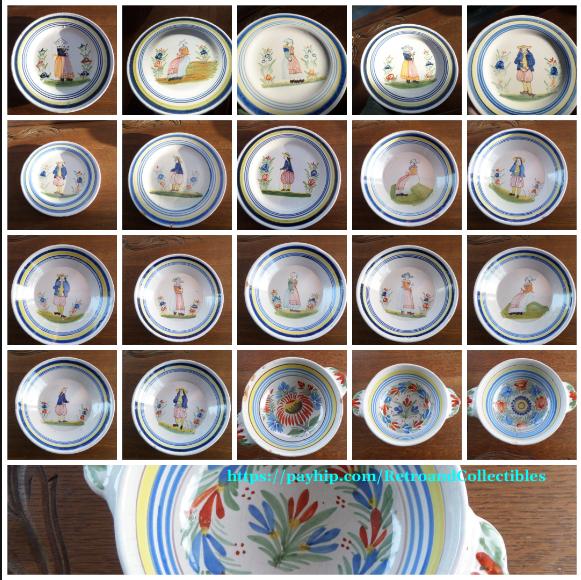
- Regional or rustic scenes (farmers, village life, Petit Breton)
Dating tips:
- Hand-painted, loosely executed polychrome decoration and lead-based color palette → often earlier (late 18th–early 19th c.).
- Transfer-printed designs, more uniform motifs, and industrial-style marks → typically mid–late 19th c.
- Crackle in glaze, soot or kiln grit under glaze, and hardness of body help indicate age.
Subject & names: “Petit Breton” / “Bretonne” refer to figures in regional Breton costume — a single standing figure (petit) or a full-figure Breton woman (bretonne). These appear as central cartouche scenes on plates, bowls, and chargers.
Typical motifs: Central Breton figure(s) surrounded by floral sprays, garlands, or rococo scrollwork; often cobalt-blue outline with polychrome (yellow, green, manganese) fills on tin-glazed white ground. Floral motifs are usually stylized local wildflowers or generic decorative sprays framing the figure.
Technique: Hand-painted faience (sometimes later transfer-printed outlines with hand-applied color); tin-glazed earthenware with painted overglaze enamels.
Collecting value & rarity: Plates and bowls from desirable 18th–early 19th century production with attractive hand-painted decoration, intact condition.
Note: Many 19th‑century workshop products bear printed or painted factory marks; early 18th–early 19th pieces are often unmarked.
The image shows a portion of our unique Malicorne collection: flat dinner plates, deep soup plates, and soup or latte coffee bowls.
Thank you for reading. Feel free to reach out anytime for additional information.
Comments ()