
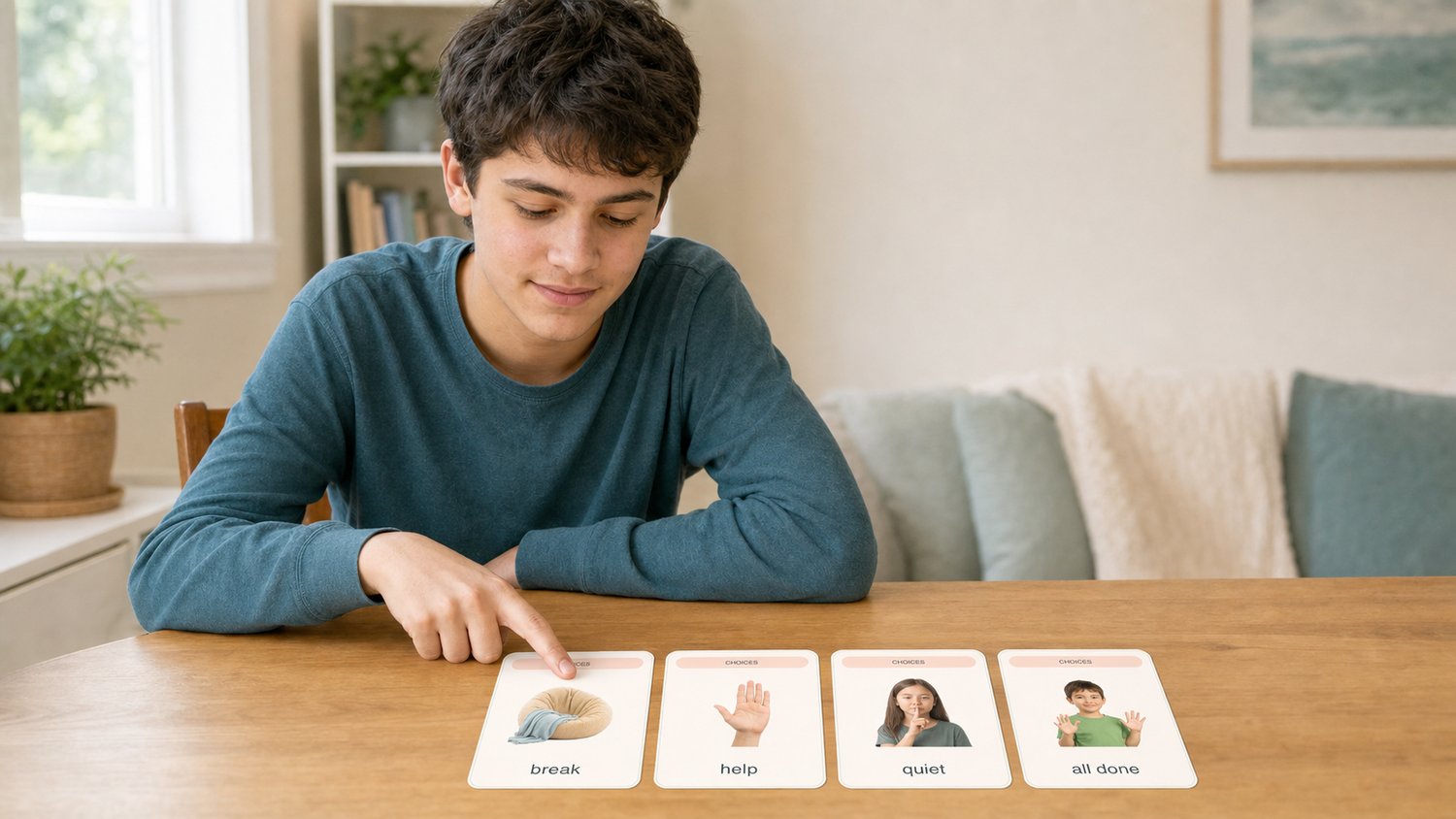
Why simple visual supports can make communication, routines, choices, and transitions feel a little easier.
There are moments in caregiving when everyone is trying their best, but words simply are not enough.
Maybe it is time to leave the house. Maybe the television is too loud, dinner is different than expected, or an appointment has changed.
For some autistic children, teens, and adults, understanding what is happening—or communicating what they need in that moment—can feel overwhelming. And for the people supporting them, it can sometimes be difficult to know what would help.
That is where visual communication cards can be useful.
They are not a “fix” for autism, and they are not meant to force someone to behave a certain way. They are simply another way to make communication more accessible—especially when speaking, listening, or processing a lot of information feels difficult.
What Are Visual Communication Cards?
Visual communication cards are simple pictures, symbols, photographs, or written cues that can help a person communicate needs, choices, feelings, routines, or next steps.
A card might represent:
Break · Help · Quiet · Toilet · All Done · I Need Space · Yes · No
They can be pointed to, handed to another person, arranged into a sequence, or simply kept somewhere visible.
And they do not have to replace other forms of communication.
Visuals can be used alongside speech, gestures, sign language, writing, AAC (augmentative and alternative communication), or whatever combination works best for the individual.
The goal is simple:
Make communication a little more available when words alone are not enough.
A Picture Can Say a Lot in a Hard Moment
Imagine a child covering their ears in a busy room.
Instead of having to explain everything they are experiencing, they may be able to point to:
“Too loud.”
Or perhaps someone becomes overwhelmed during an activity and points to:
“Break.”
A caregiver might use:
“First → Then”
to make an upcoming transition easier to understand.
And someone who does not want to explain a big feeling out loud may be able to choose:
“Worried,” “Tired,” or “I need space.”
These may seem like small interactions, but having another way to communicate can matter.
Visual supports can make expectations, choices, routines, and upcoming activities more visible. They can also give someone another way to participate in communication rather than relying only on spoken language.
Why Visual Supports Can Help With Routines and Transitions
Transitions can be difficult when the next step is unclear, especially when plans change unexpectedly.
Visual supports can make what happens next more concrete.
For example:
FIRST: Get dressed
THEN: Breakfast
or:
FIRST: Finish this activity
THEN: Play
A simple visual sequence may make the next step easier to understand.
The goal is not to make every transition perfectly smooth. Real life does not work that way.
Instead, the goal is to make the next step more visible and less surprising.
Visual cards might be kept:
- near the front door
- at the dinner table
- in a backpack
- near the bathroom
- at school
- in the car
- in a quiet space
- on a phone or tablet
Some people may benefit from only a few cards. Others may prefer a larger visual schedule or communication system.
There is no single setup that works for everyone.
Often, the simplest place to begin is with one everyday situation that currently feels difficult.
Visual Communication Does Not Replace a Person’s Voice
One concern caregivers sometimes have is whether using pictures or communication cards could discourage speech.
But communication is much broader than spoken language.
A person may communicate through speech, gestures, facial expressions, movement, pictures, written words, signs, AAC devices—or a combination of these.
Visual supports simply provide another option.
For someone who uses spoken language, a visual may reinforce what is being said or make information easier to process.
For someone who is minimally speaking or non-speaking, visual communication may provide another accessible way to express a need, preference, choice, or feeling.
The important question is not:
“Are they communicating the way we expect?”
It is:
“Do they have a way to communicate that works for them?”
Visual Supports Aren’t Only for Young Children
Visual communication supports are sometimes treated as something only small children need.
But autistic teenagers and adults may benefit from visual supports too.
An autistic teen or adult might use:
- a written checklist for a daily routine
- a visual schedule before an unfamiliar appointment
- a phone-based reminder
- a card communicating a sensory need
- a written prompt for requesting a break
- a visual explanation of a change in plans
The support should fit the individual, not assumptions about what someone of a particular age is “supposed” to need.
The best visual support is one that is useful, accessible, and respectful to the person using it.
Everyday Visual Communication Cards You Might Start With
You do not need dozens of cards on the first day.
A small set based on real everyday needs can be easier to introduce.
For example:
BREAK
HELP
QUIET
TOILET
ALL DONE
I NEED SPACE
YES
NO
You can always add more later based on what is actually useful.
A Few Gentle Tips for Getting Started
Start small.
Choose around four to eight cards that represent needs or situations that already happen regularly.
Keep them accessible.
Place the cards where communication is most likely to happen—by the door, at the table, near the bathroom, in a backpack, or in a calm space.
Model them naturally.
You might point to “break” when taking a break yourself or show a visual while explaining what happens next.
There is no need to turn the cards into a test.
Offer, do not demand.
A communication card is an invitation to communicate—not a requirement.
Pay attention to what works.
If a card is ignored, that does not mean the person has failed.
The picture may not be meaningful to them. The wording may need to change. The card may be in the wrong place. Or another communication method may simply work better.
The support should adapt to the person—not the other way around.
The Heart of It
Visual communication cards are simple tools, but they can support something deeply important:
Being understood.
They may reduce some of the pressure of finding words during a stressful moment.
They can make routines and upcoming activities clearer.
And they can create more opportunities for choice, participation, self-advocacy, and connection.
Most importantly, visual communication can remind us to pause and ask a better question.
Instead of:
“Why are they having such a hard time?”
we can ask:
“What might they be trying to tell me?”
Sometimes, making communication easier begins with giving someone another way to answer.
Looking for Ready-to-Use Visual Communication Cards?
If you'd like practical visuals you can start using at home, school, or on the go, Steady Bridge Studio's Everyday Visual Communication Cards are designed around common everyday needs, choices, routines, and transitions.
Use only the cards that are helpful for your family, introduce them gradually, and adapt them to the person using them.
→ Explore the Everyday Visual Communication Cards
Sources & Further Reading
For additional information about autism, communication, and visual supports, consider resources from the Centers for Disease Control and Prevention (CDC) and American Speech-Language-Hearing Association (ASHA), as well as guidance from the professionals supporting the individual.
This article is for educational purposes only and is not medical, therapeutic, or individualized communication advice. A speech-language pathologist or another qualified professional can help identify communication supports appropriate to an individual's needs.