

Eighty percent of a seating chart is obvious and takes about an hour. It's the other twenty percent that eats a week of evenings: your parents who don't speak, a plus-one nobody has met, six colleagues who don't know anybody, and the unanswerable question of what to do with the children. None of those are really seating problems. They're relationship problems wearing a seating problem's clothes, which is why a template can't solve them and a clear principle can.
Do the easy part first, and do it late
Don't start the chart until RSVPs are substantially in. Every seasoned planner learns this the expensive way: build it early and you'll rebuild it three times as declines arrive, because one removal from a table of eight breaks the balance of that table and often the one next to it.
When you do start, place the obvious groups first — the friendship group that already sits together, the cousins, the university lot — and leave the hard cases for a second pass. Getting 80% placed shrinks the remaining problems, and often solves one or two by accident, because you can finally see which tables have room and which have the right temperament. Expect three rounds. Everyone does three rounds.
Divorced parents
The governing principle: equal honour, comfortable distance. Both of those, not one.
Equal honour means neither parent gets visibly downgraded. Tables of similar proximity to you, similar prominence in the room, similar quality of company. Distance means they don't have to spend four hours in each other's eyeline. Two tables near the front on opposite sides of the dance floor achieves both, which is why it's the standard solution.
A few specifics that prevent most of the trouble:
• Give each parent their own table to host, populated with their own people — siblings, close friends, their side of the family. A parent with a table they're clearly hosting has a job, and a job is a great antidote to feeling sidelined.
• Don't seat new partners in the other parent's direct sightline. Step-parents are family and should be seated with the respect that implies; that's compatible with not placing them directly opposite an ex for the whole meal.
• Tell them before the day, not on it. A short, warm, decided message — "here's how we've arranged the top tables, we wanted you both close to us" — lands very differently from a surprise discovered on a place card. Deliver it as a decision you've made, not a proposal you're opening for negotiation.
• If the relationship is genuinely hostile, brief whoever is running the room (planner, venue coordinator, best man) so that someone other than you is watching it. You should not be doing conflict management in a dress.
• Consider a sweetheart table for yourselves. Just the two of you at a small table removes the entire "whose parents sit at our table" question in one move, and nobody has ever been offended by a couple wanting a table to themselves.
Plus-ones nobody has met
The mistake is seating an unknown plus-one at a table where everyone else shares fifteen years of history. It's not rude to anyone, and it's a miserable three hours for the person in question.
Two rules cover almost all of it. First, never split a couple. They came together, one of them knows nobody; separating them is the single most common seating error at weddings. Second, seat them on the friendlier edge of the group — next to the one person at that table who talks to strangers easily. Every friendship group has one. Put the newcomer beside them and the problem largely solves itself.
If you have several unattached guests who don't know the room, resist the urge to gather them into one "miscellaneous" table — people can tell. Spread them into established tables with space, each next to an anchor whose unofficial job is to make sure they're included. It's worth asking that person in advance; most are pleased to be asked. And the traditional "singles table" is a no. It was never a kindness, and it announces a judgment about their lives that has nothing to do with your wedding.
Work friends
The question to answer first: do they know each other?
If you've invited a cluster of colleagues who already socialise together, one work table is easy and they'll have a good time. Three people from three different jobs is not a work table — it's a table of strangers with an office in common, and they're better folded into friendship tables where someone will look after them.
• Seniority. If your manager is there, seat them with people they can talk to as equals, not with your most junior colleagues, who will spend the meal being careful.
• You are still at work, a little. Weddings involve toasts, drink and unguarded conversation. Seating a boss beside your loosest friend is a gamble on your own Monday.
• Don't put them at the back. Colleagues know fewer people, so a table near the action helps. Tucked beside the kitchen door reads as ranking, whether you meant it or not.
The kids table
Three separate decisions get tangled here, so take them one at a time.
Are children invited at all? A child-free wedding is entirely legitimate. What makes it go badly is inconsistency and late notice. Decide early, apply it to everyone without exceptions — one exception will be noticed and will cost you a relationship — and communicate it on the invitation by addressing it to named adults, with a line on your website if you want to be explicit. Do not spring it at the RSVP stage.
Where do the young ones sit? Under about five, with their parents. Full stop. A four-year-old at a table of other four-year-olds is a parent standing up every ninety seconds, which means that parent doesn't get a meal or a wedding.
Who is a kids table actually for? Roughly six to eleven — the age where sitting with other children is genuinely the better night. Four things make it work: keep it in clear sightline of the parents rather than in a far corner; seat one older cousin or teenager at the head of it, which most teenagers quietly enjoy; feed them first, because hungry children at a slow wedding meal is the source of most seating-chart regret; and give them something to do that doesn't need adult supervision.
Teenagers are their own case, and the mistake is treating them as children. Thirteen and up should be seated with adults, ideally near cousins their own age. Putting a fifteen-year-old at the kids table is an insult they will remember at your anniversary.
Exes, feuds, and the difficult guest
If two guests genuinely cannot be near each other, that's not a seating puzzle — it's a guest-list decision you should have made earlier. If they're both coming, place them at tables with no shared sightline, each with their own group of allies, and let it go. You cannot choreograph a room for four hours, and trying to will cost you the evening.
For the guest with strong opinions about their placement: decide, say it once, warmly, then stop reopening it. "We've thought about it and this is where we'd love you" is a complete answer.
Two practical things that make a real difference
Table shape changes the social experience more than people expect. At a round table of eight or ten, everyone can see everyone, and conversation moves around. At a long banquet table, you realistically talk to the two people beside you and the one opposite — which is fine for a tight friendship group and hard on anyone who needs help mixing. If you're using long tables, put your strangers and your shy guests where the seat neighbours matter most.
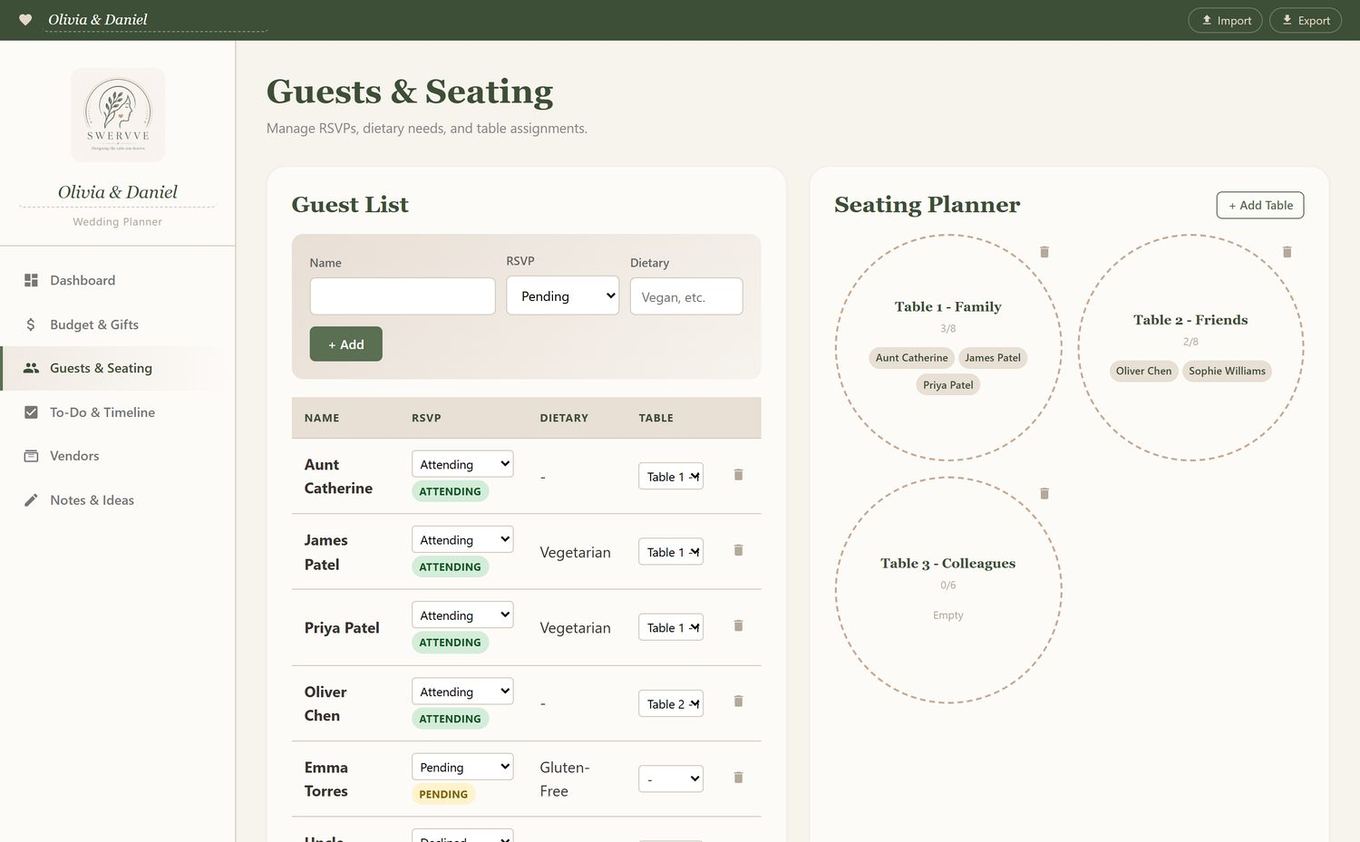
Build it somewhere you can drag things around. A chart on paper is the reason this takes a week: one change means redrawing everything. You'll also want that flexibility on the day itself — someone always cancels that morning.
What actually matters
Nobody has ever left a wedding talking about the seating chart. They have left talking about a table where they laughed for three hours, or one where they sat next to a stranger with nothing to say for the length of a meal. That's the whole brief: not perfect diplomacy, just making sure everyone in the room has someone to talk to. Get that right and the etiquette mostly takes care of itself.
Where the app fits
Everything above is decision-making, and no tool will do it for you. What a planner does is take the admin out of the way so the decisions are the only hard part: RSVPs and dietary requirements attached to each guest, tables you build and rebuild by dragging names, live counts so you know when a table is full, and the whole thing saved on your own machine — so the third round of changes takes ten minutes rather than another evening.