


You've had the test. Someone qualified looked at the result and told you it was nothing. And it helped — for an afternoon, maybe a week. Then a new sensation turned up and the whole thing started again, and now you're wondering what's wrong with you that a clear answer didn't stick.
Nothing is wrong with you. Reassurance wearing off isn't a failure of willpower or a sign the doctor missed something. It's the single most predictable feature of health anxiety, and once you understand why it happens, the way out stops looking like a mystery.
The loop has five stages, and you control one of them
Health anxiety runs on a cycle that's been mapped pretty thoroughly in cognitive behavioural models. It goes like this:
A sensation appears — a twinge, a flutter, a lump, an ache. Bodies produce these constantly; most people never notice theirs. Then comes the interpretation: of the forty ordinary explanations available, your attention reaches for the frightening one and treats it as the default until proven otherwise. That produces an anxiety spike, which is physiological — adrenaline, a faster heart, a tight chest — and which helpfully manufactures several more sensations to worry about. So you do something about it: you check. You google, you press on the spot, you take your pulse, you ask someone whether it looks normal. And you get relief.
Then your attention, now thoroughly tuned to your body, finds the next thing sooner. And around it goes.
Four of those five stages are involuntary. You cannot decide not to have a sensation, and you cannot decide not to feel a spike of fear. The checking is the only part that is a choice — which is inconvenient, because it's also the part that feels most like taking sensible action.
The relief is the problem
This is the part that surprises people, so it's worth saying slowly: the reassurance works, and that's exactly why it's damaging.
Every check genuinely brings the anxiety down. That drop is real. But a behaviour followed by relief is a behaviour your brain learns to repeat, and more than that, it learns that the relief was necessary — that you'd still be in danger if you hadn't checked. So the next spike arrives with the checking already attached to it.
Plot it out over a week and the shape is unmistakable. Each check drops the anxiety, but it lands a little higher than the last one, and the gap before the next climb gets shorter. A worry that used to show up once a month starts showing up on Tuesdays and Thursdays.
Left alone, the same spike does something different. It climbs higher, feels considerably worse, sits there for a while — and then comes down by itself, to a lower point than any check ever got you. That's the trade on offer: a worse hour today for a quieter month. It is, genuinely, a bad deal in the short run, and there's no point pretending otherwise.
Try this, it takes ninety seconds
Put this down and pay very close attention to the inside of your left hand and forearm for one minute. Look for anything unusual — a tingle, a throb, a warm patch, an ache in a knuckle, a mark you hadn't noticed.
Almost nobody finds nothing.
Your left hand wasn't unwell ninety seconds ago and it isn't now. But focused attention reliably produces findings, in any body, at any time. Which means "I keep finding things" is not evidence that something is wrong. It's evidence that you're looking. Those are very different sentences, and health anxiety depends on you never separating them.
What actually helps
1. Describe, don't diagnose
Say what's happening in words a stranger could verify. "A dull ache under my left ribs, about a four out of ten, since lunch" — not "something's wrong with my pancreas." It sounds trivial. It isn't. A described sensation is an object you're looking at; a diagnosed one is a world you're living inside.
2. Write both explanations, at the same length
Write the frightening story out in full — suppressing it just makes it louder, and you know every word already. Then write the ordinary one with the same amount of detail. Most people give the frightening story six sentences and the ordinary one three words. That imbalance is the disorder, visible on a page.
3. Stop searching — the search is not research
Searching feels like doing something. It's the opposite. Every search engine will eventually show you the worst possible cause of any symptom, because that's what people click on. Decide once, in advance, in writing: I don't search my symptoms. Not carefully. Not on a reputable medical site. Not just to rule something out.
4. Delay the check — don't ban it
This is the one that does the most work, and it comes straight out of exposure-and-response-prevention approaches. Don't promise never to check again; a prohibition you break at 11pm becomes proof you can't do this. Promise sixty seconds.
When the sixty seconds are up, you're allowed to check. Most of the time you won't want to — and on the times you do, you'll check having already proved the urge was survivable. Then the next rung is five minutes. Then twenty. You're not resisting forever; you're only ever delaying, one rung at a time.
5. Aim at uncertainty, not certainty
You will not get certainty. Not from a test, not from a second opinion, not from anyone. Certainty about your body was never available to any human being who has ever lived, and everyone else is simply getting on with their afternoon anyway.
The skill worth building isn't feeling sure you're well. It's being able to carry an unanswered question around without it running your evening. "I don't know, and I'm not going to find out tonight" is a complete and adequate thought.
6. Go back to what the fear interrupted
Health anxiety doesn't only frighten you — it shrinks the day. The call you didn't make, the run you skipped, the evening you spent half-present. Reclaiming those isn't the reward for recovering; it's a large part of how recovery happens. Finish the episode by doing one thing the spike interrupted, now, badly, while still anxious. Doing it perfectly once calm teaches your brain nothing.
About the people you keep asking
Your partner, parent or friend answers because they love you and because "you're fine" ends an uncomfortable moment. They're not doing anything wrong — they just don't know that each answer costs you the next spike.
Ask them, in a calm moment, to stop answering. Give them a line to use instead: "I'm not going to answer that one — you asked me not to. Do you want to do the delay thing, or shall we go for a walk?" Warn them you'll be annoyed the first few times. Ask them to hold it anyway.
What this does not mean
None of this asks you to ignore your body. A symptom that is new, persistent or genuinely changing still goes to a doctor, and so do screenings and follow-ups you're actually due. The distinction worth holding is between medical care and reassurance-seeking: go for something new or changing; don't go to be told again about something you've already been checked for.
And if the checking is taking more than an hour of most days, if you're avoiding care you need, or if eight weeks of working on this brings no movement at all — that's the point to talk to someone. Ask specifically about CBT for health anxiety and about exposure and response prevention. Both have good evidence behind them.
If you're having thoughts of harming yourself, please contact emergency services or a crisis line now — 988 in the US and Canada, 116 123 in the UK and Ireland, or findahelpline.com wherever you are.
The honest version of recovery
It isn't that the fear disappears. It's that it turns up, you recognise the shape of it, you don't feed it, and it leaves in an afternoon instead of a fortnight. People who recover from health anxiety aren't the ones who never spiral again. They're the ones who spiral for four days instead of four months, because they spot it sooner.
You don't need to be certain. You need to be steady. They are not the same thing, and only one of them is actually available.
Get the workbook
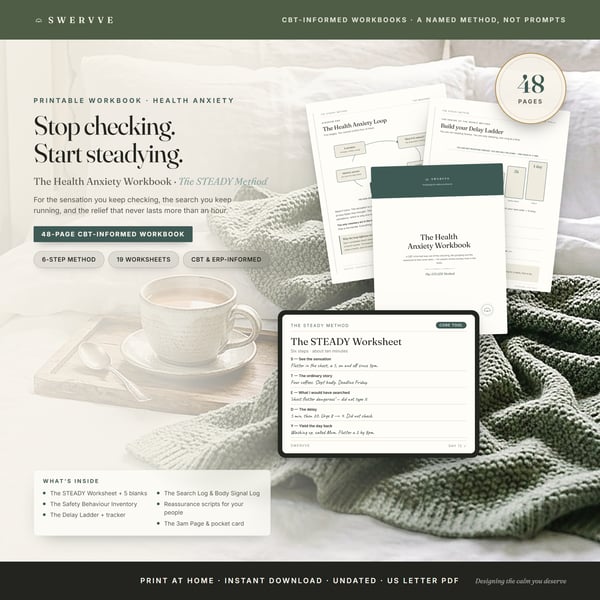
The STEADY Method — CBT‑ and ERP‑informed, for the checking, the googling and the relief that never lasts. Printable PDF, instant download.