


Someone tells you to stop worrying about it. You agree that this would be sensible. You then spend the next forty minutes worrying about it, plus a new layer of worrying about why you can't stop worrying about it. This is not a personal failing and it isn't a lack of effort. Deliberately not thinking about something is a badly designed instruction, and it has a fairly well-understood reason for backfiring.
Try not to think about a white bear
That instruction is the basis of a classic line of psychology experiments run by Daniel Wegner, who spent much of his career on what happens when people try to suppress a thought. The short version of what he found: telling people to keep a specific thought out of mind makes the thought appear more often, both during the attempt and — often more strikingly — afterwards. The suppressed thought comes back with interest. He called this the rebound effect.
The explanation he proposed is called ironic process theory, and it's worth understanding because it makes the failure make sense. Suppression needs two things running at once:
• A conscious process that goes looking for something else to think about — the distraction, the task, the other subject.
• An automatic monitor that checks, quietly and constantly, whether the unwanted thought has returned.
The problem is the second one. In order to check whether you're thinking about the thing, the monitor has to keep a representation of the thing available. The part of your mind enforcing the ban is holding the banned item up to the light every few seconds.
That's survivable while the conscious process has capacity. But when you're tired, stressed, distracted, or trying to fall asleep — precisely the conditions where you most want the thought gone — the effortful half falters, the automatic monitor keeps running, and all that's left is the process whose job is to notice the thought. Hence the 2am version of a worry, which is always the loudest.
Why "just stop worrying" is worse than useless
As advice it fails twice: it prescribes the exact mechanism that amplifies the thought, and it sets up a test you cannot pass.
That second part matters more than people realise. Once you've decided a well-functioning person would be able to switch this off, every recurrence becomes evidence of something wrong with you. Now you're not just worried about the thing — you're worried about your own mind, which is a far stickier worry, because you can't leave it behind when you change rooms.
The same logic applies to the versions we say to ourselves: I need to stop overthinking this. I shouldn't still be upset about this. Why can't I let this go. Each one installs a monitor.
Reassurance and distraction behave the same way
Two things feel like solutions and function as fuel.
Reassurance-seeking. Asking someone whether it's fine, re-checking the message you sent, searching your symptoms one more time. The relief is real and it is short — usually under an hour. Then the doubt returns, slightly stronger, because you've just demonstrated to yourself that this was a question serious enough to require checking. The worry reads your response as confirmation it was right to raise the alarm.
Distraction as escape. There's a difference between changing activity because you've finished with a thought and changing activity to flee one. The first is fine. The second leaves the loop open and running underneath — which is why you can watch an entire episode of something and arrive at the credits with the worry exactly where you left it, undiminished, waiting.
The common thread: both treat the thought as an emergency that must be neutralised. That framing is the thing keeping it loud.
What to do instead
The goal isn't a quiet mind on command. Nobody has that. The goal is to stop feeding the loop, and to give it an ending rather than an argument.
• Allow it rather than fight it. This sounds like surrender and is actually the most effective move available. Let the thought be present without treating it as an emergency and without debating it. One practical version: change the sentence from "this is going to go wrong" to "I'm having the thought that this is going to go wrong." That small grammatical move puts a gap between you and the content, which is the entire point — you're not disputing the thought, you're declining to be inside it. This is standard practice in acceptance and commitment therapy, and it works precisely because it doesn't require the thought to leave.
• Postpone it to a fixed window. Pick fifteen minutes at a set time — say 6pm, at a desk, not in bed. When a worry shows up outside that window, write one line and tell it that it has an appointment. This is a long-standing technique in the treatment of generalised anxiety, and it works for a specific reason: you're not suppressing the thought, so there's no monitor and no rebound. You're deferring it, which your mind will usually accept. Most people find that by the time the window arrives, a good proportion of the list has gone flat.
• Sort each worry into one of two piles. Solvable worries have a next action — send the email, book the appointment, check the balance. Do it, however small; action is what tells your nervous system the threat is being handled. Hypothetical worries have no action available, because they're about a future that hasn't arrived: what if in three years, what if they secretly think. Those can't be solved, only fed, so they get the allowing treatment from step one. Most people's worry is overwhelmingly the second kind, and treating it as the first is what keeps them at it for hours.
• Change the body, not the argument. Worry runs on physical arousal, and a wound-up body keeps generating threats to justify itself. You will not out-think that state. Make the exhale longer than the inhale for a minute or two. Walk, ideally outside. Get cold water on your hands. It won't resolve the thought, but it lowers the volume enough that the other four steps become possible.
• Write it out to the end. An unfinished thought restarts. Half a worry, carried around in your head, has to be re-opened every time your attention drifts back to it. Written down in full — the fear, the actual worst case, what you'd do if it happened — it gets an ending, and endings are what loops lack. This is also why journalling works for people who don't consider themselves journal people: it isn't expressive, it's administrative.
The counterintuitive part
Everything above points the same direction: you get fewer intrusive thoughts by caring less about having them, not by trying harder to prevent them. The thought stops being sticky when it stops being treated as an emergency — and it stops being treated as an emergency when you stop mounting an operation against it every time it appears.
That's a slow change rather than a switch. But it's a change that goes in the right direction, which "just stop worrying" never does, because it makes each recurrence a defeat.
What to say instead, to yourself and other people
If someone you care about is worrying, "stop worrying" hands them an impossible task. Better options offer company rather than correction: that sounds like it's been going round for a while. Do you want to think it through, or do you want a distraction? What would you do if the worst version actually happened? That last one sounds counterproductive and usually isn't — following a worry to its end is often what deflates it, because the answer is nearly always "it would be unpleasant and I would handle it." Say the same things to yourself; the tone you use with your own worry does more work than the content.
When it's more than a loop
Worry that runs most days for months, that you can't control, and that comes with physical symptoms — poor sleep, muscle tension, exhaustion, difficulty concentrating — is a recognised and very treatable pattern, and the treatment for it is good. If that's closer to your experience than the occasional bad week, a licensed therapist is a better use of your time than any article or workbook, including this one. If you're in crisis, in the US and Canada you can call or text 988; in the UK and Ireland, Samaritans is free on 116 123, any time.
Where the workbook fits
The five steps above are the whole approach, and they cost nothing but paper. What the printable version adds is the friction removal: brain-dump pages for step five, a thought log that walks the solvable-versus-hypothetical sort automatically, and enough blank copies that using it becomes routine rather than a project you decide to start. It's the original Swervve workbook, and the one review it has says the thing we care about most — straight to the point, no fluff.
Get the workbook
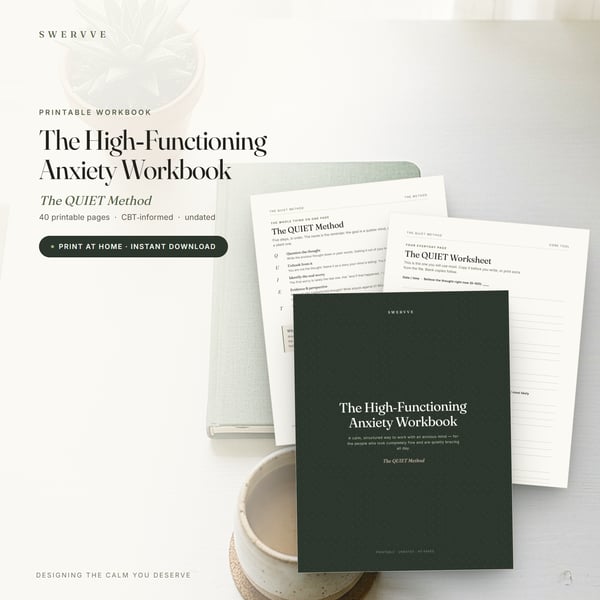
The High-Functioning Anxiety Workbook →
The QUIET Method — for the people who look completely fine and are quietly bracing all day. Printable PDF, instant download.