
If you’ve spent any time walking the path of Scottish Folk Magic, the name Isobel Gowdie likely carries a heavy, spectral weight. Often called the "Queen of Scottish Witches" or the "Witch of Auldearn," Isobel isn't just a name in a history book—she is the architect of our most vivid understanding of 17th-century sorcery.
In 1662, Isobel gave four confessions over six weeks that changed everything we know about the folklore of the region. But before we pull back the veil, a quick note: these accounts were extracted under the shadow of the gallows and the duress of interrogation. As modern practitioners, we read these not just as a record of "crime," but as a precious, albeit complicated, diary of the spiritual and magical lives of the Scottish peasantry.
The Covenant: Denying the Old Life
In her first confession, Isobel described a moment that changed the trajectory of her life: an encounter with the Devil between the farmsteads of Drumdewin. It wasn't a sudden, grand event, but a quiet, chilling pact made at the kirk in Auldearn.
Her description of the initiation is visceral:
‘The first thing I did was deny my baptism. Then I put one of my hands upon the crown of my head and the other to the sole of my foot and renounced all between my two hands to the Devil.’
Initiated by her mentor, Margaret Brodie, Isobel was baptized with blood and given a new name: Janet. This concept—of a physical, hand-to-head, hand-to-foot surrender of the self—appears in folk magic traditions from the Appalachians to the corners of Europe. It speaks to a deep, primal understanding of total commitment to the Craft.
The Devil: A Tangible Presence
Forget the red-skinned caricature of modern media. In Isobel’s world, the Devil was real, tactile, and terrifying. She described him as ‘a meikle, blak, roch man’—large, hairy, with skin like coal, and feet that were always cloven. He was cold to the touch, and he didn't just haunt the shadows; he sat at the head of the table during their Sabbats.
The Spirit Companions
One of the most fascinating aspects of Isobel's testimony is the 13-member coven structure—a standard many believe originated here. Each member had a spirit familiar to wait upon them, and the descriptions she gave are strikingly vivid:
- The Red Reiver: Isobel’s personal familiar, always dressed in black.
- Swein & Mac Hector: Always adorned in grass-green.
- Rorie: Clad in yellow.
- The Roaring Lion: Clad in sea-green.
- Robert the Rule: Clad in faded dun; described as the leader.
- Robert the Jacks: Old and "glaikit" (simple-minded).
The Dark Art of Sympathetic Magic
Isobel’s most chilling testimony involves the destruction of the Laird o’ Park’s heirs using a clay effigy. This is textbook sympathetic magic—using a surrogate to influence a living target.
She explained that they would knead the clay like dough in the Devil's name, shaping it into the likeness of the Laird's sons. The ritual was precise, rhythmic, and haunting:
"In the Devil’s name, we pour this water in among this meal, For lang dying and ill health; We put it into the fire, That it may be burnt both stik and stowre..."
They would roast the doll, turn it, and hide it away—a dark cycle of craft practiced until the unfortunate children met their end.
The Shapeshifting Rhymes
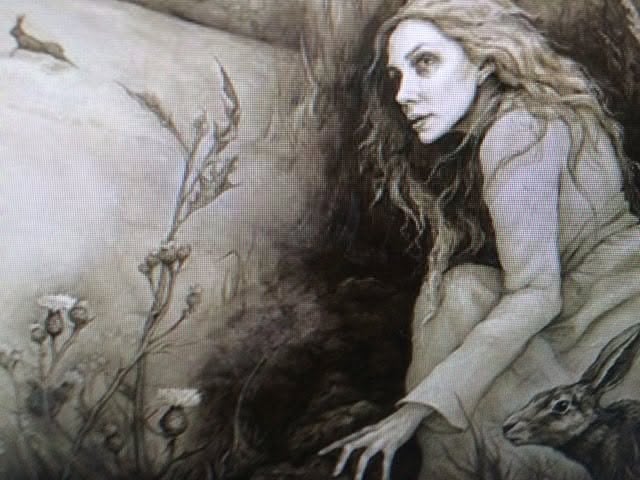
Perhaps the most famous image of Isobel Gowdie is that of the hare. To enter the form of a beast, she recited specific, rhyming incantations—a reminder that in the old ways, magic was often an oral tradition, bound by rhythm and breath.
To become a hare:
"I shall go into a hare, With sorrow and sych and meikel care; And I shall go in the Devil’s name, Aye while I come hame again."
The transition back to human form required a similar call-and-response. It suggests a fluid boundary between human and animal, where the "beast" was not just a disguise, but a temporary state of being.
Magical Flight: Horse and Hattock
How did they travel? Not by broomstick, but by the "Horse and Hattock." By standing over a blade of grass or a stalk of straw and uttering the command, the object would transform into a horse capable of flight.
"Horse and Hattock, in the Devil’s Name!"
It’s a powerful image: the mundane becoming magical with nothing more than a phrase and the will to believe.
A Legacy of Mystery
Isobel Gowdie’s confessions offer us so much more than just a list of spells. They tell us about a time when the veil between this world and the Other was thin enough to walk through. From raising the wind by knocking a wet rag against a stone to using "Elf-shots" to bind or banish, her craft was deeply tied to the land, the weather, and the survival of her coven.
While we can never fully separate the "truth" of her life from the trauma of her trial, her story remains a cornerstone of British occult history. She reminds us that magic is not just in the rituals—it is in the stories we tell, the names we keep, and the resilience of the craft through the ages.
Sources & Further Reading:
- Ancient Criminal Trials in Scotland, Vol. 3, Pt. 2 - Robert Pitcairn
- The Black Book of Isobel Gowdie - Ash William Mills
- Narratives of Sorcery and Magic, Vol. 2 - Thomas Wright
- The Visions of Isobel Gowdie - Emma Wilby
- 1Scot1Not Podcast: "Isobel Gowdie: The NAUGHTIEST Girl of the Entire 17th Century"
What do you think? Was Isobel a weaver of legends, or did she possess a power that the world was simply too afraid to understand? Let me know your thoughts in the comments.
Comments ()