
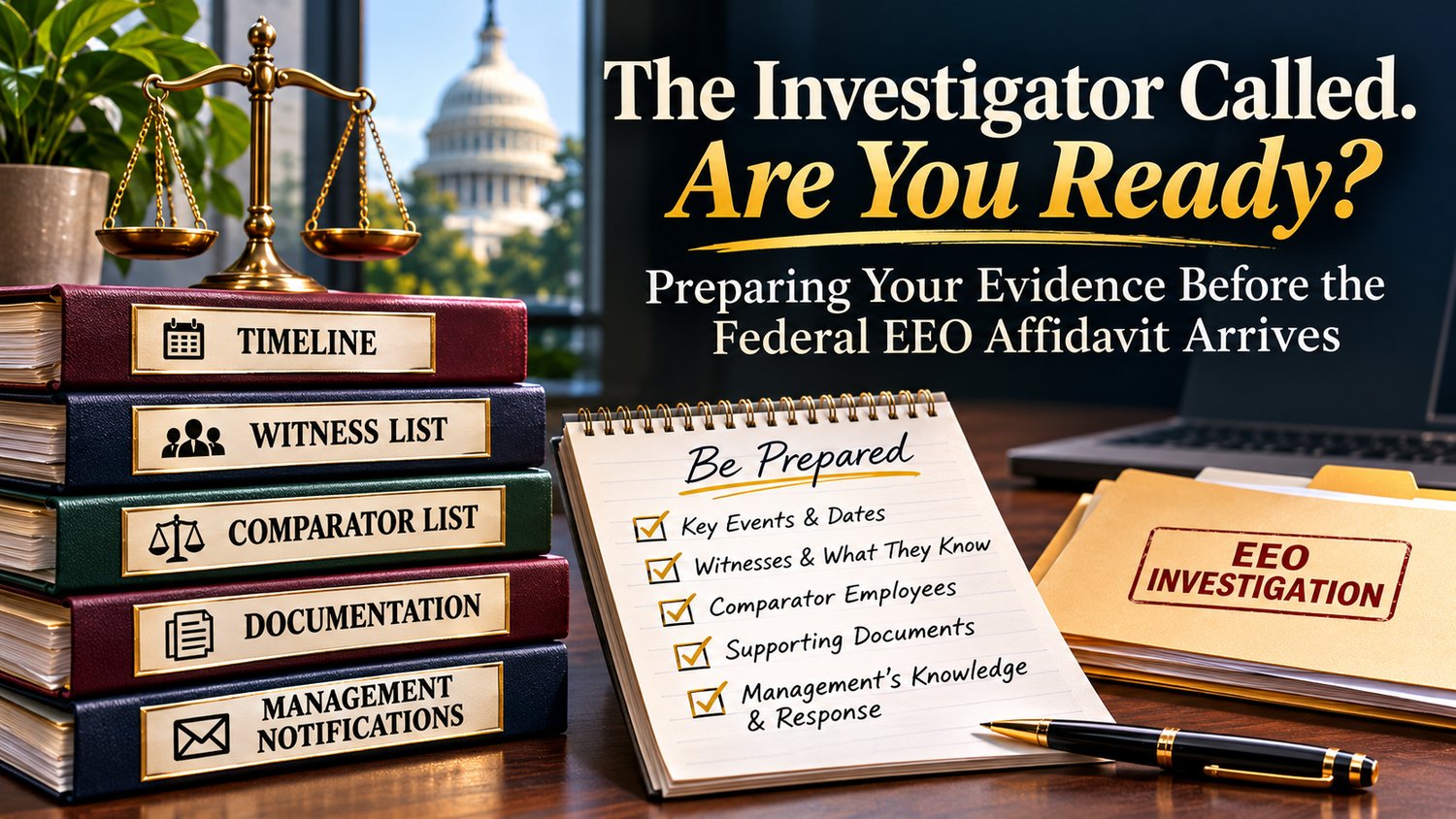
Preparing Your Evidence Before the Federal EEO Affidavit Arrives
One of the worst times to begin organizing your federal EEO complaint is when the investigator contacts you requesting an affidavit and supporting documentation.
You may have spent months experiencing and documenting discrimination, harassment, or retaliation.
Your complaint may involve multiple incidents, several management officials, numerous witnesses, and conduct that continued over an extended period.
Then, seemingly out of nowhere, an investigator contacts you with a questionnaire, a request for documents, and a relatively short deadline to respond.
Now you're expected to recall specific dates, identify witnesses, explain what each person knows, describe how other employees were treated, and connect your supporting evidence to the allegations under investigation.
That is a lot to reconstruct under pressure, especially when your complaint is complex.
And if you aren't prepared, you may inadvertently leave important information out of the investigative record.
The Affidavit Is More Than a Questionnaire
During a federal EEO investigation, the complainant may be asked to provide a sworn affidavit addressing the allegations accepted for investigation.
The questions may appear straightforward:
- Describe what happened.
- When did the incident occur?
- Who was involved?
- Were there any witnesses?
- Did you report the incident to management?
- Were other employees treated differently?
- What evidence supports your allegation?
But these questions require more than a general recollection of events.
Your answers help establish the factual record of your complaint. They may identify evidence the investigator needs to obtain, individuals who possess relevant information, and circumstances that help explain why you believe the conduct was discriminatory, harassing, or retaliatory.
The investigator's questions should not be the first time you've attempted to organize the facts supporting your allegations.
Your Witness List Should Be More Than a Collection of Names
One of the most important things a complainant can prepare in advance is a detailed witness list.
But identifying a witness involves more than remembering someone's name.
You should be able to explain who the person is, how they are connected to the events, what they know, and why their information matters.
For each potential witness, consider the following:
Who is the witness?
Identify the person's name, job title or position, work location, and relationship to the events whenever possible.
What did the witness observe or learn?
Did the person directly witness harassment? Hear a discriminatory statement? Attend a meeting? Observe management's response? Receive a report from you shortly after an incident?
There is a difference between witnessing an event firsthand and learning about it afterward. Both may be relevant, but they should be accurately distinguished.
When did the witness observe or learn about the incident?
Dates and timelines matter. Did the person witness conduct before or after you engaged in protected EEO activity? Was it a single incident or part of a continuing pattern?
What is the substance of the witness's knowledge?
What specifically can the person describe? What statement did they hear? What conduct did they observe? What did management say or do?
What allegation does the information support?
A witness may have information relevant to discrimination, harassment, retaliation, management's knowledge, or the agency's response to a complaint.
The objective is not to tell witnesses what to say. It is to identify what they may independently know and why that information is relevant.
A witness's name without an explanation of their potential testimony may tell the investigator very little.
Not Every Relevant Employee Witnessed What Happened to You
This is a distinction that complainants should understand before they are asked whether other employees were treated differently.
Some employees may be relevant to your complaint even though they never witnessed the conduct you experienced.
These individuals may be comparator employees.
A comparator is an employee whose treatment may be compared with yours under sufficiently similar circumstances to help evaluate whether different standards or consequences were applied.
For example, suppose you allege that management repeatedly scrutinized your work, imposed restrictions, or disciplined you for conduct that other employees engaged in without consequence.
An employee who engaged in comparable conduct but was treated more favorably may provide relevant comparative evidence.
That employee does not necessarily have to witness your treatment. Their own circumstances may be the basis for the comparison.
When identifying potential comparators, consider:
- Who was the employee?
- What was their position, assignment, or work responsibility?
- What circumstances were similar to yours?
- Were you subject to the same supervisor, rules, or decision-maker?
- How was that employee treated?
- How were you treated differently?
- When did the different treatment occur?
- What documents or other evidence might establish the comparison?
Comparators do not have to be identical in every respect, but the similarities must be meaningful to the issue being investigated.
And not every relevant comparison involves discipline. Differential treatment may concern assignments, scheduling, enforcement of workplace rules, opportunities, supervision, or management's response to employee misconduct.
If you only prepare a list of people who personally witnessed incidents involving you, you may overlook employees whose experiences help establish how your treatment differed from others.
That is why I recommend preparing a separate comparator list in addition to your witness list.
Your Timeline Is the Framework for Your Evidence
In a complaint involving multiple incidents, a detailed chronology is essential.
A timeline should do more than record dates. It should connect events to the individuals involved, the evidence available, and the allegations they may support.
For each incident, identify:
- The date or approximate date.
- The location.
- The people involved.
- What occurred.
- Any relevant statements or actions.
- Whether management was notified.
- How management responded.
- Potential witnesses.
- Supporting documentation.
- Any subsequent related conduct.
This becomes particularly important in retaliation claims.
You may need to explain when you engaged in protected activity, when management became aware of that activity, what happened afterward, and what evidence supports a possible connection.
A well-organized timeline can also help you distinguish separate incidents from an ongoing pattern of conduct.
Without one, you may find yourself trying to reconstruct months of events from scattered emails, text messages, handwritten notes, and memory while an affidavit deadline is approaching.
Organize Your Documents Before You Are Asked to Submit Them
Having evidence and being prepared to present it are not the same thing.
You may have emails, text messages, photographs, work schedules, personnel records, written complaints, contemporaneous notes, and other documents that support your allegations.
But if those materials are scattered across your phone, email account, computer, and paper files, locating and explaining them under a short deadline can become difficult.
Organize your documentation by incident, date, or allegation.
Whenever possible, identify what each document establishes and which part of your complaint it relates to.
An email might establish that management received notice of harassment. A schedule might support a claim involving an assignment change. A text message sent immediately after an incident might help establish when the event occurred and what was reported.
Evidence becomes more useful when you can explain its relevance, not merely produce it.
Keep original records intact, preserve dates and context, and distinguish your contemporaneous documentation from explanations prepared later.
Be Prepared to Explain What Management Knew
Another area that deserves careful preparation is management's knowledge.
If you reported harassment, discrimination, or retaliation, identify who received the report, when they received it, what you communicated, and how they responded.
Did you notify a supervisor verbally? Send an email? Request assistance? Report repeated incidents? Identify the individuals involved?
Did management investigate, intervene, dismiss your concerns, or take some other action?
Those details may matter to the issues being investigated.
Simply stating that management knew may not adequately explain how, when, or from whom management received the information.
Prepare the facts that support your statement.
Don't Let a Short Deadline Determine the Quality of Your Evidence
An EEO investigator may contact you after a lengthy period with a request to complete an affidavit and provide supporting materials within a relatively brief timeframe.
The time allowed can vary. If you need additional time, you can request an extension promptly and in writing, explain why it is necessary, and retain a copy of the request. Do not assume an extension has been granted unless it is confirmed.
But requesting more time is not a substitute for preparing in advance.
A complainant with an organized chronology, witness list, comparator list, and supporting documents is in a better position to respond thoroughly and accurately.
That preparation becomes even more valuable when the complaint involves continuing conduct, multiple allegations, several management officials, or incidents extending over many months.
You should not have to begin reconstructing your entire complaint the day the affidavit arrives.
An Incomplete Answer Can Have Consequences Beyond the Investigation
One of the greatest risks of being unprepared is that important information may never be adequately developed in the investigative record.
Suppose the investigator asks whether there were witnesses, and you identify only one person because you cannot immediately recall the others.
Or you're asked whether similarly situated employees were treated differently, and you give a vague response because you haven't organized the relevant comparisons.
Or you describe an incident but forget that you reported it to management in writing the following day.
Those omissions do not necessarily mean the evidence is lost forever. Depending on the stage of the case, there may be opportunities to request additional investigation, identify deficiencies, submit relevant evidence, or seek further development of the record.
But correcting an incomplete investigative record may require additional effort, and opportunities to supplement it are not unlimited.
The agency may later rely on the Report of Investigation, and the complainant may need to identify what evidence was overlooked or inadequately developed.
Don't make it easier for important evidence to be minimized simply because you were unprepared to explain it when asked.
Preparation Is About Protecting the Record
Federal EEO complainants should understand that they have a role in identifying relevant evidence and explaining the factual basis of their allegations.
The agency has an obligation to develop an appropriate, impartial factual record. That responsibility does not disappear because a complainant struggles to recall a date or identify a witness during an interview.
But the complainant should not rely on the investigator to independently discover every relevant person, document, comparison, or connection between events.
Your preparation helps ensure that you can identify those leads clearly and preserve your requests for relevant evidence to be considered.
And if you believe an important witness, comparator, or document has been overlooked, raise that concern specifically and in writing.
Identify the evidence, explain its relevance, and preserve your request as part of the record whenever possible.
The Bottom Line
If you're navigating the federal EEO process, don't wait for the investigator to contact you before organizing your case.
Prepare your timeline. Identify your witnesses. Research and document potential comparators. Preserve your communications. Organize your supporting evidence. Know what management was told and how it responded.
Most importantly, understand what each person and document may establish.
The time to prepare for your investigative affidavit is before the affidavit arrives.
Because when the investigator asks who witnessed an incident, who was treated differently, what management knew, or what evidence supports your allegations, you should already have a meaningful answer.
Don't allow the first time you're required to explain your evidence in detail to become the first time you've organized it.
This article provides general educational information about the federal-sector EEO process. It is not legal advice and does not establish an attorney-client relationship.
Comments ()