

For many parents, the first years of special education are filled with new terminology.
- Evaluations.
- IEPs.
- Related services.
- Least Restrictive Environment.
- Free Appropriate Public Education.
Eventually, those terms become familiar. Families learn the process, build relationships with their child's educational team, and settle into a routine.
Then, somewhere around age 14, everything changes again.
A new phrase appears on the IEP: Transition Planning.
Suddenly, conversations are no longer centered solely on academic progress. Instead, they shift toward employment, independent living, postsecondary education, community participation, adult services, benefits, and long-term independence.
For many families, it feels like starting over.
The problem isn't that parents aren't willing to learn. It's that the information they need is scattered across multiple agencies, multiple systems, and countless meetings. One answer comes from the school district. Another comes from Vocational Rehabilitation. Another from Social Security. Another from Medicaid. Adult disability agencies, nonprofits, healthcare providers, and parent organizations all play a role, yet no one hands families a roadmap showing how everything fits together.
That leaves many parents asking the same questions.
- When should we apply for SSI?
- What is an ABLE account?
- Should we consider Supported Decision-Making or guardianship?
- Who helps my child find a job?
- What happens after graduation?
- What adult services even exist?
Those questions don't arrive one at a time. They often arrive all at once.
Transition planning is one of the most significant phases of a student's education because it isn't simply about graduating from high school. It's about preparing for adult life. Decisions made during these years can influence employment opportunities, independent living skills, access to public benefits, healthcare planning, transportation, and community participation for years to come.
To make matters more challenging, every state administers many of these programs differently. Eligibility requirements, waiver systems, agency structures, and available services vary widely. Advice that works for one family may not apply to another, leaving parents to sort through information that is often incomplete—or simply overwhelming.
Over the past year, we've heard from families across the country who all shared a similar concern.
"I don't know what I don't know."
It's one of the most honest statements a parent can make.
At The Spectrum Dispatch, our goal has always been to do more than report on disability news. We want to help families understand the systems that shape their lives and give them practical tools they can use long after they've finished reading an article.
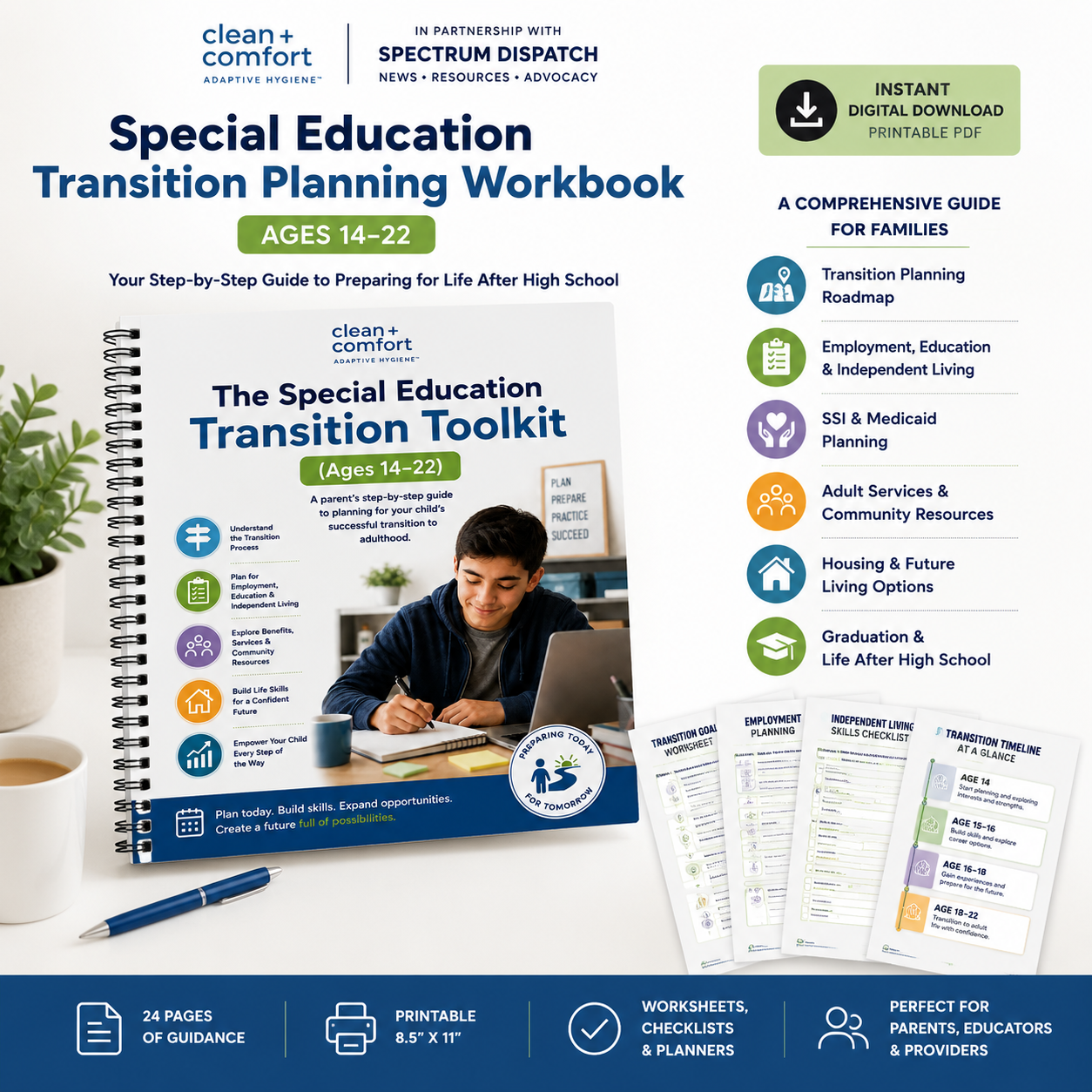
That's why we created the Transition Toolkit.
Rather than another workbook filled with generic advice, we designed it to serve as a planning guide that families can return to throughout the transition years. Inside are resources to help organize important documents, prepare for transition meetings, understand benefits and adult agencies, track employment planning, build independent living goals, compare guardianship and Supported Decision-Making, understand common transition terminology, and create a personalized roadmap from adolescence into adulthood.
The toolkit also includes practical worksheets, planning checklists, note pages, timelines, and reference guides that can help parents walk into meetings feeling more informed and better prepared to advocate for their child.
While no single guide can answer every question—or replace the expertise of your educational team or state agencies—we believe families deserve one place to start.
Transition planning shouldn't feel like assembling a puzzle without the picture on the box.
Whether your child is just entering transition planning or graduation is only a few years away, having a roadmap can make an overwhelming process feel manageable.
Because at the end of the day, transition planning isn't really about paperwork.
It's about helping young people build meaningful, independent, and fulfilling adult lives.
And every family deserves the tools to help make that journey a little easier.