
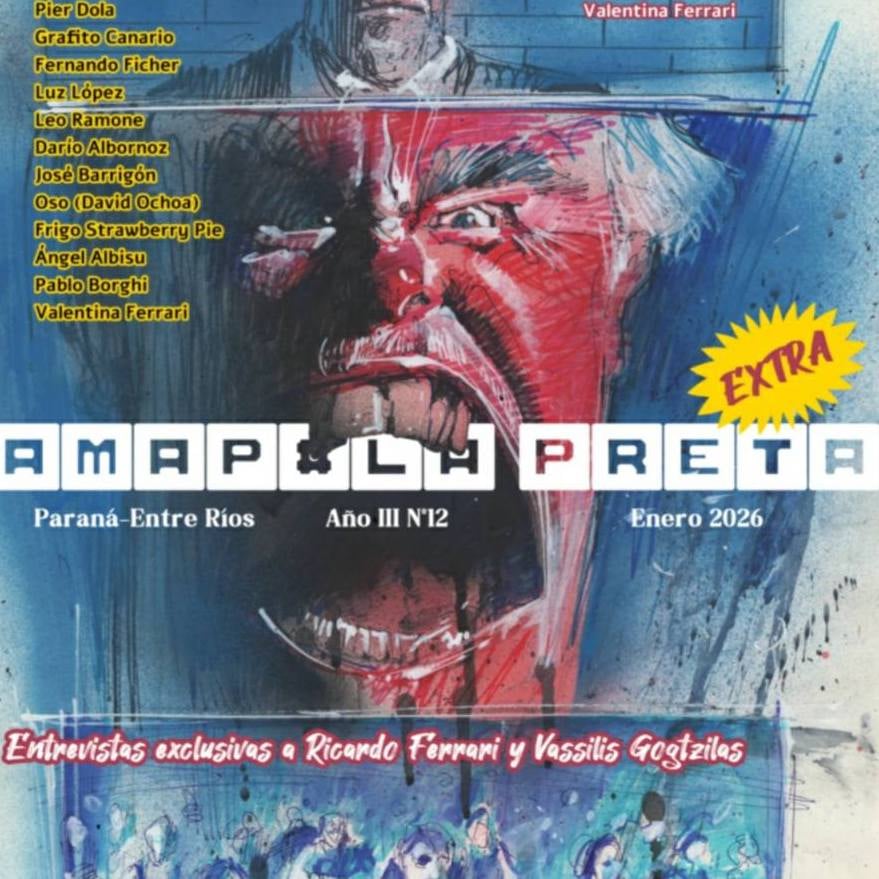
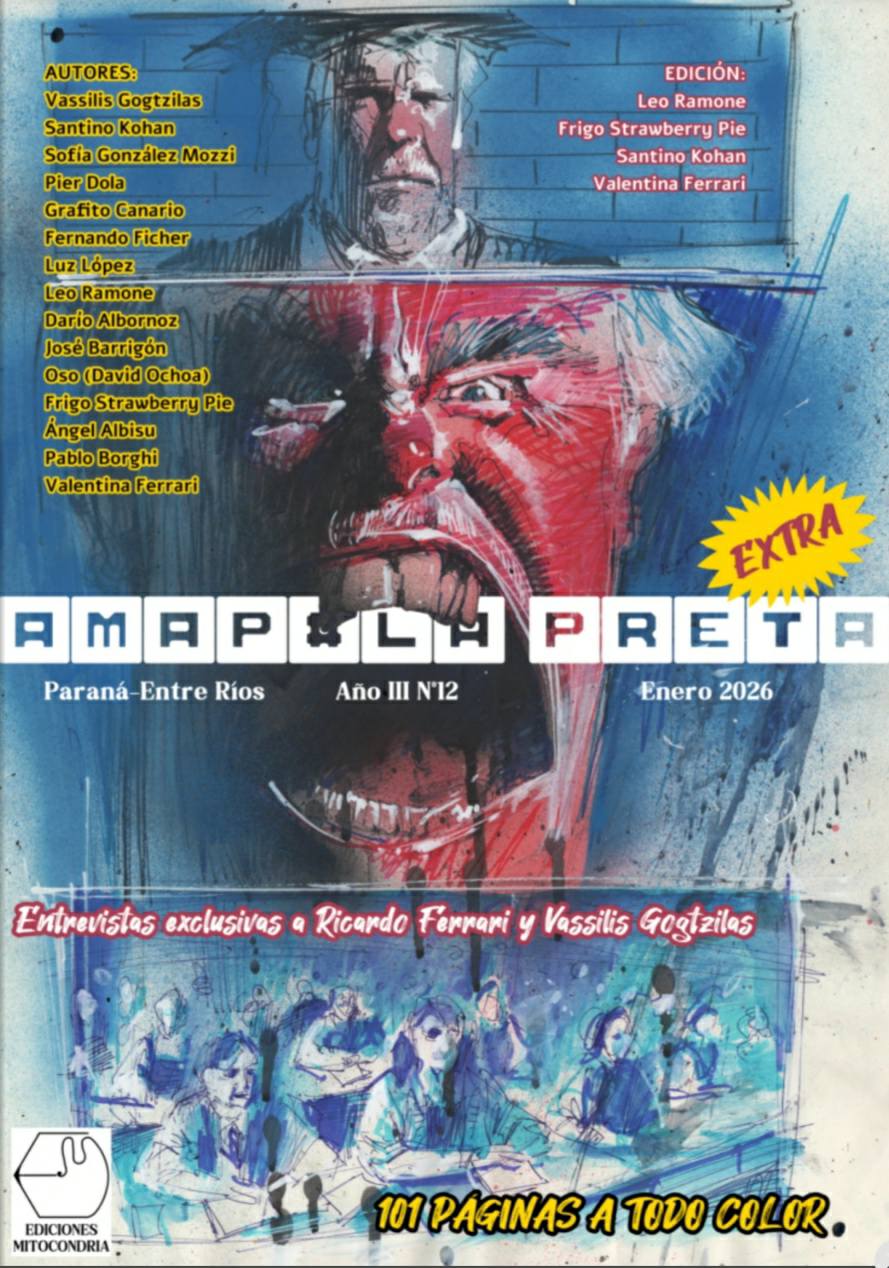
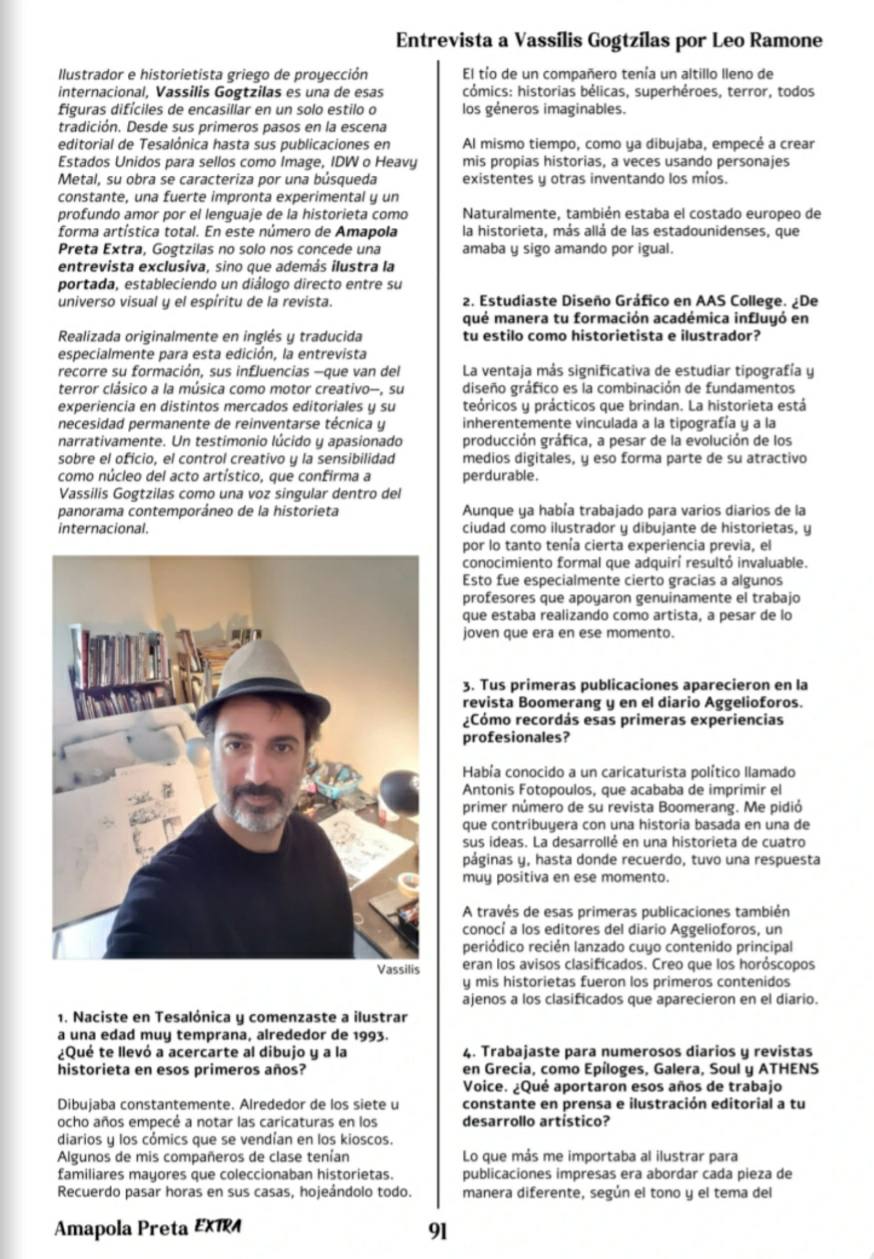
Illustrator and comic artist of international standing, Vassilis Gogtzilas is one of those figures who are difficult to confine to a single style or tradition. From his early steps in the Thessaloniki publishing scene to his publications in the United States for imprints such as Image, IDW, or Heavy Metal, his work is defined by a constant search, a strong experimental imprint, and a profound love for the language of comics as a total artistic form. In this extra issue of AMAPOLA PRETA, Gogtzilas not only grants us an exclusive interview, but also illustrates the cover, establishing a direct dialogue between his visual universe and the spirit of the magazine.
Originally conducted in English and specially translated for this edition, the interview traces his training and influences—ranging from classic horror to music as a creative driving force—his experience across different publishing markets, and his constant need to reinvent himself both technically and narratively. A lucid and passionate testimony about craft, creative control, and sensitivity as the core of the artistic act, it confirms Vassilis Gogtzilas as a singular voice within the contemporary landscape of international comics.
You were born in Thessaloniki and began illustrating at a very young age, around 1993.
What led you to approach drawing and comics in those early years?
I was drawing constantly. Around the age of seven or eight, I began to notice the cartoons in the newspapers and the comic books sold at the kiosks. Some of my classmates had older relatives who collected comics. I remember spending hours at their homes, leafing through everything. One classmate’s uncle had an attic packed with comics—war stories, superhero books, horror titles—every genre imaginable.At the same time, because I was already drawing, I started creating my own stories, sometimes using existing characters and sometimes inventing my own. Naturally, there was also the European side of comics, beyond the American ones that I loved and still love just as much.
You studied Graphic Design at AAS College.
In what ways did your academic training influence your style as a cartoonist and illustrator?
The most significant advantage of studying typography and graphic design is the combination of theoretical and practical foundations they provide. Comics are inherently interconnected with typography and print production, despite the evolution of digital media—and that is part of their enduring appeal.
Although I had already worked for several newspapers in the city as an illustrator and comics artist, and therefore had some background and experience, the formal knowledge I gained proved invaluable. This was especially true thanks to certain professors who genuinely supported the work I was doing as an artist, despite how young I was at the time.
Your first publications appeared in Boomerang magazine and the Aggelioforos newspaper. How do you remember those first professional experiences?
I had met a political cartoonist named Antonis Fotopoulos, who had just printed the first issue of his magazine Boomerang. He asked me to contribute a story based on one of his own ideas. I developed it into a four-page comic and, as far as I remember, it received a very positive response at the time.
Through these early publications, I was also introduced to the publishers of the newspaper Aggelioforos, a newly launched paper whose primary content was classified ads. I believe that the horoscopes and my comics were the first pieces of content outside of the classified section ever to appear in it.
You worked for numerous newspapers and magazines in Greece,such as Epíloges, Galera, Soul, and ATHENS Voice. What did those years of constant work in press and editorial illustration contribute to your artistic development?
What mattered most to me in illustrating for print was approaching each piece differently, depending on the tone and subject of the article. That allowed me to experiment with materials and techniques—bringing a sense of exploration and energy to the pages.
Over time, this process also helped build a circle of collaborators, many of whom I still work with today.
You also illustrated children's books. What challenges and freedoms does illustrating for children present compared with your more adult or experimental work?
I consider myself an ideal fit for fantasy themes and children’s books, and I would very much like to publish more of them. The children’s books I have illustrated so far were created for the Greek market, where contemporary topics tend to focus primarily on social issues.
I hope that in the future I will also have the opportunity to work on fantasy series.
You had a very active role in 9 magazine, designing covers and comics. What did that period mean for your artistic growth?
9 was a magazine insert in a nationwide newspaper, and it was read by a very large audience. It reached many readers. You know, when someone is young, they do not think in such practical terms—I simply loved drawing and creating comics, so every publication felt like happiness to me.
Seeing your work printed on paper is incomparable. The same was true for certain newspaper front pages I illustrated. When I saw them hanging at kiosks around the city, it felt as if I were looking at an art exhibition displayed for the entire public. That is the magic of print.
Your first publication in the United States appeared in the POPGUN anthologies by Image Comics.
How did you enter that market, and what did that international leap mean to you?
In Greece, I began to feel that I would keep circling around the same types of projects unless I did something drastic. The desire to publish work in the United States had been with me since I was a teenager. My first trip abroad was to Bristol, England, in 2002, where I met Jim Valentino and Joe Quesada—Valentino at Image Comics at the time, and Quesada at Marvel.
Before my publication in Popgun, I had traveled to San Diego, California. One of the people I met there who genuinely believed in my potential was Erik Larsen. I had sent him a story featuring Mister Universe, which was eventually printed after the Popgun publications, since we decided that my participation in Popgun would help increase the sales of the Mister Universe issue.
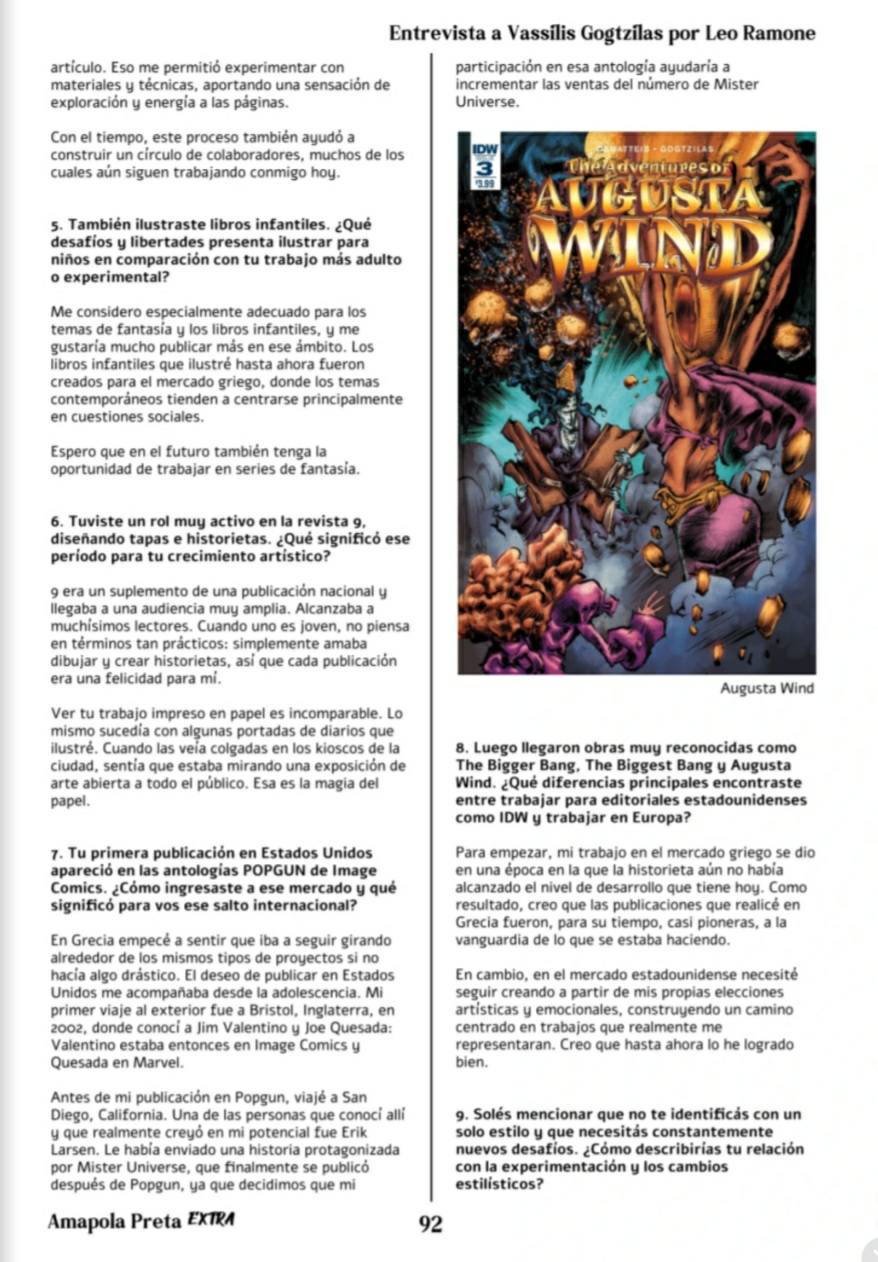
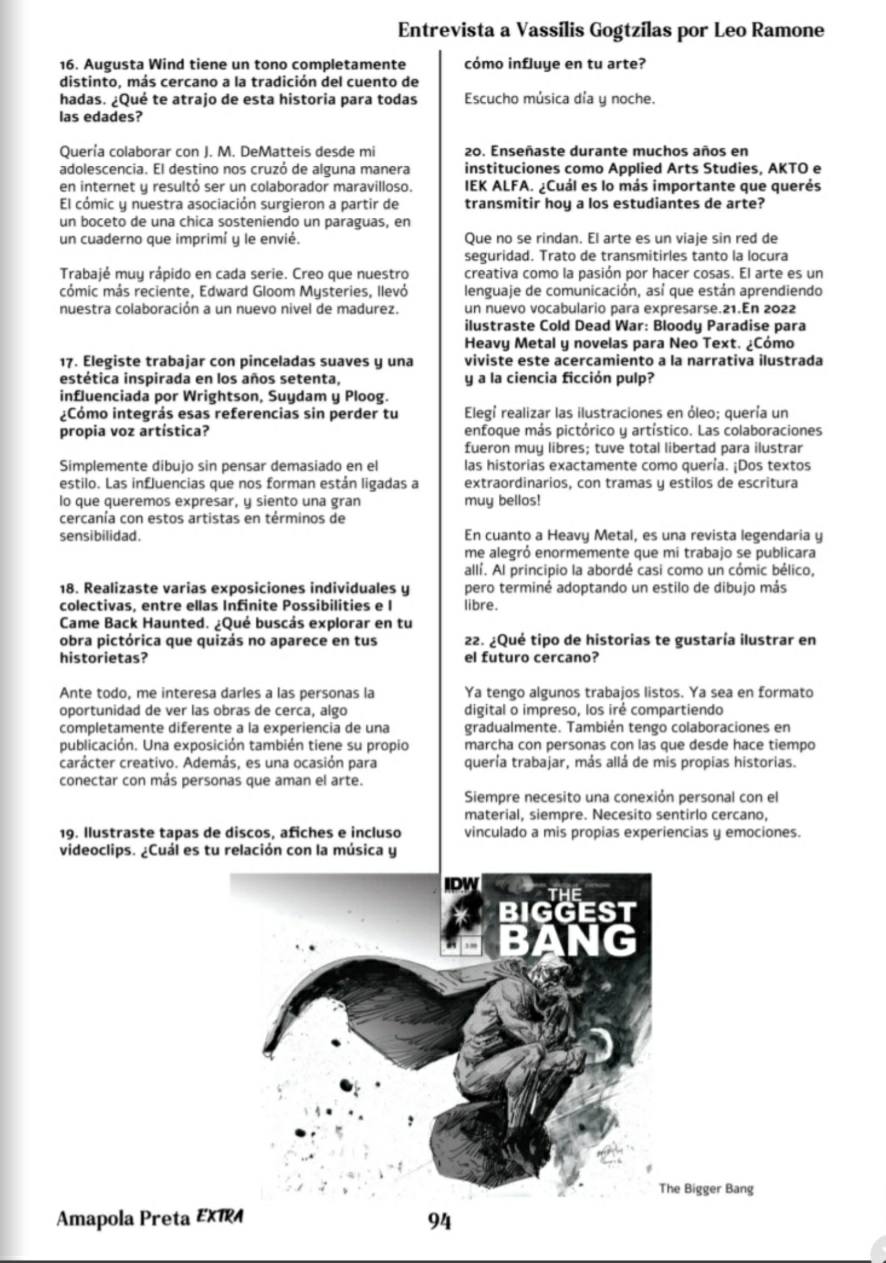
Then came highly recognized works such as TheBiggerBang, The Biggest Bang, and Augusta Wind.
What main differences did you find between working for American publishers like IDW and working in Europe?
To begin with, my work in the Greek market took place during a period when comics had not yet reached the level of development they enjoy today. As a result, I believe that the publications I had in Greece were, for their time, almost pioneering—at the forefront of what was being done.
In contrast, in the American market I needed to continue creating based on my own artistic and emotional choices, building a path centered on work that genuinely expressed me. I believe I have done well so far.
You often mention that you don’t identify with a single style and that you constantly need new challenges.How would you describe your relationship with experimentation and stylistic shifts?
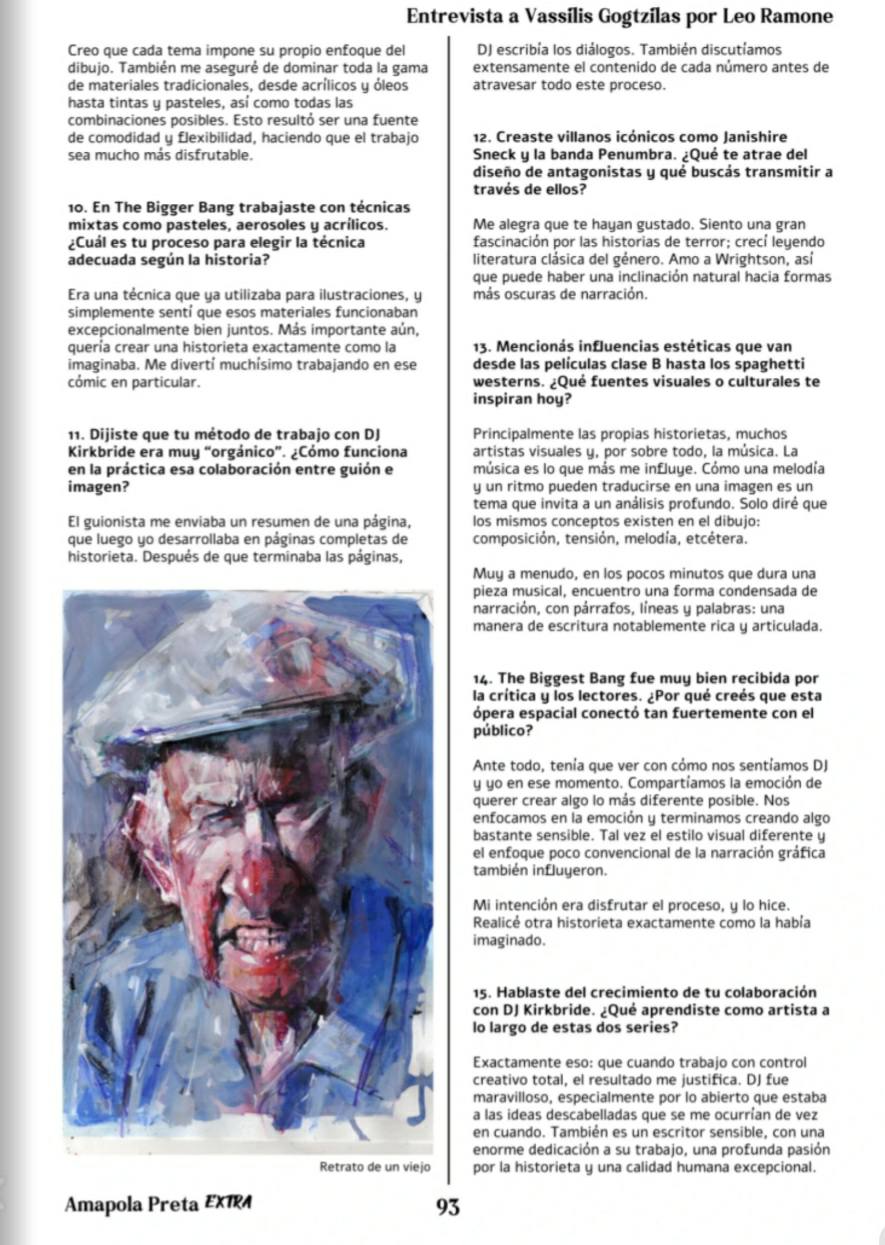
I believe that every subject imposes its own approach to drawing. I also made sure to be proficient in the full range of traditional materials—from acrylics and oils to inks and pastels, as well as all the possible combinations. This proved to be a source of both ease and flexibility, making the work itself far more enjoyable.
In The Bigger Bang, you worked with mixed techniques such as pastels, spray paints, and acrylics. What is your process for choosing the right technique according to the story?
It was a technique I used for illustrations, and I simply felt that these materials worked exceptionally well together. More importantly, I wanted to create a comic exactly the way I envisioned it. I had a great deal of fun working on that particular comic.
You’ve said that your working method with DJ Kirkbride was very “organic.”
How does that collaboration between script and image work in
practice?
I would receive from the writer a one-page summary, which I then developed into full comic pages. After I finished the pages, DJ would write the dialogue. We also discussed the content of each issue extensively before going through this entire process.
You created iconic villains such as Janishire Sneck and the Penumbra gang.
What attracts you to designing antagonists, and what do you seek
to convey through them?
I’m glad you liked them. I find great fascination in horror stories—I grew up with classic horror literature. I love Wrightson, so there may well be a natural inclination toward darker forms of storytelling.
You’ve mentioned aesthetic influences that range from B-movies to spaghetti westerns. What visual or cultural sources inspire you today?
Primarily the comics themselves, many visual artists, and above all, music. Music is what influences me the most. How a melody and a rhythm can be translated into an image is a subject that invites extensive analysis. I will simply say that the same concepts exist in drawing as well—composition, tension, melody, and so on.
Very often, within the few minutes of a musical piece, I find a condensed form of storytelling, complete with paragraphs, lines, and words—a remarkably rich and articulate way of writing.
The Biggest Bang was very well received by critics and readers. Why do you think this space opera connected so strongly with audiences?
It was, first and foremost, about how DJ and I were feeling at the time. We shared the excitement of wanting to create something as different as possible. We focused on emotion and ended up creating something quite sensitive. Perhaps the different visual style and the unconventional approach to visual storytelling also played a role.
My intention was to enjoy the process—and I did. I made another comic exactly as I had imagined it.
You spoke about the growth of your collaboration with DJ Kirkbride.
What did you learn as an artist throughout these two series?
Exactly—that when I work with full creative control, the result justifies me.
DJ was wonderful—especially in how open he was to the crazy ideas I would come up with from time to time. He is also a sensitive writer with great dedication to his work, a deep passion for comics, and an exceptionally good person.
Augusta Wind has a completely different tone, closer to the fairy-tale tradition.
What attracted you to this all-ages story?
I had wanted to collaborate with J. M. DeMatteis since my teenage years. Fate somehow brought us together online, and he turned out to be a wonderful collaborator. The comic and our partnership grew out of a sketch of a girl holding an umbrella in a sketchbook I had printed and sent to him.
I worked very quickly on each series. I believe that our most recent comic, Edward Gloom Mysteries, brought our collaboration to a new level of maturity.
You chose to work with soft brush strokes and a 1970s-inspired aesthetic, influenced by Wrightson, Suydam, and Ploog. How do you integrate these references without losing your own artistic voice?
I simply draw without overthinking style. The influences that shape us are tied to what we want to express, and I feel very close to these artists in terms of sensibility.
You held several solo and group exhibitions, including Infinite Possibilities and I Came Back Haunted. What do you seek to explore in your pictorial work that may not appear in your comics?
First and foremost, I am interested in giving people the opportunity to see the works up close—something that is entirely different from the experience of a publication. An exhibition has its own creative character as well. It is also an occasion to connect with more people who love art.
You illustrated album covers, posters, and even music videos.
What is your relationship with music, and how does it influence
your art?
I listen to music day and night.
You taught for many years at institutions such as Applied Arts Studies, AKTO, and IEK ALFA. What is the most important thing you want to transmit to art students today?
Not to give up. Art is a journey without a safety net. I try to convey to them both the creative madness and the passion for making things. Art is a language of communication, so they are learning a new vocabulary to express themselves.
In 2022, you illustrated Cold Dead War: Bloody Paradise for Heavy Metal and novels for Neo Text. How did you experience this approach to illustrated narrative and pulp science fiction?
The illustrations were my choice to be done in oils—I wanted a more painterly, artistic approach. The collaborations were very free; I had complete liberty to illustrate the stories exactly as I wanted. Two outstanding texts, with very beautiful plots and writing styles!
As for Heavy Metal, it is a legendary magazine, and I was extremely pleased to have my work published there. I initially approached it somewhat like a war comic but ended up adopting a freer style of drawing.
What kinds of stories would you like to illustrate in the near future?
I already have some works ready. Whether online or in print, I will be sharing them gradually. I also have some collaborations in the works with people I have long wanted to work with, beyond my own stories.
I always need a personal connection to the material—always. I need to feel it close to me, connected to my own experiences and emotions.
Comments ()