
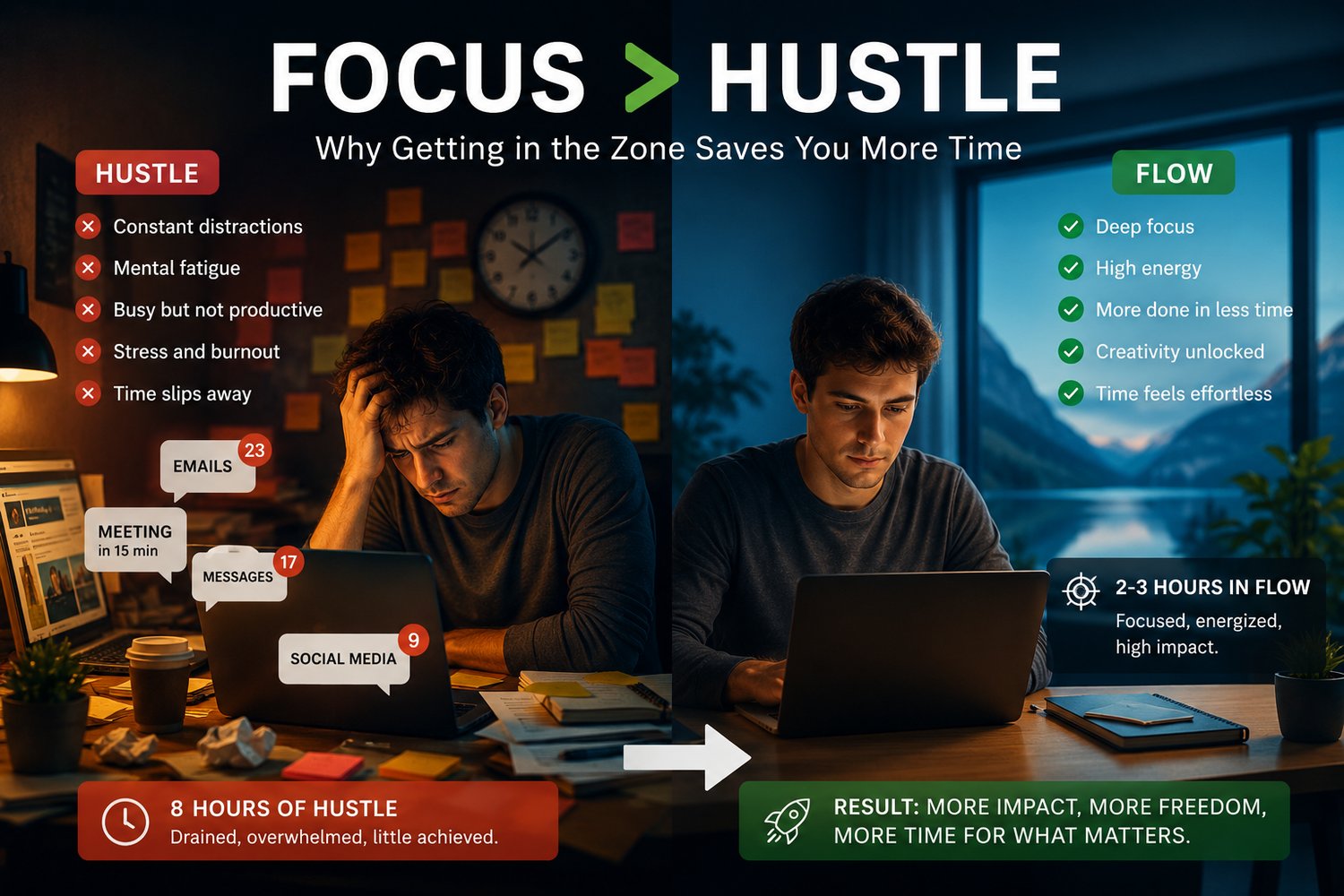
Why Getting in the Zone Saves More Time Than Hustling Ever Will
The Hidden Productivity Secret Nobody Talks About
For years, we've been sold the idea that success belongs to the people who work the longest hours, answer emails at midnight, and stay constantly busy. Hustle culture tells us that if we're not exhausted, we're not trying hard enough.
But what if the opposite is true?
What if working harder isn't the answer?
What if the real key to extraordinary productivity is learning how to work with complete focus instead of constant effort?
The most productive people aren't necessarily the busiest. They're the people who know how to enter a state psychologists call flow—that powerful mental zone where distractions disappear, time seems to slow down, and meaningful work gets done faster than you thought possible.
If you've ever become so immersed in a task that hours felt like minutes, you've experienced flow. And once you understand how to access it consistently, you'll realize that a few hours of focused work can outperform an entire day of frantic hustling.
The Difference Between Being Busy and Being Effective
Many people confuse activity with productivity.
They spend their days bouncing between emails, meetings, messages, social media notifications, and endless to-do lists. At the end of the day, they're exhausted—but somehow the important work remains unfinished.
That's the trap of hustle culture.
Flow operates differently.
Instead of scattering your attention across dozens of tasks, flow channels your mental energy toward one meaningful objective. Your focus becomes sharper, your decisions become easier, and your work quality improves dramatically.
The result?
You accomplish more in less time while feeling less stressed.
Think about it. Would you rather spend eight distracted hours working on a project or two deeply focused hours producing your best work?
For most people, the answer becomes obvious.
Why Flow Multiplies Your Productivity
When you're in a flow state, your brain operates at a higher level of efficiency.
You're not constantly restarting tasks after interruptions. You're not wasting mental energy deciding what to do next. You're fully engaged in the task at hand.
Research has consistently shown that interruptions can dramatically reduce productivity because every distraction forces your brain to refocus. Those small interruptions add up, creating hours of lost productivity every week.
Flow eliminates much of that waste.
Instead of repeatedly switching gears, you maintain momentum. Ideas connect naturally. Problems become easier to solve. Progress accelerates.
This is why some people accomplish remarkable results without appearing busy. They spend less time working but more time focused.
Creativity Thrives in Deep Focus
Hustling may help you complete tasks, but flow helps you create.
Creativity rarely emerges when you're constantly distracted. Great ideas require mental space.
When you enter a flow state, your brain begins making connections that aren't possible during fragmented attention. Solutions appear more naturally. Insights arrive unexpectedly. Complex challenges become easier to navigate.
Writers often describe losing themselves in their work and producing thousands of words effortlessly. Designers experience moments when ideas seem to flow onto the page. Athletes refer to being "in the zone" when performance feels automatic.
These are all examples of flow in action.
The more frequently you access this state, the more creative and innovative your work becomes.
Why Hustle Leads to Burnout
The biggest problem with hustle culture isn't inefficiency.
It's exhaustion.
Constantly pushing yourself without recovery eventually catches up with you. Mental fatigue accumulates. Motivation declines. Creativity disappears.
What initially feels productive slowly becomes unsustainable.
Flow offers a healthier alternative.
Because flow aligns effort with engagement, work feels less draining. Instead of forcing yourself through every task, you're pulled forward by concentration and momentum.
You still work hard—but the experience is entirely different.
You're energized rather than depleted.
Over time, this creates a sustainable path to long-term performance without sacrificing your health or happiness.
How to Create the Conditions for Flow
Flow doesn't happen by accident.
It happens when certain conditions are present.
Eliminate Distractions
Every notification competes for your attention. Turn off unnecessary alerts, silence your phone, and create an environment where interruptions are minimized.
Focus on One Important Task
Multitasking destroys concentration. Choose one meaningful objective and give it your full attention.
Set Clear Goals
Your brain performs best when it knows exactly what success looks like. Define the outcome before you begin.
Work in Focused Blocks
Many high performers use structured work sessions to maintain concentration. Working intensely for a specific period followed by a short break can help sustain focus for longer periods.
Match Challenge with Skill
Flow occurs when a task is difficult enough to engage you but not so difficult that it creates anxiety. Aim for the sweet spot between boredom and overwhelm.
The Role of Mindfulness in Entering Flow
One of the fastest ways to improve focus is through mindfulness.
Mindfulness trains your attention. It teaches you to recognize distractions without following them and to return your focus to the present moment.
Even five to ten minutes of daily meditation can strengthen your ability to concentrate.
Over time, you'll notice that entering flow becomes easier because your mind is no longer conditioned to seek constant stimulation.
The ability to stay present is one of the most valuable productivity skills you can develop.
Adopt a Growth Mindset
Flow isn't about perfection.
It's about progress.
People who enter flow consistently tend to view challenges as opportunities to learn rather than threats to avoid. They embrace discomfort because they understand that growth happens at the edge of their abilities.
A growth mindset keeps you engaged during difficult tasks and helps you maintain momentum when obstacles arise.
Instead of asking, "What if I fail?"
Ask, "What can I learn from this?"
That simple shift can dramatically improve both performance and resilience.
Final Thoughts
The world encourages us to hustle harder, move faster, and stay busier.
But busyness is not the same as productivity.
Real productivity comes from focused attention, intentional effort, and the ability to enter a state of flow where your best work naturally emerges.
When you learn to work in the zone, you stop wasting energy on distractions and start making meaningful progress in less time.
You become more creative, more productive, and less stressed.
Most importantly, you build a sustainable way of working that allows you to succeed without sacrificing your well-being.
The next time you're tempted to hustle harder, try something different.
Slow down.
Focus deeply.
Get in the zone.
You may discover that the fastest path to success isn't working more—it's working with complete attention.