

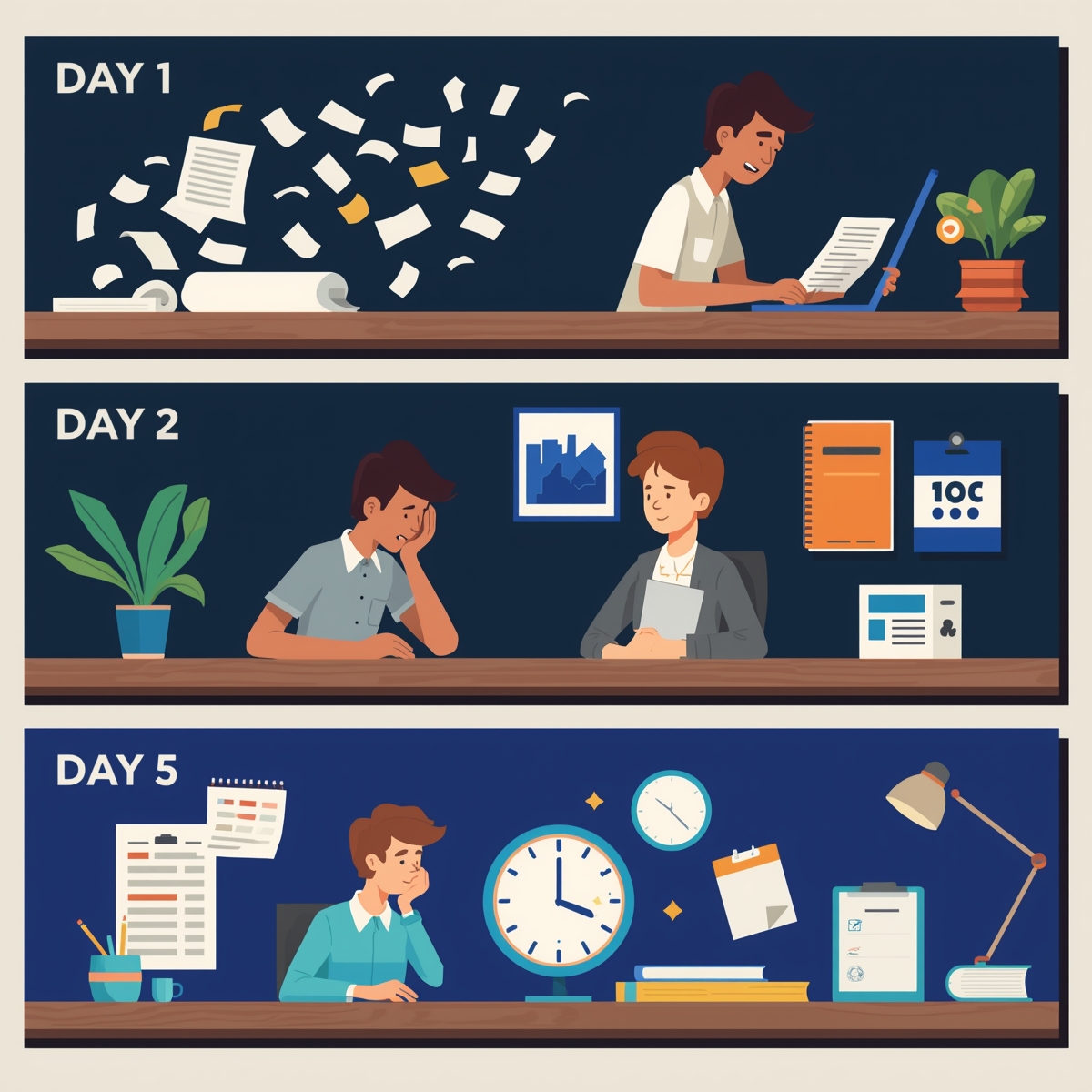
I used to start studying for finals three weeks early.
Not because I was organized—because I was terrified. I'd make color-coded schedules, watch "study with me" videos, and reorganize my notes three times. Then I'd still end up cramming at 2 AM the night before, surviving on energy drinks and panic.
My grades were fine. My mental health wasn't.
Last semester, I tried something different. Five days. One system. No all-nighters. I got my best exam scores ever—and I slept before midnight every night.
Here's exactly what I did.
Day 1: The Audit (2 Hours)
Morning: I gathered every piece of material for each exam. Syllabi, notes, past assignments, study guides. Everything dumped into one folder per subject.
Afternoon: I ran one prompt per subject through ChatGPT:
"Analyze my exam coverage: [paste syllabus/topics]. Identify the 3 highest-weight topics I should prioritize, 2 common mistake patterns students make on this exam, and a 4-day study schedule with specific tasks."
Why this works: Most students study what they like or what they already know. I studied what would actually move my grade.
The result: Instead of vague "study Chapter 5," I had specific daily targets. Micro-clarity beats macro-planning.
Day 2: The Knowledge Build (4 Hours)
Morning: I tackled my hardest subject first (math). Used a prompt that broke each concept into three levels—simple explanation, worked example, advanced application.
Afternoon: Switched to my memory-heavy subject (biology). Ran my notes through a prompt that turned them into 20 flashcards with mnemonics and a spaced repetition schedule.
Evening: 30-minute review of morning math. No new material.
The key: I wasn't re-reading. I was retrieving. Active recall beats passive review by 3x for memory retention. The prompts forced me to generate answers, not just recognize them.
Day 3: The Practice Exam (5 Hours)
Morning: Created a full mock exam for my hardest subject using a custom prompt. It generated 25 questions matching my professor's style—multiple choice, short answer, problem sets.
Afternoon: Took the exam under timed conditions. Brutal. I got 68%.
Evening: Ran my wrong answers through an error-analysis prompt. It didn't just give correct answers—it explained why I made each mistake and gave me specific practice problems for those gaps.
The psychology: Most students avoid practice exams because failure feels bad. But failing at home on Day 3 beats failing in the exam room on Day 5. I fixed my weak spots while I had time.
Day 4: The Essay Prep (3 Hours)
I had two essay-based finals. I wasn't writing full essays—I was building answer frameworks.
For each potential topic, I used a prompt that generated:
- 3 possible thesis statements
- 2 pieces of evidence per thesis
- 1 counterargument and rebuttal
The result: I walked in with mental blueprints, not memorized paragraphs. I could adapt to any question because I understood the structure, not just the content.
Time saved: 6+ hours of writing practice essays I'd never see again.
Day 5: The Confidence Check (2 Hours)
Morning: Light review only. Flashcards for biology formulas. Quick math problem sets for muscle memory. Glanced at essay frameworks.
Afternoon: Nothing. Rest. Actual rest—not guilt-scrolling while pretending to study.
Evening: Early sleep. Exam Day 1 tomorrow.
What Made This Possible
I didn't work harder. I worked with structure.
Every prompt I used had three things in common:
- Forced active engagement—I had to answer, generate, or solve
- Created specific outputs—flashcards, practice questions, error analysis
- Saved decision fatigue—no wondering "what should I study now?"
The prompts did the planning. I did the learning.
The Exact Prompts I Used
I didn't invent these from scratch. I refined them over three semesters of trial and error.
The five most critical ones—audit, knowledge build, practice exam, error analysis, essay framework—are part of my full system.
But you can start with three foundational prompts that handle 80% of finals prep:
✓ The Priority Auditor — figure out what actually matters
✓ The Active Recall Builder — turn notes into memory that sticks
✓ The Practice Exam Generator — simulate test conditions at home
[Download the Free AI Study Starter Pack →]
(3 copy-paste prompts, instant access)
When You Need the Full System
Those three prompts got me through my first "structured" finals week. But I kept hitting gaps:
- How do I build a Pomodoro schedule that matches my energy crashes?
- What about the subject where I missed three lectures?
- How do I break out of procrastination spirals when I can't start?
I built 59 prompts total for every finals situation:
- Homework Domination (13 prompts) — for last-minute assignment catch-up during exam week
- Study Smarter (11 prompts) — memory techniques, flashcards, concept mastery
- Essay & Writing (12 prompts) — frameworks, arguments, polish under pressure
- Test Preparation (11 prompts) — practice exams, error analysis, exam-day confidence
- Productivity & Focus (12 prompts) — schedules, motivation, procrastination killers
Each one is copy-paste ready. Fill in the [brackets]. Get instant structure.
[Get the Full 59+ AI Study Prompts (€8) →]
The Real Difference
My roommate did what I used to do. Started "studying" three weeks early. Spent 40+ hours in the library. Pulled two all-nighters. Got worse grades than me.
I spent 16 focused hours over 5 days. Slept 8 hours nightly. Scored higher.
The difference wasn't effort. It was eliminating wasted motion. No re-reading. No passive highlighting. No fake productivity that feels like studying but isn't.
Just targeted, active, structured learning—with AI handling the planning so my brain could handle the thinking.
Your Turn
Finals are coming. For you, maybe next week. Maybe next month. Maybe tomorrow.
You can do what I used to do: start early, panic anyway, cram until 3 AM, hope for the best.
Or you can do what worked: 5 days, specific system, sleep, better results.
Start with the free prompts. Test them on one subject. See if Day 1 feels different.
Then decide if you want the other 56 for the rest of exam season.
[Download the Free AI Study Starter Pack →]
(3 copy-paste prompts, instant access)
P.S. I post real-time study strategies and prompt experiments on @vorocto.ai. Follow if you want to see what I'm testing for next semester's finals.