
The Cognitive Reset: How to Identify and Rewire Negative Thought Loops for Lasting Well-being
Beyond Toxic Positivity: Mastering the Thinking Patterns That Protect Your Mental Health in 2026
The Introduction: The "Internal Narrative" Hook
Hello, incredible humans! Let’s perform a quick audit. If your thoughts were broadcasted on a loudspeaker today, would you be inspired by what you heard, or would you be exhausted?
In a world that thrives on "doom-scrolling" and high-stakes pressure, our brains often default to negativity bias—an evolutionary relic designed to keep us safe from predators, not to help us thrive in a digital age. Positive thinking patterns are the intentional habits of interpreting life through a lens of possibility, growth, and self-compassion. It’s not a "vibe"; it’s a biological survival strategy.
Section 1: The Cognitive Loop
The Biology of Belief
Our thoughts don't just stay in our heads; they create a physiological ripple effect. This is the foundation of Cognitive Behavioral Therapy (CBT). When you change a thought, you change your chemistry.
We can model the Mental Health Result (MH) as a function of our internal loops:
MH = MH = ∫ (Thought → Emotion → Behavior) dt
Every time you practice a positive thinking pattern, you are physically strengthening the neural pathways in your prefrontal cortex. You are literally building a "muscle" for hope.
Section 2: Identifying the "Glitch"
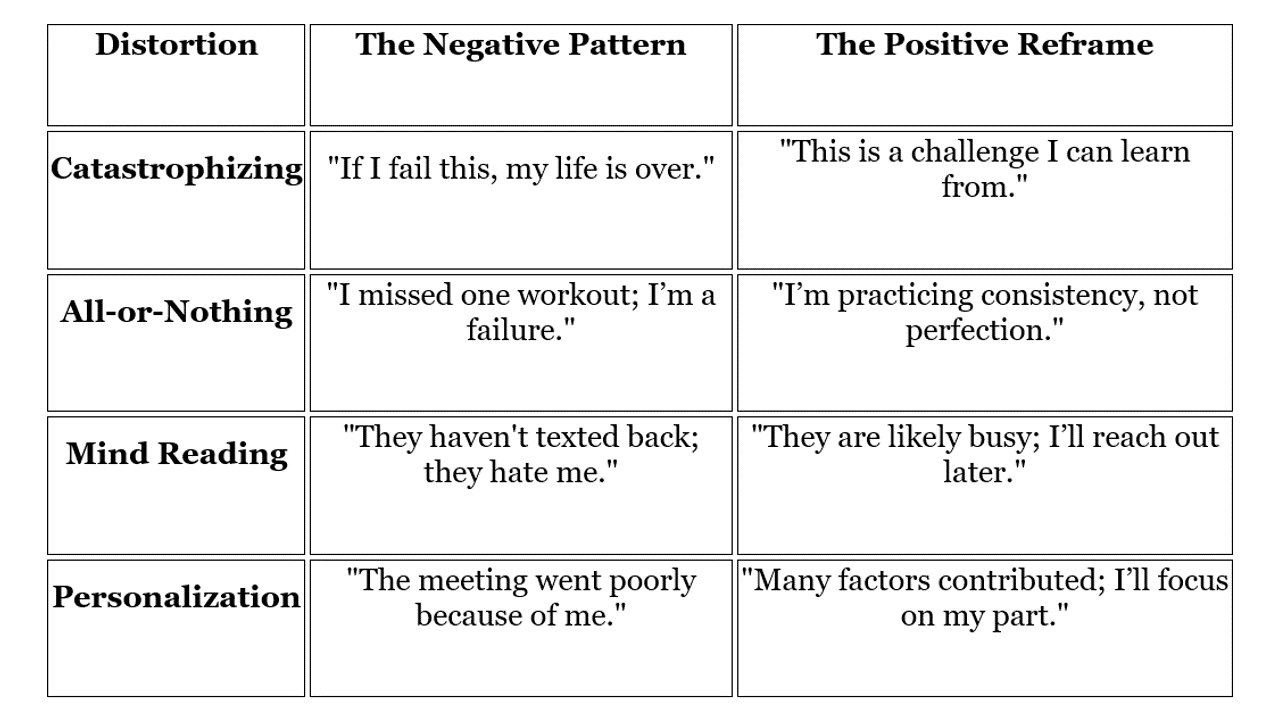
Common Cognitive Distortions
Before we can build new patterns, we have to identify the "bugs" in our current software. Are you falling into these traps?
Section 3: The 2026 Toolkit for Mental Mastery
1. The "Neural Reframing" Practice
When a negative thought arises, don't suppress it. Instead, act like a scientist. Ask: "Is this thought helpful? Is it 100% true?" Replace "I have to" with "I get to."
2. Selective Attention (The Reticular Activating System)
Your brain has a filter called the RAS. If you look for problems, you will find them. If you look for "glimmers" (micro-moments of joy), your brain will start to highlight them automatically.
3. The "Yet" Addition
Whenever you feel a sense of inadequacy, add the word "yet" to the end of the sentence. "I don't know how to manage this stress... yet." It shifts the brain from a fixed state to a growth state.
Section 4: The Impact on Mental Health
Resilience as a Result
Positive thinking patterns don't stop bad things from happening. They change how you recover from them.
- Reduced Cortisol: Lower stress levels mean better sleep and a stronger immune system.
- Increased Longevity: Studies show that optimists live significantly longer and have lower rates of cardiovascular disease.
- Social Magnetism: We are naturally drawn to those who radiate hope, strengthening the social connections vital for mental health.
Conclusion: The Choice is Yours
My resilient friends, your mind is the only place you have to live 24/7. Why not make it a beautiful place to be?
In 2026, mental health isn't just the absence of illness; it’s the presence of a resilient, positive internal narrative. You are the architect. You are the coder. You are the storyteller. Let’s make it a masterpiece.
What is one "Negative Loop" you are committing to reframing this week? Let’s put it out there and support each other in the comments! 👇
Comments ()