

Beyond "Fine": The 3 Daily Check-Ins That Reveal Your True Mental Health Status. (Your 4-Step Self-Assessment Guide)
Hey, future-focused friends! It's me, and let me ask you: When someone asks, "How are you?" do you automatically say, "Fine," even when your internal state feels like a 3/10? Of course you do!
The problem is, we are trained to check our physical health (temperature, blood pressure, weight) but we're given zero roadmap for checking our mental health. It’s like sailing without a map—you know you're lost, but you don't know how lost or which direction to steer.
In 2026, we are throwing out the guesswork. We’re moving beyond "I guess I'm fine" and installing an Inner Compass—a structured way to check your mental health level daily. This isn't about being clinical; it's about being conscious and empowered.
Ready to get your map? Let’s learn the 4 signals your body and mind are sending you every single day.
Section 1: Why "How Do I Know?" Is the Wrong Question
Shifting from Guesswork to Graded Awareness
The first step in self-assessment is accepting that mental health isn't a simple "on/off" switch. It exists on a spectrum. Most experts and therapists use a graded approach—you are somewhere between Flourishing and Struggling (and often, cycling between the two).
Instead of asking, "Am I sick?" let's ask, "Where am I on the Wellness-Illness Continuum today?"
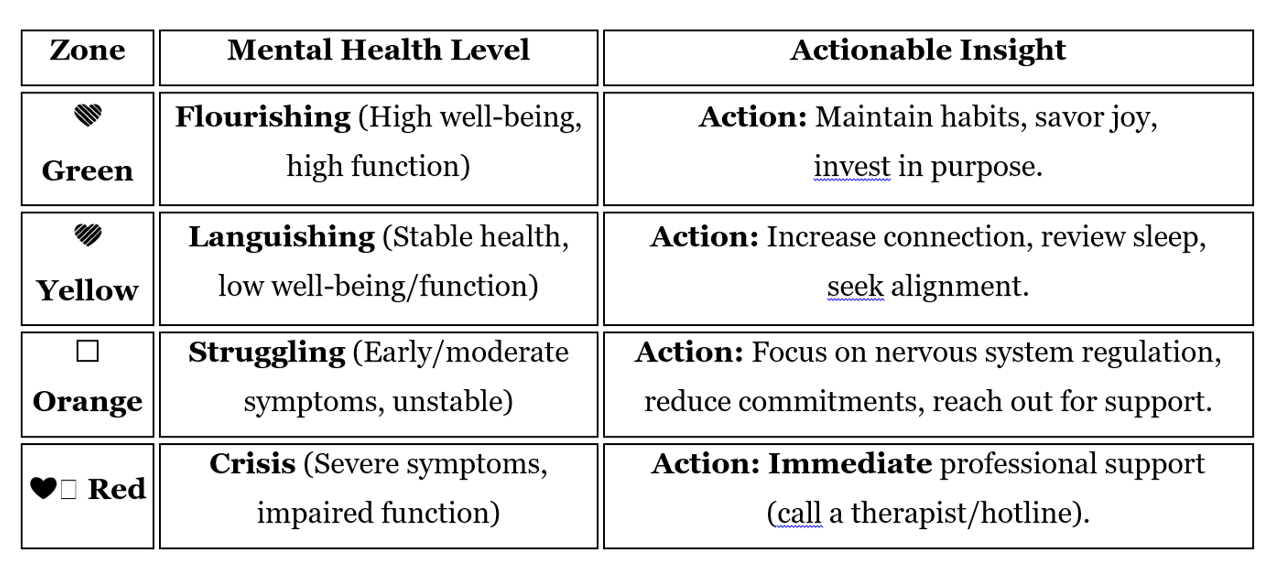
Your goal is to become intimately familiar with the signals that move you from Green to Yellow, and Yellow to Orange.
Section 2: Your 4-Step Daily Self-Assessment
To quickly and accurately gauge your level, focus on these four measurable and observable categories. This is your personal "Daily 4-Check."
Check 1: The Body Score (Physiological Signals)
Your body is the first warning system. Your mental health level is reflected in your physical systems.
· The Question: How is my physical engine running?
· The Scorecard:
o Sleep: How was the quality and duration? Did you wake up feeling rested?
o Energy: What is your sustained energy level today (not just caffeine highs)?
o Tension: Where are you holding tension? (Jaw, shoulders, stomach?) High, persistent tension is a major Orange Zone signal.
Check 2: The Action Score (Functional Signals)
This tracks your ability to perform daily tasks and manage life's demands.
· The Question: How is my capacity to execute tasks?
· The Scorecard:
o Focus: Can you concentrate for 15 minutes? Is your mind constantly racing or foggy?
o Initiation: How hard was it to start tasks (getting out of bed, opening your laptop)? High difficulty suggests a slide toward Languishing (Yellow).
o Avoidance: Are you delaying tasks that you normally handle easily?
Check 3: The Emotion Score (Affective Signals)
This is not about the presence of sadness, but the intensity and duration of your emotions.
· The Question: How stable and proportional are my reactions?
· The Scorecard:
o Proportionality: Did you overreact to a minor event? (A small issue leading to tears or intense anger.)
o Joy/Interest: Are you experiencing moments of joy or interest in things you usually love? Low interest is a critical signal.
o Irritability: Are you consistently more irritable or anxious than normal?
Check 4: The Connection Score (Relational Signals)
Your relationships are often the first casualty when your mental health dips.
· The Question: How connected and boundaried am I?
· The Scorecard:
o Isolation: Have you been withdrawing from loved ones or isolating yourself?
o Boundaries: Are you saying "yes" when you desperately want to say "no"? Overextending yourself often leads straight to Orange.
o Empathy: Is it hard to feel compassion for others or yourself?
Section 3: From Score to Strategy
Using Your Data to Design Your Day
You don't need a clinical diagnosis to act on your scores. If three or more checks show an Orange or Yellow signal, you need to implement your Resilience Protocol.
· If Yellow (Languishing): Double down on the fundamentals. Priority
· Action: Schedule Connection (call a friend) and Purpose (do one small task that aligns with your values).
· If Orange (Struggling): It's time to drastically reduce demands. Priority Action: Focus intensely on Nervous System Regulation (Box Breathing, deep stretching) and ask for help (delegate a task, tell a partner you need space).
Your Mental Health Level is a daily data point, not a permanent identity!
Conclusion: Claiming Your Inner Expertise
My incredible readers, the power to know your own mind is the highest form of personal sovereignty. Stop waiting for a crisis to check in. Start using your Daily 4-Check to proactively maintain your inner compass.
The most important step you can take today is to become the leading expert on your own well-being.
Which of the 4 Checks is your most reliable signal? Share your insight in the comments and let's create a community of self-aware experts!
Comments ()