

Stop Being Your Own Bully: The Science-Backed Guide to Positive Internal Narratives and Emotional Health
The Most Important Voice You Hear: How Kind Self-Talk Rewires Your Brain for Resilience and Mental Wellbeing in 2026
The Introduction: The "Hidden Roommate" Hook
Hello, incredible souls! I want you to imagine something. If you had a roommate who followed you around all day saying the things you say to yourself in your head—"You're so lazy," "You always mess this up," "Why did you say that?"—how long would you let them stay?
In the high-speed, high-comparison world of February 2026, our "Inner Critic" has become a master of the "Negative Loop." But kind self-talk isn't about being delusional or "soft." It is about Cognitive Accuracy. It’s about becoming a supportive mentor to yourself rather than a relentless drill sergeant.
Section 1: The Neurobiology of the "Inner Critic"
The Cortisol Connection
When you speak to yourself harshly, your brain doesn't distinguish between a threat from the outside and a threat from within. Your Amygdala (the fear center) fires, releasing cortisol and adrenaline.
We can model your Mental Equilibrium (ME) as a function of your internal tone:
ME=∫𝑡2𝑡1 Self-Compassion / Critical Stimuli 𝑑𝑡
If the denominator (Critical Stimuli) is constantly high, your equilibrium collapses. By shifting to kind self-talk, you activate the Parasympathetic Nervous System, allowing your prefrontal cortex—the part of you that solves problems and feels joy—to come back online.
Section 2: The "Inner Bully" Audit
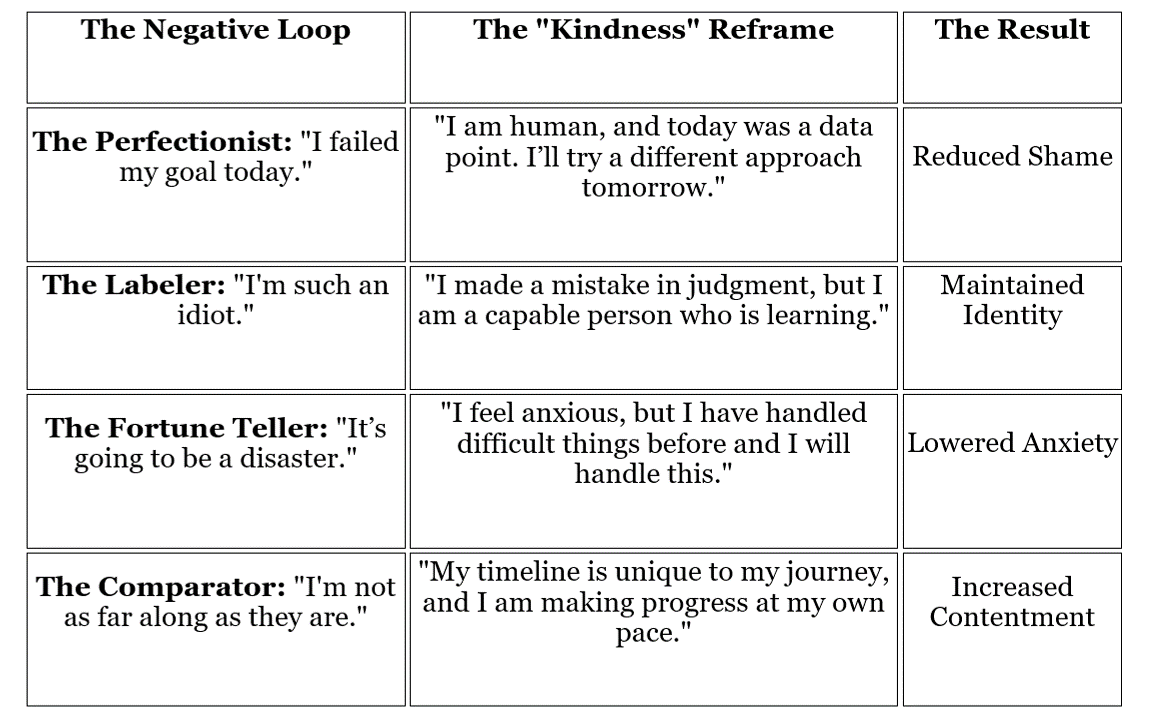
How do we move from criticism to kindness? We have to identify the "glitches" in our software. Are you using these 2026 "Mind-Traps"?
Section 3: The 2026 "Self-Compassion" Protocol
How to Rewire Your Narrative
- The "Third-Person" Technique: When you're spiraling, address yourself by your name. Instead of "I'm failing," say, "[Name], you're having a hard time right now, and that's okay." Research shows this creates "psychological distance" and lowers emotional intensity.
- The "Best Friend" Filter: Before you finish a thought about yourself, ask: "Would I say this to my best friend if they were in my shoes?" If the answer is no, the thought is invalid.
- The Neural "Thank You": When your inner critic pops up to "warn" you about something, say: "Thank you for trying to keep me safe, but I’ve got this." It acknowledges the brain's protective intent without letting it drive the car.
Section 4: The Impact on Your Life
Kindness as a Performance Multiplier
When you talk to yourself kindly, your mental wellbeing isn't the only thing that improves.
- Creativity Spikes: A safe brain is a creative brain.
- Resilience Builds: You recover from setbacks faster because you aren't wasting energy on self-flagellation.
- Social Health Improves: The more grace you give yourself, the more grace you naturally extend to others.
Conclusion: Make Your Mind a Home
My resilient friends, you are the only person you are guaranteed to spend every second of the rest of your life with.
In February 2026, let’s make a pact. Let’s stop the "Inner Bully" and start the "Inner Mentor." Speak to yourself with the same love you give to the world. Because you cannot pour from a cup that you are constantly poking holes in.
What is one kind thing you can say to yourself right now? Let’s fill the comments with some "Self-Love Affirmations"! 👇
Comments ()