

Beyond Self-Care: 5 Science-Backed Strategies to Build Radical Emotional Resilience
The Art of the Bounce: Why Emotional Strength is the #1 Mental Health Metric of 2026 (And How to Build It)
The Introduction: The "Glass vs. Rubber" Hook
Hello, vibrant souls! Imagine dropping a glass ornament and a rubber ball. One shatters into a thousand pieces; the other hits the floor, absorbs the impact, and jumps back up.
In our hyper-accelerated 2026 lives, many of us feel like that glass ornament—one more "ping," one more deadline, or one more piece of bad news away from cracking. But Emotional Resilience is the process of turning your mind into that rubber ball. It’s the ability to adapt to stressful situations and "bounce forward" from adversity.
Section 1: The Physics of the Bounce
The Resilience Coefficient
Resilience isn't just a "feeling"—it’s a dynamic equilibrium. We can model your Resilience Coefficient (R) using this relationship:
R = (Adaptive Capacity × Social Support) / Perceived Stress
To increase your R, you don't always need to lower the stress (sometimes that's impossible!). Instead, we focus on maximizing your Adaptive Capacity—your internal toolkit.
Neuroplasticity in Action
When you practice resilience, you are training your brain to switch from the "fight-or-flight" amygdala response to the "logical-problem-solving" prefrontal cortex. You are literally rewiring your hardware for peace.
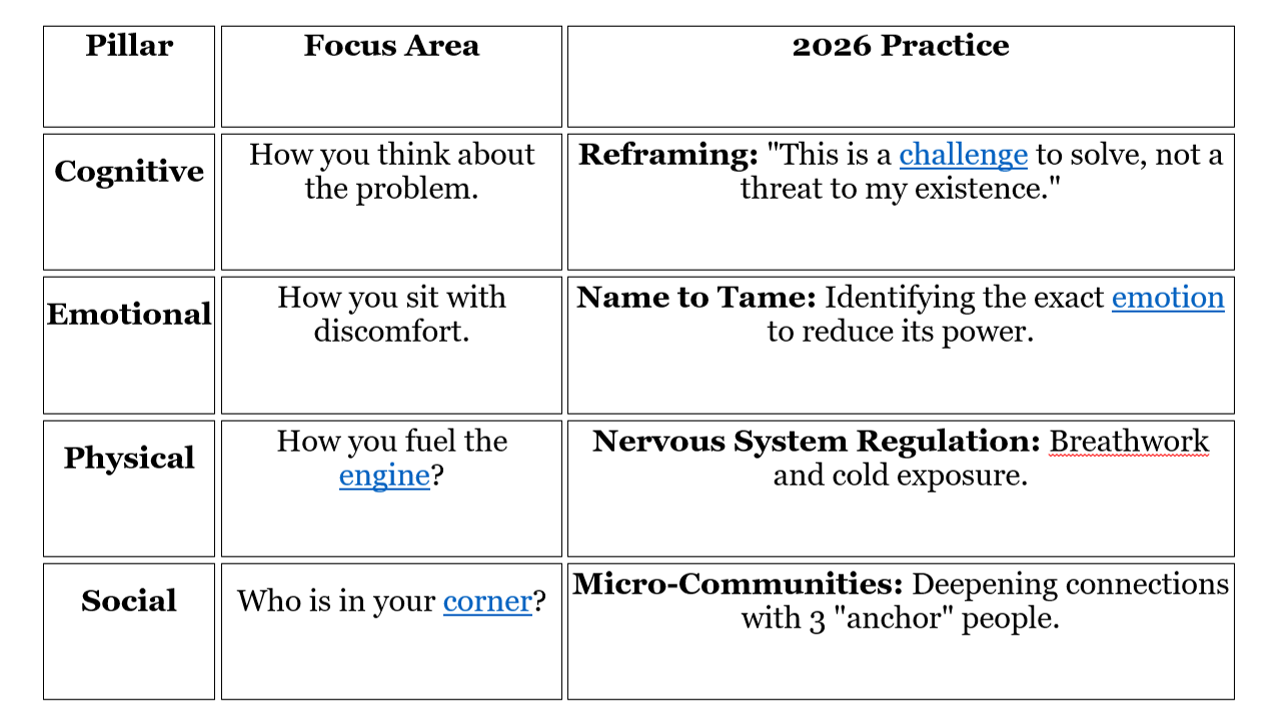
Section 2: The Four Pillars of Resilience
To build a mind that lasts, we need to address these four core areas:
Section 3: The "Resilience Protocol"
3 Steps to Build Your Mental Muscle
- Embrace the "Pivot" Mindset: When things go wrong, give yourself 60 seconds to feel the frustration (don't suppress it!). Then, ask: "What is the one thing I can control right now?" This shifts you from "Victim" to "Architect."
- Practice "Stress Inoculation": Don't wait for a crisis. Take "micro-risks" daily—speak up in a meeting, try a new skill, or take a cold shower. You are teaching your nervous system that "uncomfortable" doesn't mean "unsafe."
- The "Glimmer" Search: For every "trigger" you experience, find a "glimmer"—a micro-moment of beauty or safety. This balances your brain's natural negativity bias.
Section 4: Why Resilience is Your 2026 Superpower
The Ripple Effect
Emotional resilience doesn't just keep you from breaking; it changes how you show up for the world.
- In Leadership: You stay calm when the market shifts.
- In Parenting: You model emotional regulation for the next generation.
- In Self: You stop fearing the future because you know you can handle whatever it brings.
Conclusion: You Are Built to Last
My resilient friends, the storm isn't going to stop. The world of 2026 is beautiful, but it is chaotic. Your job isn't to stop the wind; it's to build a better sail.
You have survived 100% of your hardest days so far. That’s a pretty incredible track record. Now, let’s start building the version of you that doesn't just survive the next one, but grows because of it.
What is one "micro-win" from a difficult situation you've faced recently? Let’s celebrate our resilience in the comments! 👇
Comments ()