
Why Your 'Normal' Stress Level is Actually Chronic—And 5 Ways to Reset Your Nervous System Today
The Burnout Blueprint: Understanding Chronic Stress and the Science-Backed Path to Reclaiming Your Mental Health in 2026
The Introduction: The "Boiling Frog" Hook
Hello, vibrant souls! There’s an old story about a frog in a pot of water. If you drop him in boiling water, he jumps out. But if you turn the heat up slowly, degree by degree, he doesn't notice until it's too late.
In 2026, we are that frog.
We have normalized "The Redline." We think being constantly "on," constantly alerted, and constantly tired is just the price of admission for a successful life. But Chronic Stress isn't a badge of honor; it’s a biological debt that your mental health eventually has to pay.
Section 1: The Physics of "The Load"
Acute vs. Chronic: Know the Difference
Our bodies were designed for Acute Stress—the "Lion in the bushes" moment. Your heart races, cortisol spikes, you survive, and then you recover.
Chronic Stress is the lion moving into your guest bedroom. It never leaves.
We can look at your Systemic Load (SL)—the total impact on your mental health—through this relationship:
𝑆𝐿 = ∑ (Micro-stressors× Duration) / Recovery Index
The Math of Burnout: If your "Recovery Index" (sleep, mindfulness, connection) is low while your stressors and duration are high, your Systemic Load becomes unsustainable. Your brain stays in the "survival" amygdala and loses access to the "thriving" prefrontal cortex.
Section 2: The Signs You’re Ignoring
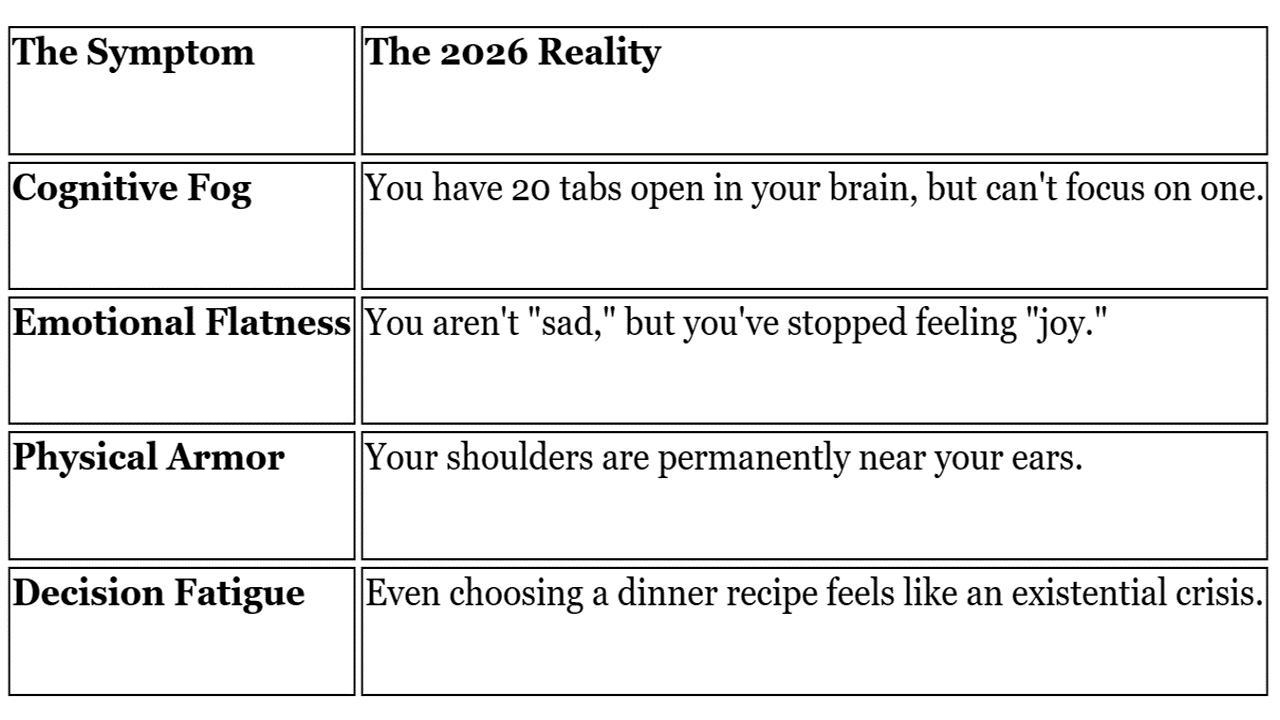
Chronic stress is a master of disguise. It doesn't always look like a panic attack; sometimes it looks like "efficiency."
Section 3: The "Nervous System Reset" Protocol
Moving from Survival to Sovereignty
- Digital Decoupling: In 2026, our phones are "stress-delivery devices." Implement a "No-Ping Zone" for the first and last hour of your day. Protect your brain's transition states.
- The "Sigh" Science: Use the Physiological Sigh—two quick inhales through the nose followed by a long exhale through the mouth. This is the fastest biological "hack" to offload carbon dioxide and signal your vagus nerve to calm down.
- Micro-Recovery: Don't wait for a vacation. Practice "The Rule of 20": Every 20 minutes, look at something 20 feet away for 20 seconds. It breaks the visual and mental "lock" of chronic focus.
Section 4: The Power of "Selective Inefficiency"
The Radical Act of Doing Less
The most popular influencer move in 2026 isn't doing more—it's doing better. Chronic stress thrives on the "Busy Trap."
The Pro-Tip: Identify your "One Big Thing" for the day. If you do that, you've won. Everything else is a bonus. By reducing the volume of tasks, you increase the quality of your mental presence.
Conclusion: You Are Not a Machine
My resilient friends, your value is not measured by your output when you are running on fumes. You are a biological being that requires seasons of rest and cycles of recovery.
Chronic stress is a signal, not a destination. It’s your soul’s way of saying, "I need you to come back to center." Listen to the whisper before it becomes a scream. Reclaiming your mental health starts with the brave decision to turn the heat down on the pot.
What is one "micro-stressor" you are committing to removing from your life this week? Let’s share our boundaries in the comments! 👇
Comments ()