

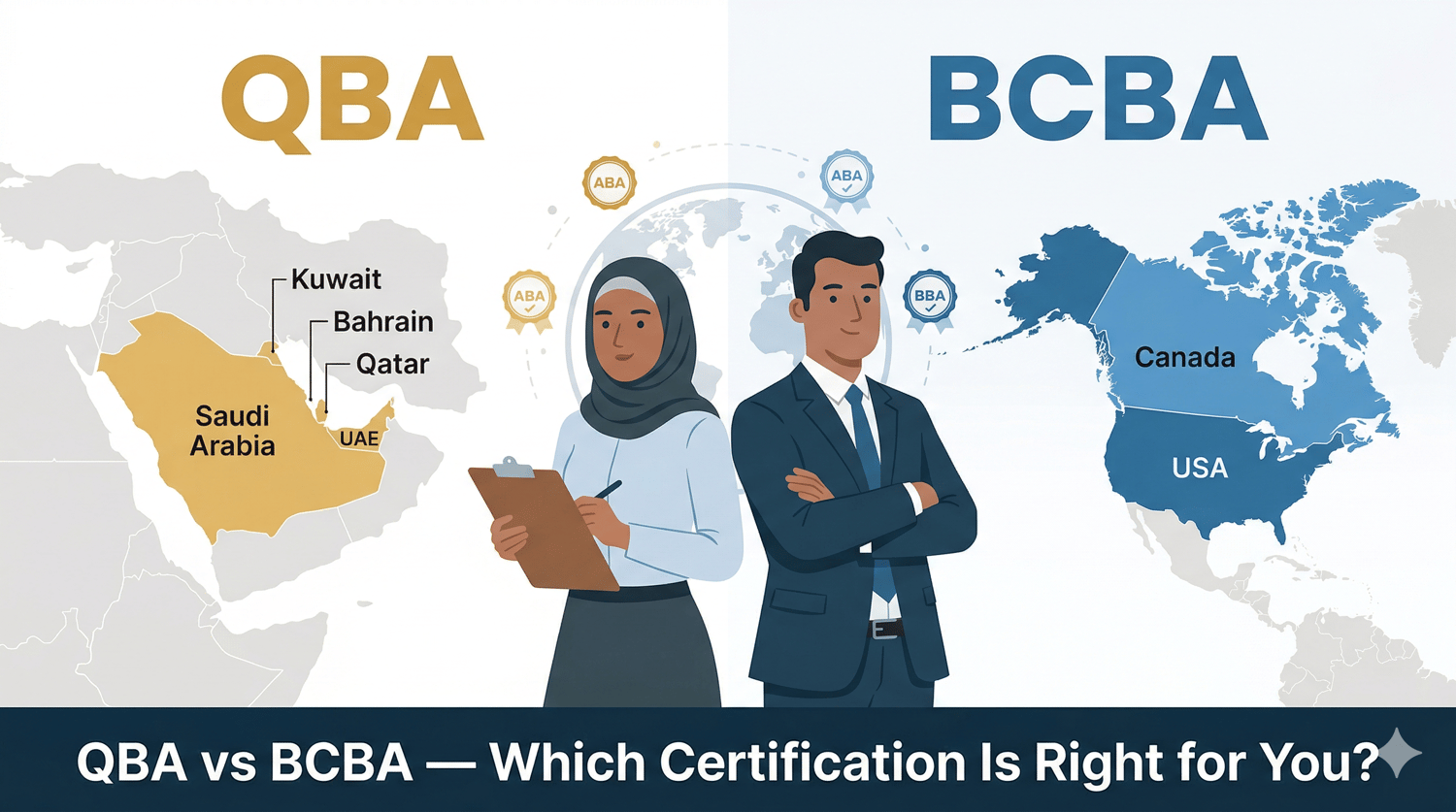
Two Certifications. One Career. Choose Wisely.
You've done the clinical hours. You know your ABA. But now you're staring at two credentials—the QBA certification and the BCBA certification—and nobody's giving you a straight answer about which one actually matters where you live and work.
Not "globally." Not "in theory. "Where you are.
That's the gap most comparisons miss. They either worship the BCBA without context, or they dismiss the QBA without understanding the Gulf market. You deserve better than that.
If you've already decided the QBA exam is your path and you want a proper QBA study guide with full mock exams, head straight to aba-practice.com/qba-exam-prep-bundle—Arabic-language materials included. If you are still deciding, please continue reading. This will sort it out.
What Is the BCBA — and Who Is It Really For?
The Board Certified Behavior Analyst (BCBA) credential comes from the Behavior Analyst Certification Board (BACB), which has been the leading organization in ABA since 1998. It is, without question, the most recognized ABA certification in North America.
To earn it, you need:
- A master's degree or higher in behavior analysis or a related field
- Coursework aligned with the BACB 6th Edition Task List
- 2,000 supervised fieldwork hours
- A passing score on the BCBA exam — 185 questions, four hours, nine content domains
Here's the number that matters: first-time pass rates hover around 50–60%. That's not a scare tactic — it's a signal. The BCBA exam punishes candidates who relied on passive reading and light BCBA practice questions. You need a structured BCBA study guide, timed BCBA mock exams, and serious domain-by-domain drilling to walk in ready.
What Is the QBA — And Why Does It Exist?
The Qualified Behavior Analyst (QBA) credential is issued by the Qualified Applied Behavior Analysis Credentialing Board (QABA). It was built to solve a real problem: thousands of skilled ABA professionals working internationally who have strong clinical foundations but no realistic path to a BACB-approved master's program.
QBA certification requirements:
- A bachelor's degree or higher
- Coursework through a QABA-affiliated provider
- Verified supervised experience hours
- A passing score on the QBA exam
And let's be direct—the QBA is not the easy option. It tests real competencies: measurement, behavior change procedures, reinforcement principles, ethics, and supervision. Candidates who treat it casually fail. Those who invest in a solid QBA study guide and work through QBA mock exams under timed conditions pass. Same logic as any serious board exam.
What the QBA removes is the master's-level barrier — which, for practitioners in the Gulf, Southeast Asia, and Latin America, is a genuine and legitimate obstacle, not an excuse.
Global Reach: Where Each Credential Actually Opens Doors
This is the part most articles get wrong.
The BCBA is built for North America. Most US states require BCBA licensure to practice independently. Insurance billing for ABA therapy for autism requires a BCBA supervisor. If you're heading to the US, Canada, or Australia — even in a telehealth supervision role — the BCBA isn't optional. It's the price of entry.
The QBA owns the Gulf. In Saudi Arabia, Qatar, the UAE, Kuwait, and Bahrain, clinics, special education centers, and government ASD programs hire QBA-credentialed professionals for supervisory roles every day. QABA's footprint is also growing steadily across Southeast Asia and Latin America. Employers in these markets know what the QBA is, respect it, and hire for it.
If you're based in the Gulf with no near-term plans to relocate to North America, the QBA isn't a backup plan. It's the strategically correct credential for your market—and a proper QBA study guide and QBA practice test bundle puts you ahead of most candidates who walk in underprepared.
The 2026 Reality Nobody Talks About
The ABA field across the Gulf is professionalizing fast. Governments are funding ASD intervention programs at scale. Hospitals and private schools are building formal behavior analysis departments. And Arabic-speaking ABA markets — especially in the Gulf — have a credentialed practitioner shortage that isn't going away soon.
Five years ago, some employers looked the other way on credentials. That window is closing. Today, not having a recognized ABA certification is becoming a genuine career ceiling — even in markets where the BCBA isn't yet the default. The question isn't whether to get certified. It's which certification and how fast.
Which Exam Is Actually Harder?
Both are hard. Neither is a vocabulary test.
The BCBA exam hits you with application-based scenario questions—clinical situations where you have to identify the right behavior analytic response under ethical and practical constraints. Candidates who memorized definitions and skipped BCBA mock exams get blindsided consistently.
The QBA exam works the same way. The most common feedback from candidates who fail? " I didn't expect so many case-based questions." The exam tests whether you can apply ABA principles in real clinical contexts — not whether you can spell "differential reinforcement."
The preparation strategy for both is identical:
- A structured ABA study guide covering every domain
- Full-length mock exams under real timed conditions
- Detailed answer rationale — especially for questions you got right
- Spaced repetition across weak areas until they're not weak anymore
The Best QBA & BCBA Study Guides and Mock Exams for 2026
Most study materials on the market fall into one of two traps: either they're too shallow—flashcard apps and YouTube summaries that build familiarity without understanding—or they're too academic, written for researchers rather than practitioners preparing for a timed exam.
What a genuine ABA exam study guide needs to do:
- Mirror the actual exam format—application-based, not definition-based
- Cover every competency area in the QABA or BACB task list
- Explain why answers are right or wrong, not just flag them
- Include full-length mock exams that simulate real test timing and pressure
- Offer Arabic-language ABA study materials for Gulf-based candidates who process complex content better in their first language
Our QBA Study Guide & Mock Exam Bundle at aba-practice.com/qba-exam-prep-bundle was built with all of this in mind. The QBA mock exams reflect the actual QABA task list structure. The QBA practice questions are written in application format—the same style you'll face on test day. And Arabic-language support is fully integrated throughout, not a translated afterthought.
So—QBA or BCBA?
Here's the clean answer:
Go with the BCBA if:
- You're planning to work in the US, Canada, or Australia
- You have or are completing a master's degree in behavior analysis
- Your role requires BCBA licensure for supervision billing or legal practice
Go with the QBA if:
- You're based in the Gulf, Middle East, Southeast Asia, or Latin America
- You hold a bachelor's degree and want a recognized ABA certification now
- You want to build your career in a market where the QBA is the respected standard
The practitioners who pass on their first attempt aren't more talented. They're more prepared. They used a proper study guide. They took multiple mock exams before test day. They knew their weak domains and fixed them before walking into the testing center.
If the QBA exam 2026 is your target, you already know what to do next.
Start with the right materials: aba-practice.com/qba-exam-prep-bundle—full QB Mock exams, domain-by-domain QBA practice questions, and Arabic-language study support built for professionals across the Gulf. You've already put in the clinical work. Now make sure your exam score shows it.
Disclaimer: ABA Practice is an independent provider of exam preparation materials. We are not affiliated with, endorsed by, or sponsored by the BACB®, QABA®, or IBAO®.