

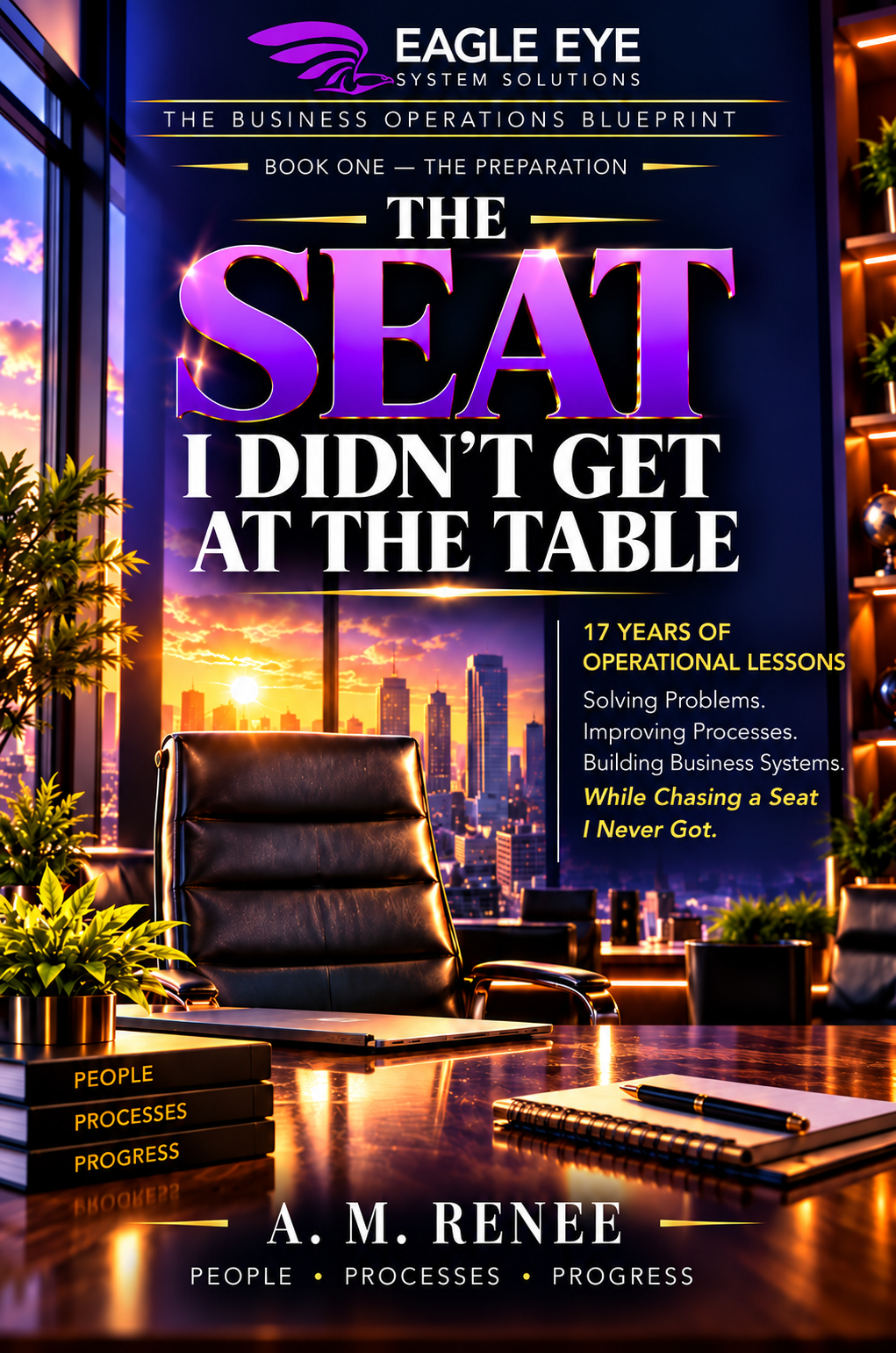
The Seat I Didn't Get at the Table | Book One: The Preparation
The Seat I Didn't Get at the Table
17 Years of Business Operations Lessons, Workplace Problem-Solving & Process Improvement
What if the experience you gain solving everyday workplace problems becomes more valuable than the position you're working toward?
Every business has challenges. Inefficient workflows, disconnected departments, undocumented procedures, underused software, and employees who rely on one person for critical information can create delays, confusion, unnecessary costs, and operational risks.
But solving these problems requires more than recognizing that something isn't working.
It requires understanding how a business operates, how people and departments depend on one another, and how to develop systems and processes that support consistent performance.
Drawing from seventeen years of hands-on business operations experience, The Seat I Didn't Get at the Table explores real workplace challenges and the practical lessons learned while identifying problems, improving processes, implementing systems, and supporting daily business operations.
What You'll Learn
1. How to Identify Operational Problems
Recognize inefficiencies, recurring bottlenecks, duplicated work, communication gaps, and everyday issues that prevent businesses from operating effectively.
2. Why Understanding the Entire Workflow Matters
Learn why problems affecting one department may originate somewhere else and why understanding how information and responsibilities move between teams is essential.
3. The Importance of Standard Operating Procedures (SOPs)
Explore how documenting procedures, organizing responsibilities, and preserving operational knowledge can improve consistency, accountability, and employee training.
4. How to Recognize Underused Business Technology
Understand why businesses sometimes invest in software without using its full capabilities and how evaluating existing systems can reveal opportunities for improvement.
5. How to Reduce Dependency on One Employee
Discover the operational risks that develop when critical business knowledge exists primarily in one person's memory and why knowledge sharing and documentation matter.
6. How to Improve Communication Between Departments
Explore the importance of clearly defined responsibilities, reliable information sharing, and coordinated processes across departments.
7. How to Build More Organized and Accountable Operations
Understand how structured workflows, clear procedures, tracking systems, and defined responsibilities can help reduce confusion and improve daily performance.
8. How to Approach Workplace Problems With a Problem-Solving Mindset
Learn to look beyond immediate symptoms, investigate how work actually gets done, and consider practical improvements before assuming that additional employees or resources are necessary.
The Experience Behind the Lessons
For seventeen years, A. M. Renee worked within one organization, developing an understanding of how business operations function behind the scenes.
Through daily challenges, changing responsibilities, and opportunities to improve systems, she gained practical knowledge in process development, operational organization, software implementation, and workplace problem-solving.
Behind that experience was the pursuit of a leadership opportunity that never came.
What initially seemed like a professional disappointment would eventually reveal a different purpose: the knowledge developed along the way was preparing her for opportunities beyond the organization where she had spent seventeen years.
This book brings those operational lessons together so others can recognize similar challenges and identify opportunities for improvement within their own workplaces.
Who This Book Is For
- Business owners looking to understand and improve daily operations.
- Managers responsible for departments, workflows, and employee performance.
- Supervisors seeking better organization and accountability.
- Professionals who want to develop stronger operational problem-solving skills.
- Aspiring leaders interested in learning how businesses function beyond their individual job responsibilities.
The Key Message
Strong business operations are built through intentional processes, effective systems, and practical problem-solving.
The knowledge gained from solving everyday workplace problems can become the foundation for stronger teams, better systems, and more effective organizations.
PEOPLE • PROCESSES • PROGRESS
The Eagle Eye Blueprint — We Provide the Blueprint. You Build the Structure.
Written by A. M. Renee
Format: Digital Book (PDF)