




BRIDGE -Durabilité et Vieillissement Des Matériaux Polymères-(Free DEMO - MultiLanguage)
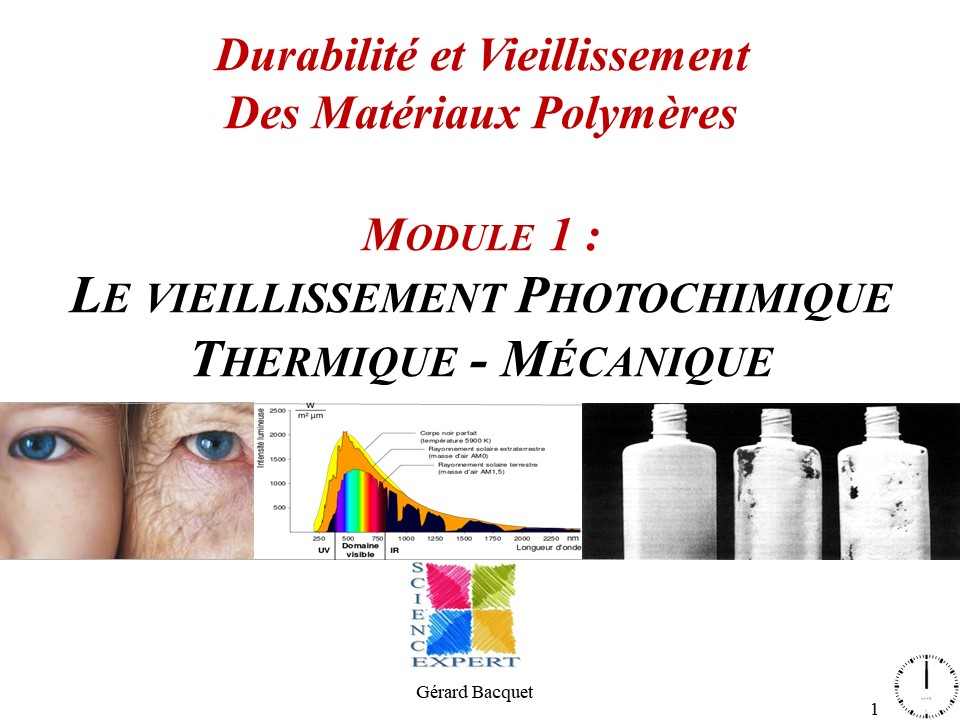
Le vieillissement des matériaux polymères : mécanismes, dégradation et stabilisation
Comprendre les mécanismes de vieillissement des polymères, identifier les facteurs de dégradation et maîtriser les stratégies permettant d'améliorer leur durabilité.**
Présents dans de nombreux secteurs industriels, les matériaux polymères sont soumis à différentes agressions environnementales susceptibles de modifier leurs propriétés au cours du temps.
Comment la lumière, la chaleur et l'oxygène provoquent-ils leur dégradation ? Quelles sont les différences entre vieillissement chimique, physique et biologique ? Comment protéger les matériaux et anticiper leur durée de vie ?
Ce cours d'environ cinq heures propose une approche scientifique approfondie des mécanismes de vieillissement des polymères. Il explore les réactions de dégradation, les relations entre structure moléculaire et propriétés, les phénomènes de biodégradation ainsi que les stratégies de stabilisation utilisées dans l'industrie.
A travers un parcours scientifique en neuf chapitres, l'objectif est de comprendre les mécanismes fondamentaux pour mieux analyser, caractériser et maîtriser la durabilité des matériaux polymères.
1. Le vieillissement photochimique
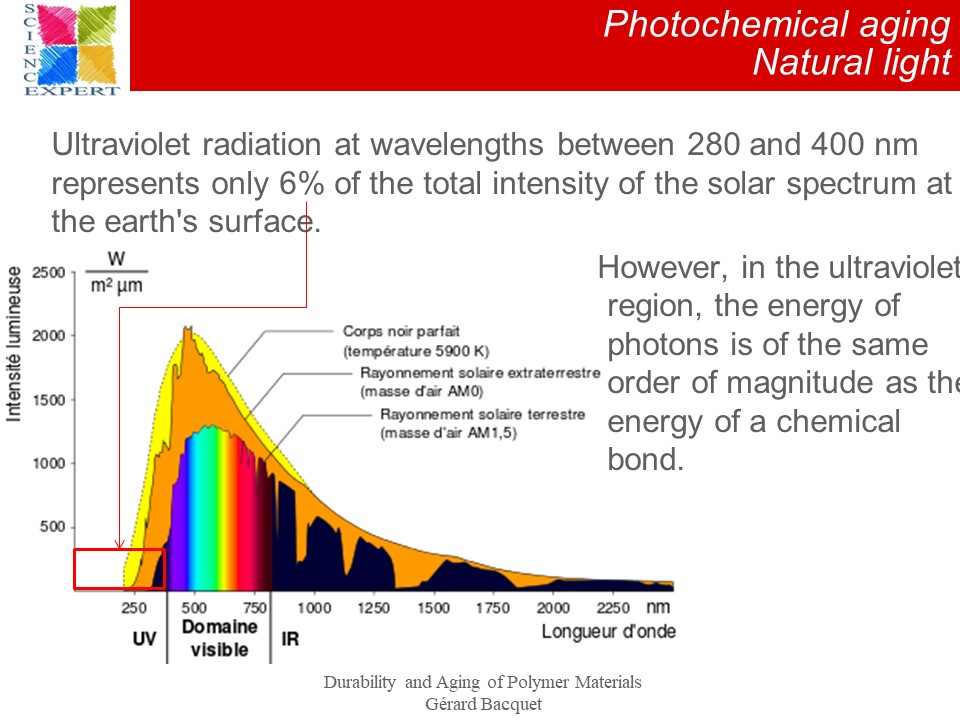
Étude de l'action des rayonnements UV, de la photolyse, de la formation des radicaux libres et des principales réactions photochimiques, notamment Norrish I et II et photo-Fries.
2. Le vieillissement thermochimique
Influence de la température sur la stabilité des polymères, mécanismes de dépolymérisation et exemples de matériaux industriels : PMMA, PTFE, polyamides-imides et PEEK.
3. Le vieillissement thermo-oxydatif
Compréhension des réactions radicalaires en chaîne, de la formation des hydroperoxydes, de la diffusion de l'oxygène et des conséquences de l'oxydation sur les propriétés des polymères.
4. Le vieillissement physique
Étude des échanges de matière, de la plastification, de la perte de plastifiants, du fluage et des phénomènes de fissuration sous contrainte, notamment l'ESCR.
5. Le vieillissement biologique et la biodégradabilité
Distinction entre fragmentation, bioassimilation et minéralisation. Présentation des mécanismes aérobies et anaérobies et différence entre polymères biosourcés et biodégradables.
6. Les grandes familles de biopolymères
Découverte des PLA, PLGA, PHA, polysaccharides, protéines et caoutchouc naturel, ainsi que des relations entre structure moléculaire et comportement en dégradation.
7. Dégradation et fin de vie des polymères
Photodégradation, fragmentation, polymères oxodégradables et photocatalyse par le dioxyde de titane, avec des exemples d'applications aux surfaces autonettoyantes.
8. Les additifs de stabilisation et la durabilité
Étude des stabilisants UV, HALS, antioxydants, antiozonants, agents antimicrobiens et antistatiques. Présentation des mécanismes de réticulation par irradiation, peroxydes et silanes, notamment les procédés Sioplas et Monosil.
9. Caractérisation et prédiction du vieillissement
Approche de l'évaluation du comportement des matériaux polymères et de l'étude de leur évolution au cours du temps.
À l'issue de ce cours, vous serez capable de :
- Comprendre les principaux mécanismes de vieillissement et de dégradation des polymères.
- Expliquer les réactions photochimiques et thermo-oxydatives.
- Distinguer vieillissement chimique, physique et biologique.
- Identifier les principales familles de biopolymères.
- Analyser les conséquences du vieillissement sur les propriétés des matériaux.
- Comprendre le rôle des additifs stabilisants et des procédés de réticulation.
- Appréhender les méthodes d'étude et de caractérisation de la durabilité.
Ce cours s'adresse aux :
- Étudiants de Master et doctorants** en chimie, science des matériaux et génie des procédés.
- Ingénieurs R&D et formulateurs** des secteurs des polymères, plastiques, peintures, revêtements et matériaux industriels.
- Enseignants et chercheurs** souhaitant approfondir les mécanismes de vieillissement.
- Professionnels de l'industrie** impliqués dans la formulation, la transformation et la caractérisation des matériaux.
BRIDGE : une formation scientifique conçue pour être accessible à tous
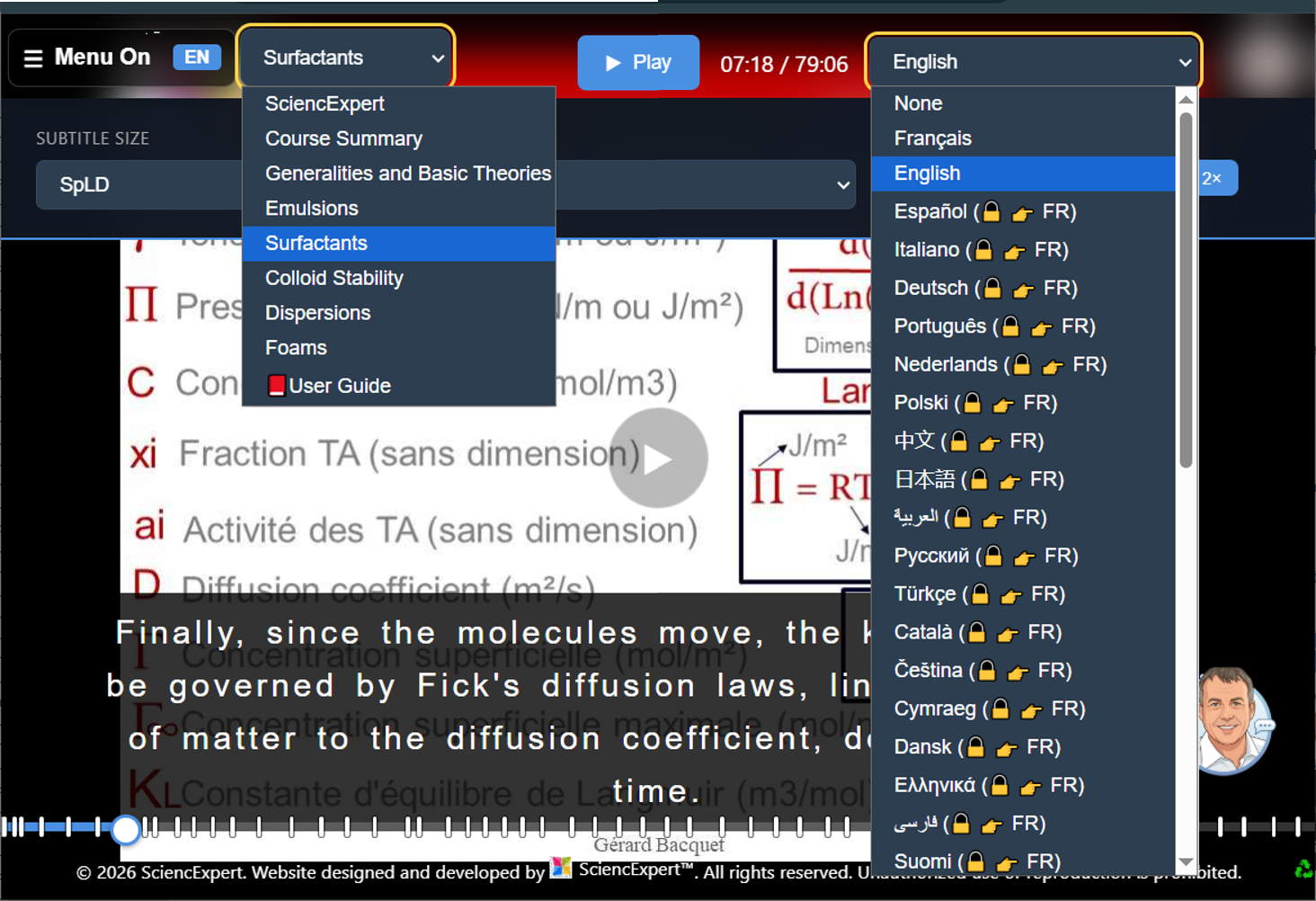
Ce cours s'inscrit dans l'initiative **BRIDGE – Bridging Research and Inclusive Digital Education**, qui place l'inclusivité au cœur de la formation scientifique universitaire.Son ambition est de rendre les connaissances scientifiques spécialisées accessibles au plus grand nombre, en intégrant les technologies d'assistance et les possibilités de personnalisation de l'apprentissage.
Le dispositif BRIDGE repose sur six piliers complémentaires :
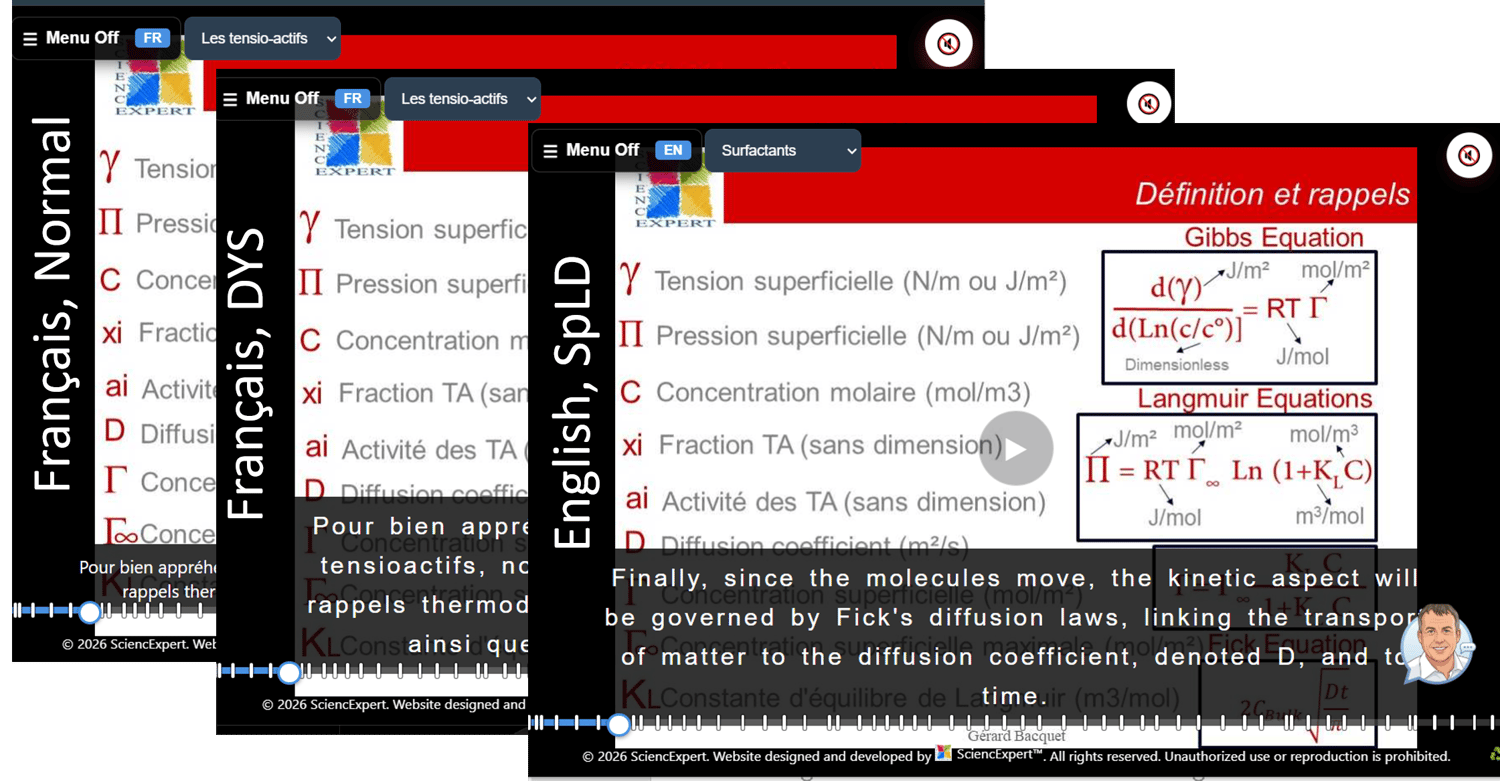
Accessibilité cognitive : Personnalisation des polices de caractères, des contrastes et de la taille des sous-titres afin de faciliter la lecture et l'apprentissage, notamment pour les personnes présentant des troubles spécifiques des apprentissages (DYS).
Accessibilité audio : Possibilité d'écouter les contenus grâce à la restitution audio et aux présentations multilingues, facilitant notamment l'accès aux connaissances pour les personnes présentant une déficience visuelle.
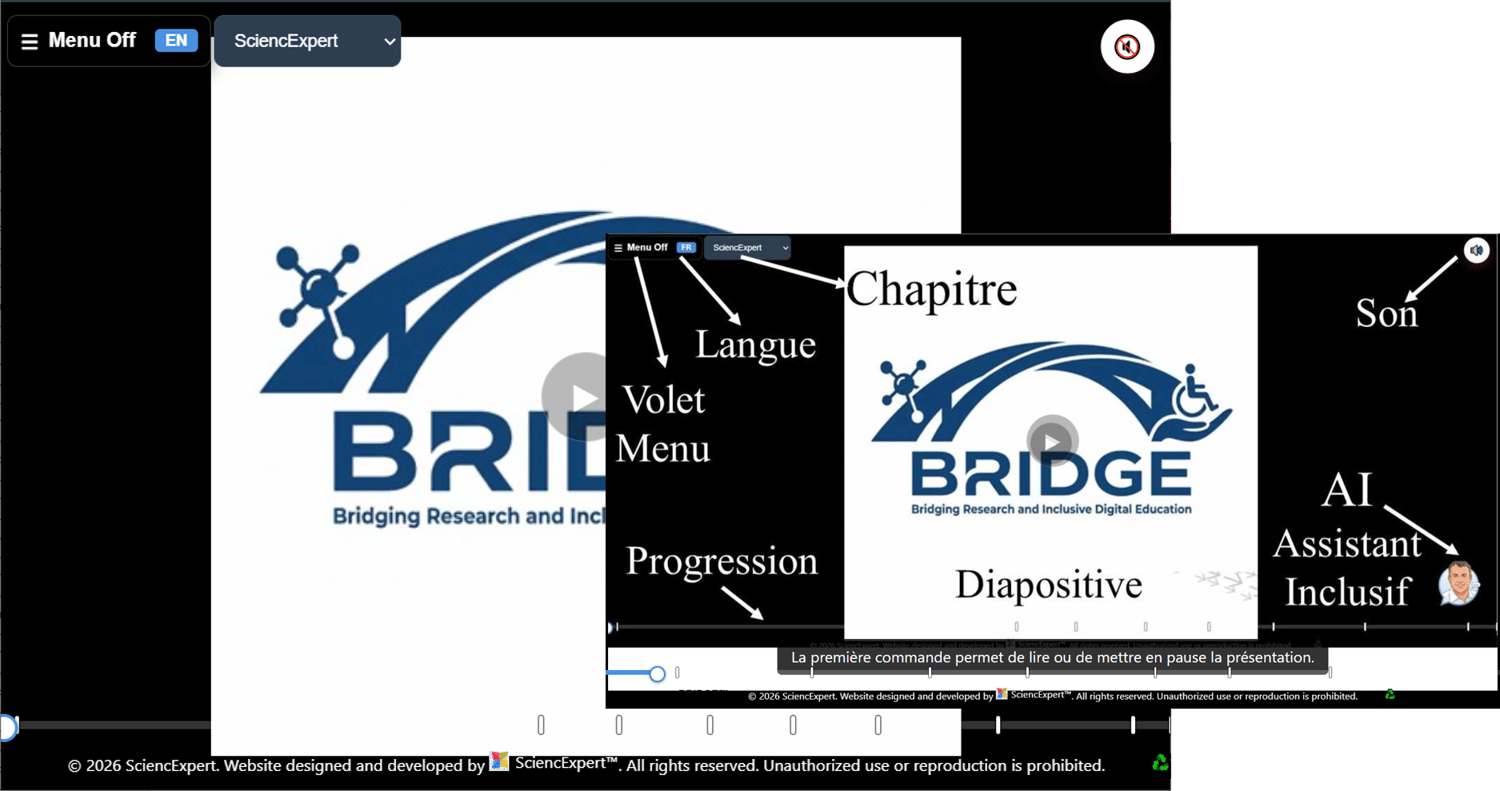
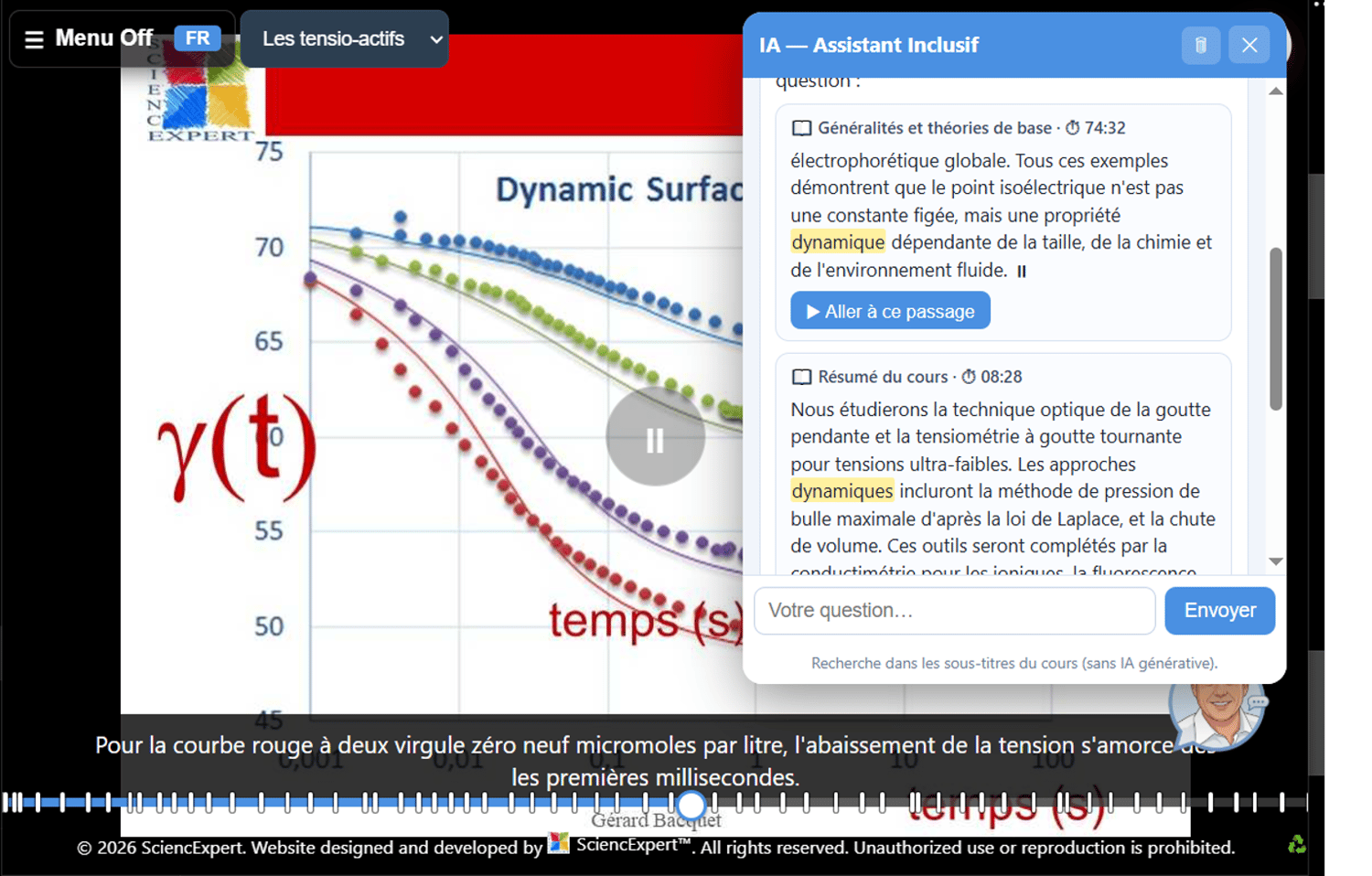
Assistant pédagogique basé sur l'intelligence artificielle : Un tuteur intégré accompagne l'apprenant, l'aide à retrouver les chapitres concernés et l'oriente vers les notions scientifiques complexes en fonction de ses besoins.
Accessibilité multilingue : Les modules peuvent être traduits à la demande afin de faciliter l'accès à la formation des apprenants internationaux. Le dispositif permet de mobiliser près de 20 langues.
Frugalité numérique : Une plateforme HTML légère, sans installation logicielle spécifique, accessible depuis un ordinateur, une tablette ou un smartphone.
Rythme d'apprentissage flexible : L'apprenant peut adapter la vitesse de lecture, naviguer librement entre les chapitres et personnaliser son expérience de formation selon ses besoins.
SCIENCEXPERT – Science In Action
Avec BRIDGE, l'excellence académique s'associe aux technologies d'assistance pour démontrer que les connaissances scientifiques de haut niveau doivent être accessibles à tous.
Au-delà de la transmission des savoirs, notre ambition est de proposer une expérience d'apprentissage numérique fluide, structurée, inclusive et adaptée aux exigences de la formation scientifique spécialisée.
Aging of polymeric materials: mechanisms, degradation and stabilization
Understand the mechanisms of polymer aging, identify degradation factors, and master strategies to improve their durability.
Present in many industrial sectors, polymeric materials are subjected to various environmental stresses that can alter their properties over time.How do light, heat, and oxygen cause their degradation? What are the differences between chemical, physical, and biological aging? How can materials be protected and their lifespan predicted?This approximately five-hour course offers an in-depth scientific approach to the aging mechanisms of polymers. It explores degradation reactions, the relationships between molecular structure and properties, biodegradation phenomena, and stabilization strategies used in industry.Through a scientific journey in nine chapters, the objective is to understand the fundamental mechanisms in order to better analyze, characterize, and control the durability of polymeric materials.
1. Photochemical aging
Study of the action of UV radiation, photolysis, the formation of free radicals, and the main photochemical reactions, including Norrish I and II and photo-Fries.
2. Thermochemical aging
Influence of temperature on the stability of polymers, depolymerization mechanisms and examples of industrial materials: PMMA, PTFE, polyamide-imides and PEEK.
3. Thermo-oxidative aging
Understanding of radical chain reactions, hydroperoxide formation, oxygen diffusion, and the effects of oxidation on polymer properties.
4. Physical aging
Study of material exchanges, plasticization, loss of plasticizers, creep and stress cracking phenomena, including ESCR.
5. Biological aging and biodegradability
Distinction between fragmentation, bioassimilation and mineralization. Presentation of aerobic and anaerobic mechanisms and the difference between bio-based and biodegradable polymers.
6. The main families of biopolymers
Introduction to PLA, PLGA, PHA, polysaccharides, proteins, and natural rubber, as well as the relationships between molecular structure and degradation behavior.
7. Degradation and end-of-life of polymers
Photodegradation, fragmentation, oxodegradable polymers, and photocatalysis by titanium dioxide, with examples of applications to self-cleaning surfaces.
8. Stabilizing additives and durability
Study of UV stabilizers, HALS, antioxidants, antiozonants, antimicrobial agents, and antistatic agents. Presentation of crosslinking mechanisms by irradiation, peroxides and silanes, including the Sioplas and Monosil processes.
9. Characterization and prediction of aging
Approach to assessing the behavior of polymeric materials and studying their evolution over time.
At the end of this course, you will be able to:- Understand the main mechanisms of aging and degradation of polymers.
- Explain photochemical and thermo-oxidative reactions.
- Distinguish between chemical, physical, and biological aging.
- Identify the main families of biopolymers.
- Analyze the effects of aging on the properties of materials.
- Understand the role of stabilizing additives and crosslinking processes.- Understand the methods for studying and characterizing sustainability.
This course is intended for:
- Master's and doctoral students** in chemistry, materials science and process engineering.
- R&D engineers and formulators** in the polymers, plastics, paints, coatings and industrial materials sectors.
- Teachers and researchers** wishing to gain a deeper understanding of aging mechanisms.- Industry professionals** involved in the formulation, processing and characterization of materials.
BRIDGE: a science course designed to be accessible to all
This course is part of the **BRIDGE – Bridging Research and Inclusive Digital Education** initiative, which places inclusivity at the heart of university-level scientific education. Its aim is to make specialized scientific knowledgeaccessible to as many people as possible, by integrating assistive technologies and options for personalizing learning.
The BRIDGE system is based on six complementary pillars:
Cognitive accessibility: Customization of fonts, contrasts and subtitle size to facilitate reading and learning, especially for people with specific learninglearning disabilities (DYS).
Audio accessibility: The ability to listen to content through audio playback and multilingual presentations, particularly facilitating access to knowledge for people with visual impairments.
AI-based teaching assistant: An integrated tutor supports the learner, helping them to find the relevant chapters and guiding them toward complex scientific concepts according to their needs.
Multilingual accessibility: The modules can be translated on request to facilitate access to training for international learners. The system can support nearly 20 languages.
Digital frugality: A lightweight HTML platform, with no specific software installation required, accessible from a computer, tablet or smartphone.
Flexible learning pace: The learner can adjust the reading speed, navigate freely between chapters, and customize their learning experience according to their needs.
SCIENCEXPERT – Science in ActionWith BRIDGE, academic excellence is combined with assistive technologies to demonstrate that high-level scientific knowledge should be accessible to all.
Beyond the transfer of knowledge, our ambition is to offer a seamless, structured, inclusive digital learning experience that is tailored to the requirements of specialized scientific education.