

NEXIE IN™ Practice to Capability
ECEC Applied Practice Microskill Series
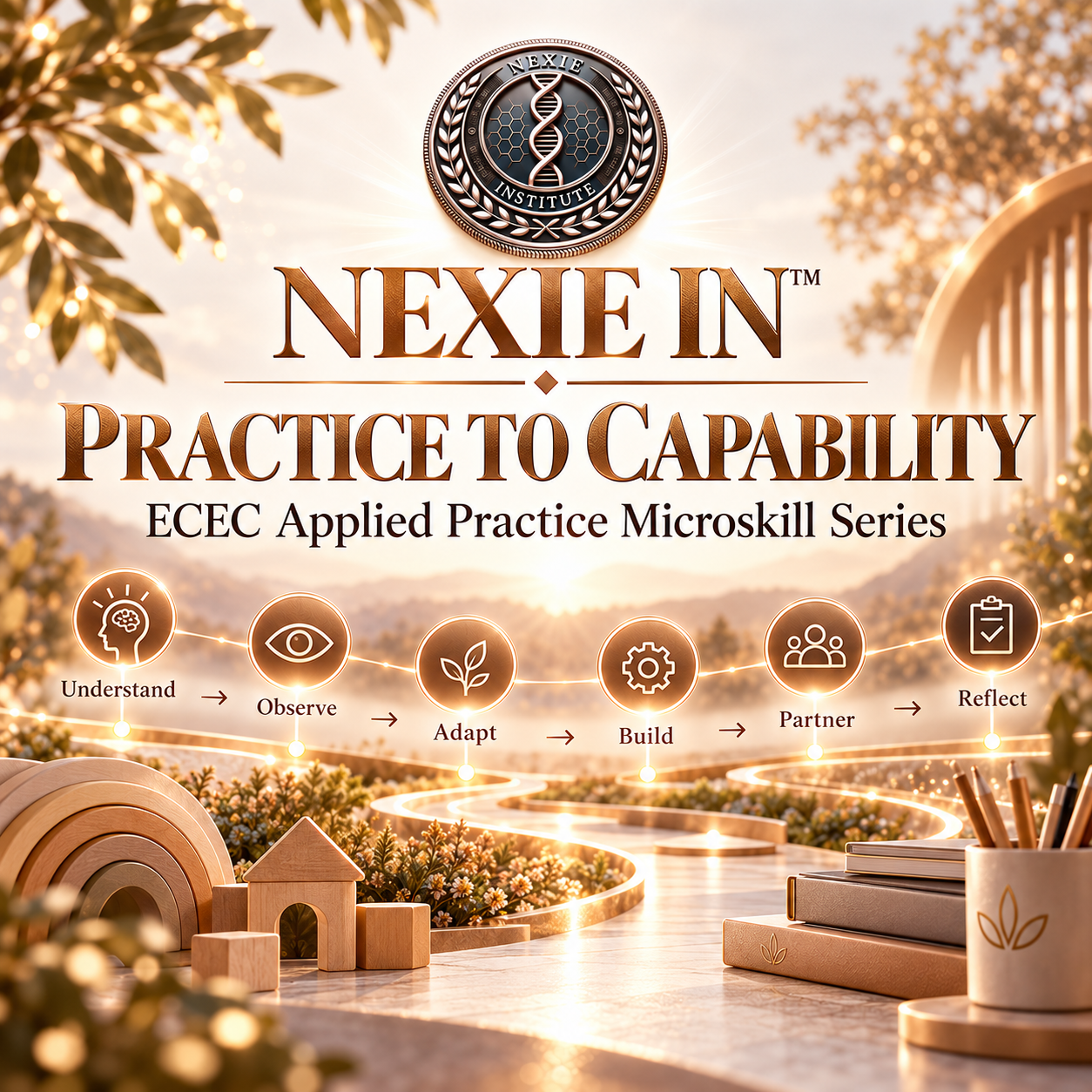
NEXIE IN™ Practice to Capability
ECEC Applied Practice Microskill Series
Understand. Notice. Respond. Reflect. Build capability.
Professional learning is most useful when it changes what educators notice, how they understand a situation and what they do next.
NEXIE IN™ Practice to Capability is a six-part applied professional-learning series designed to help early childhood educators move from behaviour-focused responses towards contextual, relational and capability-building practice.
The series follows one connected progression:
Understand → Observe → Adapt → Build → Partner → Reflect
Each microskill focuses on a practical part of everyday ECEC practice and helps educators translate learning into action.
Choose a pricing plan
This TAFE microskills course is free
Course curriculum
NEXIE IN™ Practice to Capability — ECEC Applied Practice Microskill Series is a six-part professional-learning pathway helping educators move from understanding and observation into environmental adaptation, capability-building, family partnership and reflective practice. Each microskill uses LEARN IT → WAGOLL → BUILD IT to translate professional learning into everyday ECEC practice.
How the microskills work
Each lesson uses the same simple learning structure:
LEARN IT → WAGOLL → BUILD IT
LEARN IT
Introduces the professional learning, key concepts and scope.
WAGOLL
Shows What A Good One Looks Like through a realistic applied example.
BUILD IT
Helps you practise the learning and apply it to an educational situation.
The aim is not just to read about good practice.
It is to:
understand it → see it → practise it → reflect on what happens next.
What is included
Your course includes:
NEXIE IN™ Practice to Capability Brief
Start here.
The Product Brief introduces the purpose, structure, audience and complete six-microskill learning pathway.
Then work through the six lessons in order.
Lesson 1
Understanding Before Intervention
UNDERSTAND
Begin with the NEXIE principle:
Understanding Before Intervention
Explore:
- Behaviour is Communication;
- URE™ — Understanding, Relationships and Environments;
- observation before response;
- current capacity;
- environmental pressure;
- expectations;
- relationships;
- communication;
- co-regulation;
- proportionate educational response;
- educator scope.
The core question is:
What might I need to understand before deciding what to do?
What you practise
Move from a behaviour label towards observation, contextual questions and a proportionate educational response.
Lesson 2
Observe Without Labelling
OBSERVE
Strengthen the difference between:
what happened
and
what we think it might mean.
Use the NEXIE reasoning sequence:
Observation → Interpretation → Hypothesis → Action → Response → Reflection
Explore:
- objective description;
- source clarity;
- family knowledge;
- child voice;
- interpretation;
- hypothesis;
- patterns;
- bias;
- uncertainty;
- cautious professional language.
The core question is:
What do I actually know, and what am I adding to the story?
Lesson 3
Compatible Environments
ADAPT
Sometimes meaningful change begins by changing what surrounds the person.
Explore how participation may be influenced by:
- sound;
- movement;
- lighting;
- group size;
- routines;
- transitions;
- predictability;
- communication;
- sensory conditions;
- expectations;
- relationships;
- choice;
- accessibility;
- cultural fit.
Use:
Keep → Change → Test → Observe
The core question is:
What could we change around the person before expecting the person to change?
Lesson 4
From Strengths to Capability
BUILD
Learn how everyday play, participation and relationships can provide opportunities for capability to grow.
Explore:
LAMAHS™
Life, Action, Mind and Heart Smart
and the NEXIE 6Cs:
- Caring
- Connection
- Creativity
- Critical Thinking
- Creative Problem Solving
- Contribution
The core question is:
What capability is already emerging, and what opportunity could help it grow?
The 6Cs are used to notice possibilities and opportunities.
They are not child scores or developmental rankings.
Lesson 5
Family Knowledge as Educational Evidence
PARTNER
Families hold knowledge that can change how educators understand participation, communication, strengths and support.
Explore:
- family as first educator;
- family priorities;
- routines;
- communication;
- culture;
- child voice;
- shared decision-making;
- consent;
- privacy;
- information sharing;
- professional scope.
Learn the:
NEXIE No-Duplication Rule
Link, pull or reference before asking someone to enter the same information again.
The core question is:
What does the family know that would help us understand and support participation?
Lesson 6
Reflect, Adapt and Sustain What Helps
REFLECT
Introducing a strategy is not the end of the process.
Learn to use:
CARIE™
Context → Awareness → Reflection → Interpretation → Engagement
to review:
- what changed;
- intended effects;
- unintended effects;
- educator response;
- child response;
- family feedback;
- environmental conditions;
- what should continue;
- what should change;
- whether more support is required.
The core question is:
What changed, what did we learn and what should happen next?
This connects with the PEDICure™ principle of Correction:
Correct the fit, plan or response — not the child.
The complete learning pathway
1. UNDERSTAND
Understanding Before Intervention
↓
2. OBSERVE
Observe Without Labelling
↓
3. ADAPT
Compatible Environments
↓
4. BUILD
From Strengths to Capability
↓
5. PARTNER
Family Knowledge as Educational Evidence
↓
6. REFLECT
Reflect, Adapt and Sustain What Helps
What you receive
The series includes:
1 Practice to Capability Product Brief
plus
6 complete professional-learning microskills
Each microskill contains:
- LEARN IT
- WAGOLL
- BUILD IT
Total:
19 professional-learning resources
Professional learning time
Each microskill is designed as approximately:
60 minutes
The complete six-part series provides approximately:
6 hours of structured professional learning
Additional workplace application and reflection may extend the learning beyond that time.
What to expect
-
Who is this series for?
NEXIE IN™ Practice to Capability is designed for:
- early childhood educators;
- early childhood teachers;
- community preschool staff;
- long day care educators;
- Family Day Care educators and coordinators;
- educational leaders;
- practitioners returning to the sector;
- educators wanting to update and strengthen existing practice.
It is suitable for both experienced educators and those developing confidence in applying developmental and relational practice.
-
Designed for everyday practice
The series is designed to be useful across:
- community preschool
- long day care
- Family Day Care
- and other ECEC contexts.
Examples and activities focus on realistic educator practice rather than abstract theory.
Professional practice connections
NEXIE IN Practice to Capability is designed to support professional reflection connected with areas of:
- EYLF V2.0;
- National Quality Standard;
- relationships;
- assessment and planning;
- learning environments;
- family partnerships;
- critical reflection;
- educational leadership and continuous improvement.
For teachers, relevant APST connections may also be identified where appropriate.
These connections support professional learning and reflection.
They do not determine regulatory compliance, accreditation, competency or quality ratings.
-
What this series is — and is not
NEXIE IN Practice to Capability is:
professional learning
applied educator development
evidence-informed
strengths-based
relational
non-diagnostic
It does not:
- diagnose children;
- provide clinical treatment;
- replace existing qualifications;
- determine RTO competency;
- guarantee regulatory outcomes;
- confer NEXIE Facilitator status;
- grant commercial delivery rights;
- imply TAFE NSW or NSW Department of Education endorsement.
-
Where this series sits
NEXIE IN Practice to Capability is the foundation of the:
NEXIE IN™ Professional Learning Collection
It can be followed by:
NEXIE IN™ Lead
Leadership & Implementation Microskill Series
Learn → Coach → Embed → Improve
and future specialist professional learning in:
NEXIE IN™ Transition
NEXIE IN™ Family Partnership
NEXIE IN™ Inclusion & Participation
NEXIE IN™ Play & Capability
Move beyond knowing what good practice is.
Learn how to notice it, apply it and improve it.
NEXIE IN™ Practice to Capability
Understand → Observe → Adapt → Build → Partner → Reflect
Understanding Before Intervention.
Start Practice to Capability