
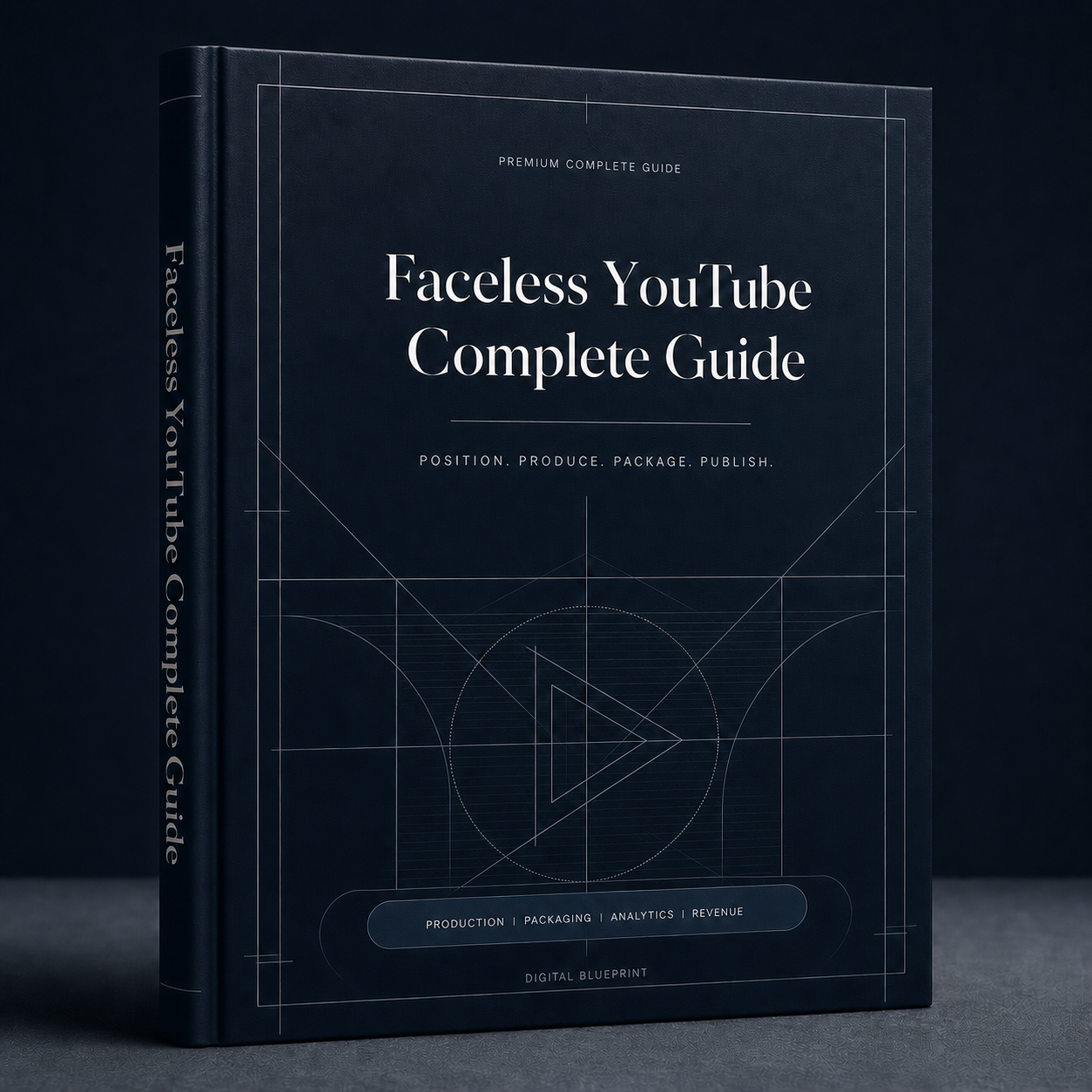
Faceless YouTube Complete Guide
FACELESS YOUTUBE COMPLETE GUIDE
Build one clear, repeatable YouTube channel system — without showing your face or improvising every video.
You do not need more disconnected tools, random content ideas, or another promise of overnight success.
You need a system that helps you make the right decisions in the right order.
The **Faceless YouTube Complete Guide** is a practical 47-page guide for building and running one focused faceless YouTube channel. It takes you beyond the beginner stage and shows you how to turn an idea into a structured production workflow you can repeat, review, and improve.
No camera. No personal brand. No guaranteed-income claims.
Just a clearer way to position, produce, package, publish, and learn.
## Stop treating every video like a new project.
Most new creators do not struggle because they lack ideas.
They struggle because every upload requires them to make the same decisions again:
- Which topic should I choose?
- Is this niche specific enough?
- What should the video promise?
- How do I research and structure the script?
- Which visuals actually support the message?
- How do the title and thumbnail work together?
- What should I review after publishing?
- How does content connect to a relevant next step?
Without a repeatable process, content becomes slow, inconsistent, and mentally exhausting.
This complete guide turns those decisions into one connected workflow.
---
Inside the Faceless YouTube Complete Guide
### 01 — Positioning & Channel Strategy
Define the viewer, recurring problem, channel promise, proof mechanism, and content territory. Use the niche stress test to check whether your idea has enough depth before building the library.
### 02 — The Production Operating System
Move every video through a clear seven-stage pipeline: brief, research, script, audio, visual map, editing, and packaging. Create stronger video briefs and batch similar decisions without making the content generic.
### 03 — Voiceover & Audio Quality
Build a consistent voice direction, whether you use your own voice or licensed AI narration. Review pacing, authority, pronunciation, volume, music, and trust-breaking audio defects.
### 04 — Visual Direction & Editing
Give every visual a purpose: explain, prove, orient, or create emotion. Plan the visual map before opening the timeline and review the final video through story, visual, audio, and accessibility passes.
### 05 — Packaging: Titles & Thumbnails
Package the idea before production. Explore genuinely different title directions, create one clear visual hierarchy, and use the five-second promise test to check whether the right viewer understands the value.
### 06 — Discovery & Channel Architecture
Understand the roles of Search, Suggested, and Browse without relying on keyword stuffing. Build entry, depth, proof, and action videos that form a useful library instead of a disconnected pile of uploads.
### 07 — Analytics & Diagnosis
Connect every metric to a practical question. Diagnose whether the current constraint is topic fit, packaging, expectation match, retention, or the missing next-video path.
### 08 — The Content Funnel
Give each video one primary job: discovery, trust, intent, or action. Build a relevant viewer journey and choose a clear CTA without turning the channel into a constant sales pitch.
### 09 — Monetization & Offer Design
Understand the main revenue models and choose the first one that genuinely matches the audience. Build trust through relevance, transparent disclosure, realistic claims, and a useful next level of support.
### 10 — AI Prompt Library
Use structured prompts for audience research, positioning, angles, outlines, hooks, script review, visual planning, titles, thumbnails, analytics, and content clusters.
### 11 — Your 90-Day Foundation Plan
Turn the complete guide into a focused first 90 days: establish the channel, publish a connected content cluster, improve packaging, and connect one relevant lead magnet or first revenue path.
You will also receive practical implementation tools
- Channel-positioning framework
- Niche stress test
- Channel foundation worksheet
- Seven-stage production pipeline
- Video-brief formula
- Voice-direction framework
- Audio-quality checklist
- Visual grammar system
- Four-pass editing review
- Packaging brief
- Title-direction formulas
- Thumbnail-quality checklist
- Channel architecture framework
- Publishing checklist
- Analytics diagnosis matrix
- Content portfolio model
- CTA map
- Revenue quality checklist
- AI prompt library
- 90-day foundation plan
- Weekly review questions
- Clear “ready to scale” criteria
This guide is for you if…
- You want to build a YouTube channel without showing your face.
- You understand the basics but still do not have a reliable production workflow.
- You spend too much time switching between tools and deciding what to do next.
- Your video ideas feel random instead of connected to a clear channel promise.
- You want stronger scripts, visuals, titles, thumbnails, and publishing decisions.
- You want to understand analytics without obsessing over daily numbers.
- You want to create one stable channel before thinking about teams or multiple channels.
---
This is not a shortcut or income guarantee.
The Faceless YouTube Complete Guide will not promise a specific number of subscribers, views, or revenue.
It will not tell you that AI can build a valuable channel without human judgment.
It will not replace research, consistency, originality, or learning from real viewers.
What it gives you is a clearer operating structure — so your effort is focused, your production becomes more repeatable, and every video teaches you something useful for the next one.
---
## Complete Guide vs. Scale System
The **Faceless YouTube Complete Guide** helps you build and stabilize one faceless channel as a solo creator.
The **Scale System** is the next level. It covers advanced production volume, SOPs, delegation, hiring, email systems, revenue stacking, multiple channels, and operating the channel like a media business.
Start with the Complete Guide if you are still building the channel and production foundation.
Move to the Scale System when the workflow is stable and the goal changes from producing videos to directing an operation.
---
Build the foundation before you try to scale it.
One clear viewer.
One useful promise.
One repeatable production workflow.
One finished video — followed by a better one.