


Beyond the Formula Part 1 - The Science of Understanding Physics
Beyond the Formula — Part I: The Science of Understanding Physics
How Intuition, Mental Models, and Cognitive Science Shape the Way We Learn Physics
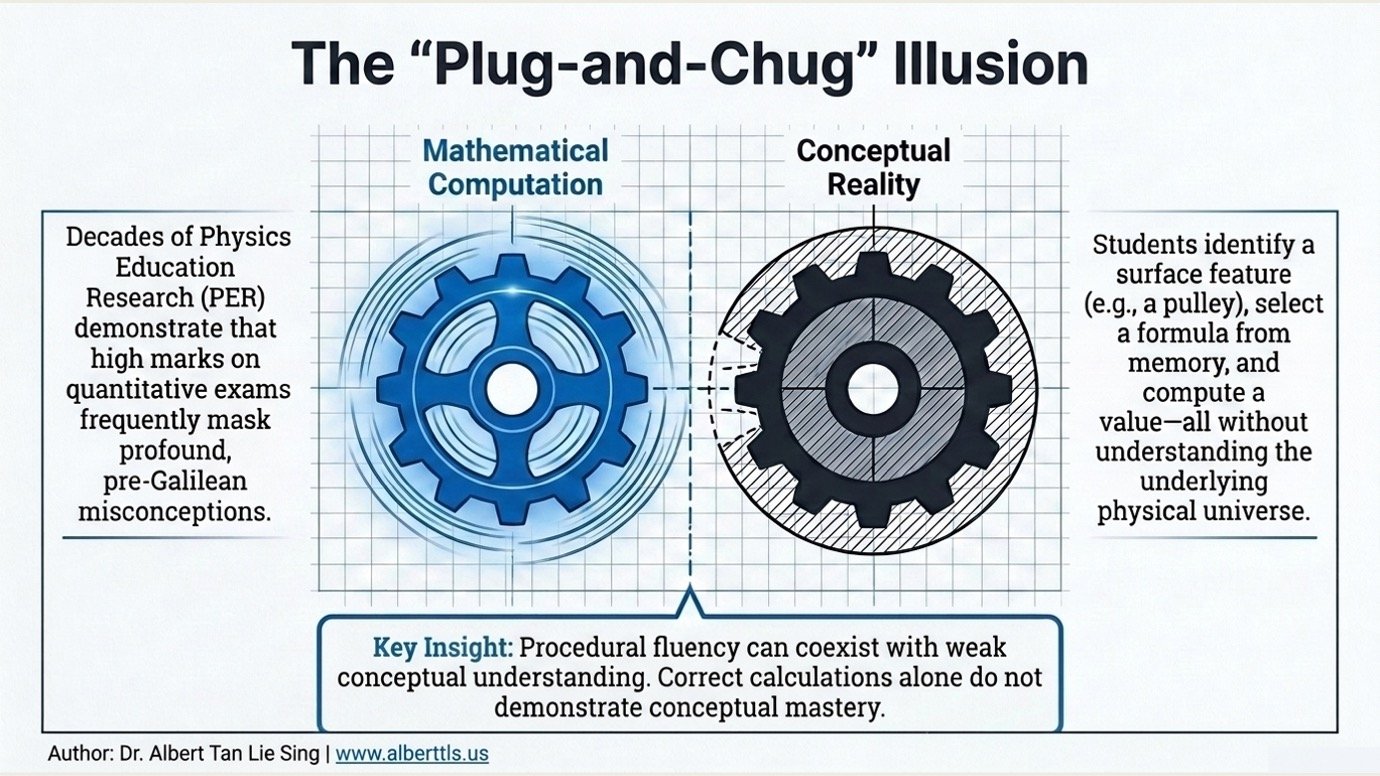
Why can someone memorize equations, solve mathematical problems, and still struggle to understand physics?
Beyond the Formula — Part I explores the cognitive foundations of physics understanding. Drawing on established physics education research and cognitive science, this illustrated guide examines why formula memorization does not always translate into conceptual mastery.
Discover how intuitive reasoning, misconceptions, mental models, working memory, and metacognition influence the ways we interpret physical phenomena.
Through research-informed explanations, conceptual diagrams, and examples involving Newtonian mechanics, the publication introduces a more thoughtful approach to understanding physics beyond mathematical substitution.
Inside this 16-page illustrated guide:
- The limitations of formula-centered problem solving
- Differences between novice and expert physics reasoning
- Conceptual change and knowledge-in-pieces theory
- Intuition, context, and physical interpretation
- Working memory, multiple representations, and metacognition
- Five practical habits for understanding physics
For: Curious general readers, physics learners, parents, educators, and anyone interested in how scientific understanding develops.
Format: Downloadable, illustrated landscape PDF
Author: Dr. Albert Tan Lie Sing
Edition: Version 1.0 (2026)
Part I of the Beyond the Formula two-volume series.
What you will learn:
Discover why memorizing formulas is not the same as understanding physics. Learn how intuition, mental models, misconceptions, working memory, and cognitive science influence the way we interpret the physical world. Develop a more thoughtful approach to scientific reasoning by learning to recognize physical principles, question assumptions, connect mathematical ideas with reality, and reflect on your understanding.
Part I encourages readers to change the question from “Which formula should I use?” to “What is physically happening, and why?”