
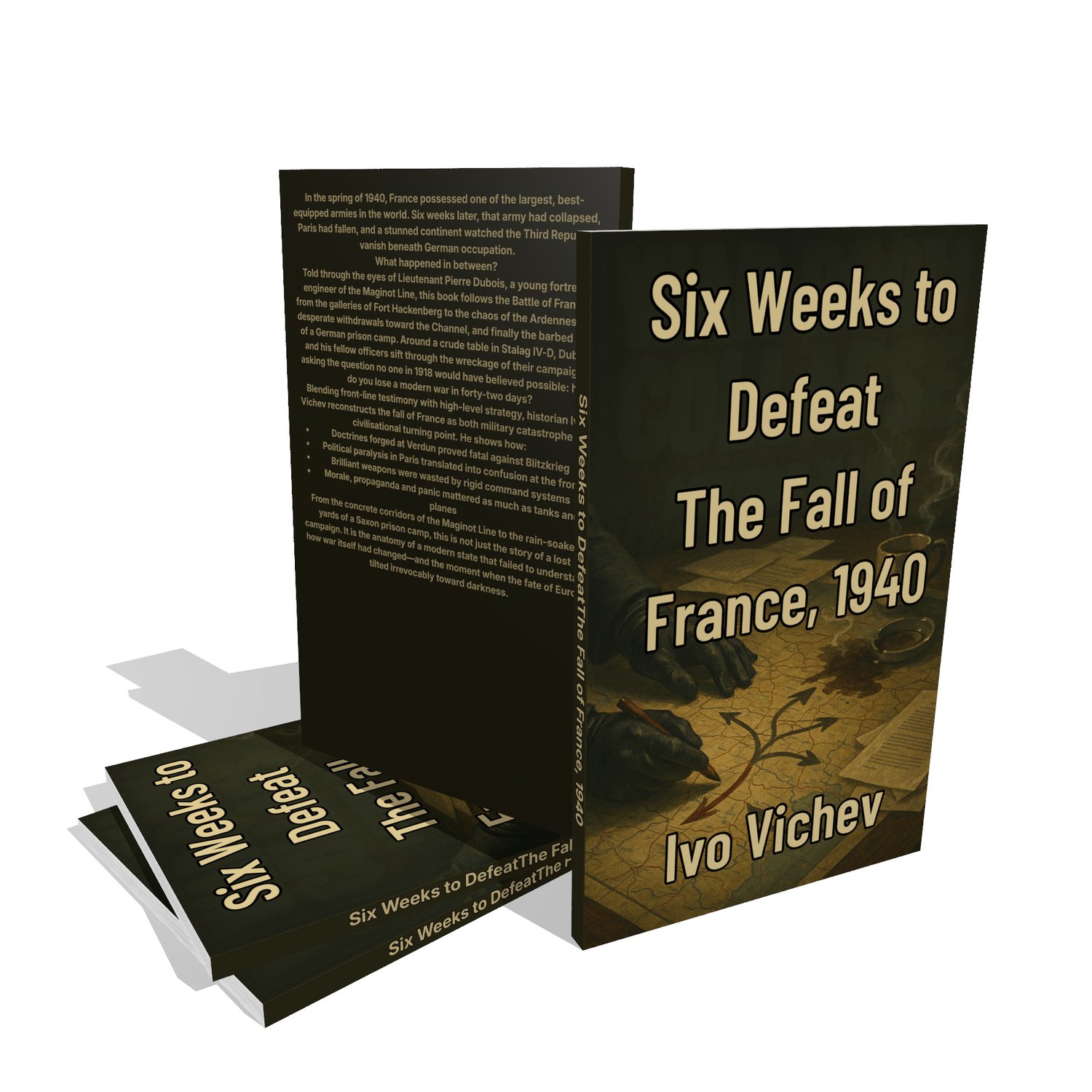
Six Weeks to Defeat The Fall of France, 1940
How does a modern great power collapse in just six weeks?
In May 1940, the French Army was widely seen as the strongest land force in Europe. By mid-June, France had fallen, its government in flight, its soldiers marching into captivity. Between those dates lies one of the most misunderstood campaigns of the Second World War.
Told through the eyes of Lieutenant Pierre Dubois, a fortress engineer at the massive Maginot Line position of Fort Hackenberg, this book follows the Battle of France from the illusion of security to the shock of defeat—and into the prison camps where officers had nothing left but time to ask what went wrong.
Inside the fort’s concrete galleries, Dubois and his men begin the campaign convinced that technology, planning and firepower have made France impregnable. As German forces break through at Sedan, race to the Channel and encircle entire armies, that confidence shatters. Orders arrive late or not at all. Communications fail. Refugee columns clog the roads. Air attack becomes a constant, terrifying presence.
By the time Dubois reaches a transit camp attached to Stalag IV-D at Neuburxdorf in Saxony, the fighting is over—but the real reckoning is only beginning. Around a rough table of Red Cross crates, officers from armoured divisions, staff headquarters and Dunkirk beachheads begin to piece together the larger picture of France’s defeat.
This book moves between front-line narrative and clear, structured analysis, showing how tactical shocks and deep structural flaws combined to bring down a great power at unprecedented speed.
You’ll see:
- The Maginot Line from the inside – daily life in a fortress that was technically impressive, tactically powerful, and yet strategically bypassed.
- How Blitzkrieg really worked in 1940 – not as magic, but as ruthless integration of tanks, aircraft, artillery and radio into a single, fast-moving system.
- French doctrine versus German practice – why an army that still thought in terms of 1918 “methodical battle” was overwhelmed by an enemy that treated the front as fluid and time as a weapon.
- Leadership and command failure – from Gamelin and Weygand at the top to colonels who could not act without orders, contrasted with German commanders empowered to exploit opportunity on the spot.
- The politics behind the battlefield – revolving-door governments, budget cuts, ideological quarrels and stop–start rearmament versus a dictatorship that aligned industry, strategy and propaganda to a single goal.
- Intelligence that saw numbers but missed ideas – a system that counted tanks and aircraft yet failed to grasp how Germany intended to use them, and buried its own warnings in bureaucracy and wishful thinking.
- Air power as the campaign’s great multiplier – Stuka dive-bombers as flying artillery, French fighter units brave but misused, and the psychological shock of discovering that the sky itself now belonged to the enemy.
- Logistics, communications and collapse – telephone lines cut by bombing, radios restricted to higher command, depots bypassed, units that still had ammunition and courage but no orders and no fuel.
- The human side of defeat – columns of refugees, rumours and propaganda racing ahead of the front line, officers trying to hold units together as the sense of inevitable loss spreads faster than any German advance.
- Alliance failure – French, British and Belgian forces fighting side by side yet not truly together, with incompatible doctrines, equipment, priorities and intelligence systems.
- The long shadow of the Great War – how the memory of Verdun and the Somme pushed French planners toward fortifications and defensive firepower, while German thinkers drew the opposite lesson: never fight another static war.
- Economic and industrial foundations – coordinated German rearmament from 1933 vs. French programmes repeatedly disrupted by politics, and what that meant for equipment, training and maintenance by 1940.
- Propaganda, “fifth columns” and morale – German radio and leaflets amplifying panic, French counter-propaganda floundering, and the more damaging defeatism growing inside French politics itself.
- Terrain as opportunity, not barrier – how the Ardennes, dismissed as tank-proof, became the key to the campaign, and how roads, rivers and Channel ports were turned into levers of operational decision.
By the end of the book, the fall of France is no longer a simple story of “cowardice” or “inevitable” German superiority. It becomes what it truly was: a convergence of doctrine, politics, technology, leadership, morale and chance, in which courageous soldiers on both sides were trapped.
For France, the consequences were immediate and profound: occupation, Vichy, resistance, a split colonial empire and a national identity marked for decades by the memory of 1940. For Europe and the wider world, the collapse of the continental counterweight to Germany transformed a regional war into a global one and reshaped the balance of power from the Atlantic to the Urals.
Written in a vivid, accessible style but grounded in serious military and political analysis, this book offers:
- A gripping, human-scale narrative of the 1940 campaign, centred on one officer and one fortress.
- A clear breakdown of the key factors behind France’s defeat—from radio sets and staff procedures to parliamentary crises and industrial planning.
- A thoughtful reflection on what the Battle of France still has to teach about modern war, coalition politics and the danger of preparing for the last conflict instead of the next one.
The Battle of France lasted six weeks. Its consequences shaped the rest of the Second World War—and the world that followed.
This book shows how and why it happened.