
Criminal Law — NCA Complete Notes Bundle
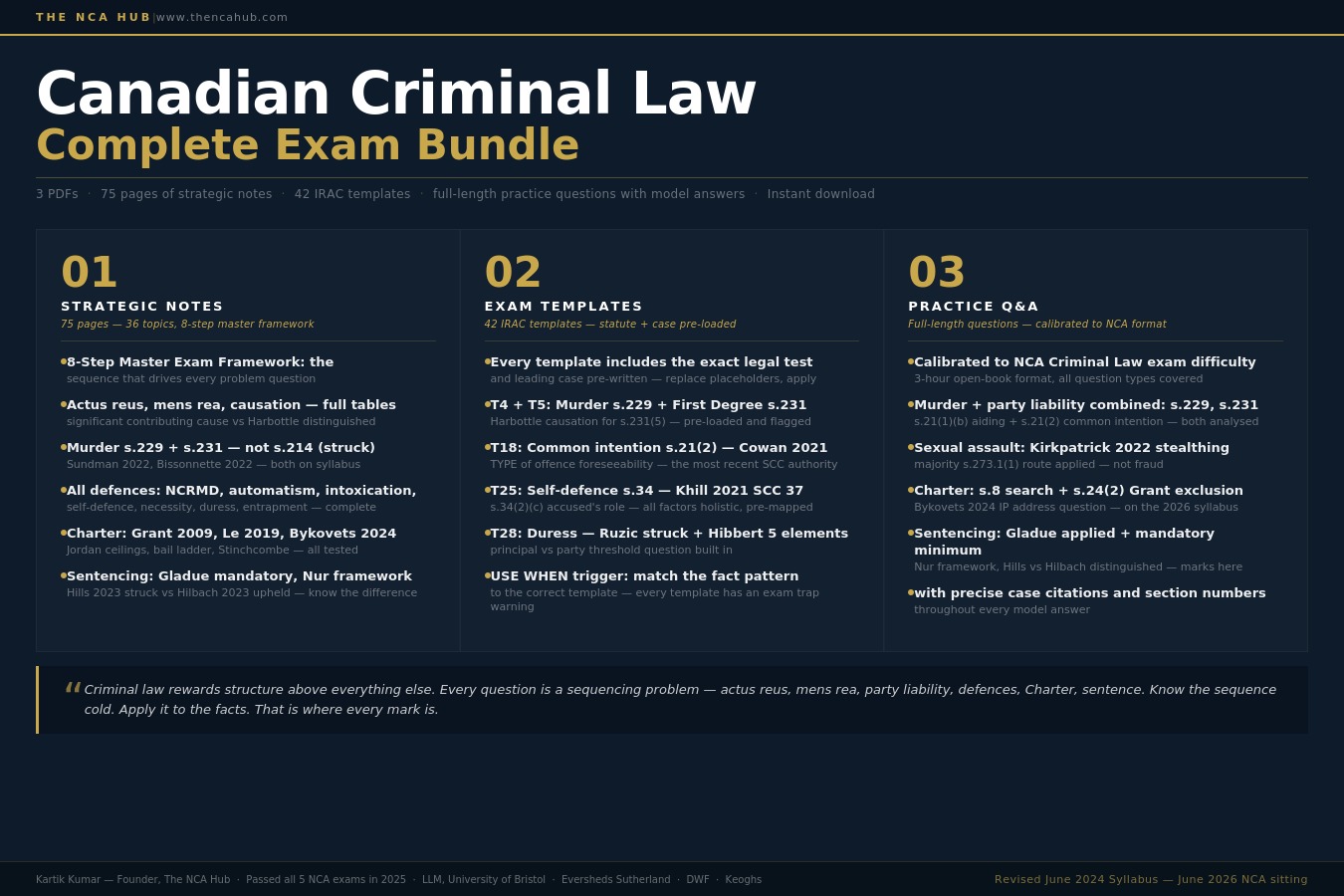
THE NCA CRIMINAL LAW BUNDLE
The most common failure in the NCA Criminal Law exam is not knowing the law. It is failing to apply it in sequence. Actus reus, mens rea, party liability, defences, Charter, procedure, sentence: each issue requires its own analysis, its own authority, and its own conclusion. Candidates who describe the law without applying it to the facts do not pass.
This bundle builds the 8-step analytical sequence first, then gives you the statutory provisions, case principles, IRAC templates and practice questions to score marks on every issue type.
WHAT IS IN THE BUNDLE
3 PDFs. Instant download after purchase.
STRATEGIC NOTES, 80+ pages
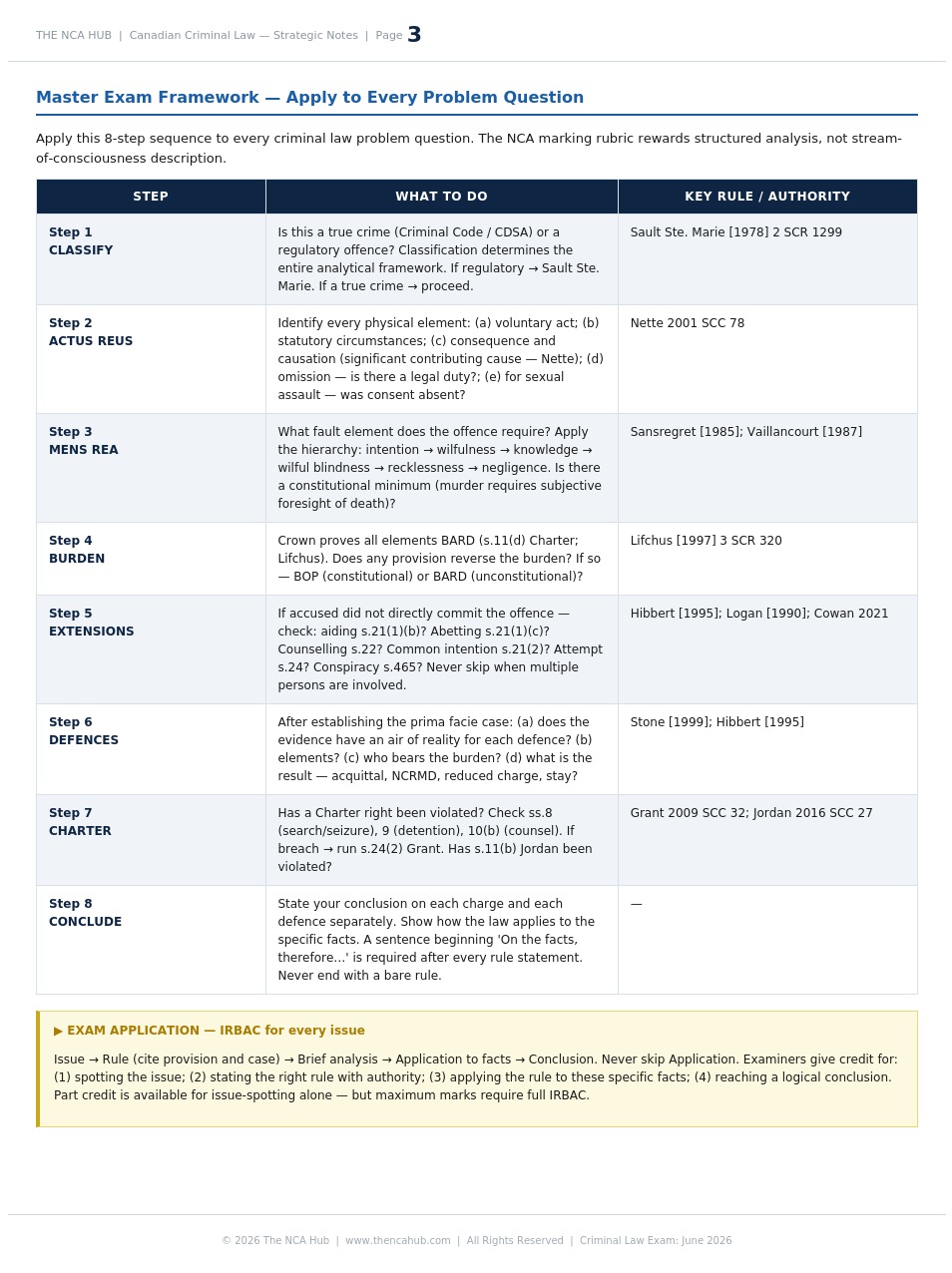
Opens with the Master Exam Framework: an 8-step sequence that structures every criminal law problem question from classification through to sentencing conclusion. Step 1 classifies the offence as true crime or regulatory, which determines every step that follows. Skip it and you lose marks on every analysis after it.
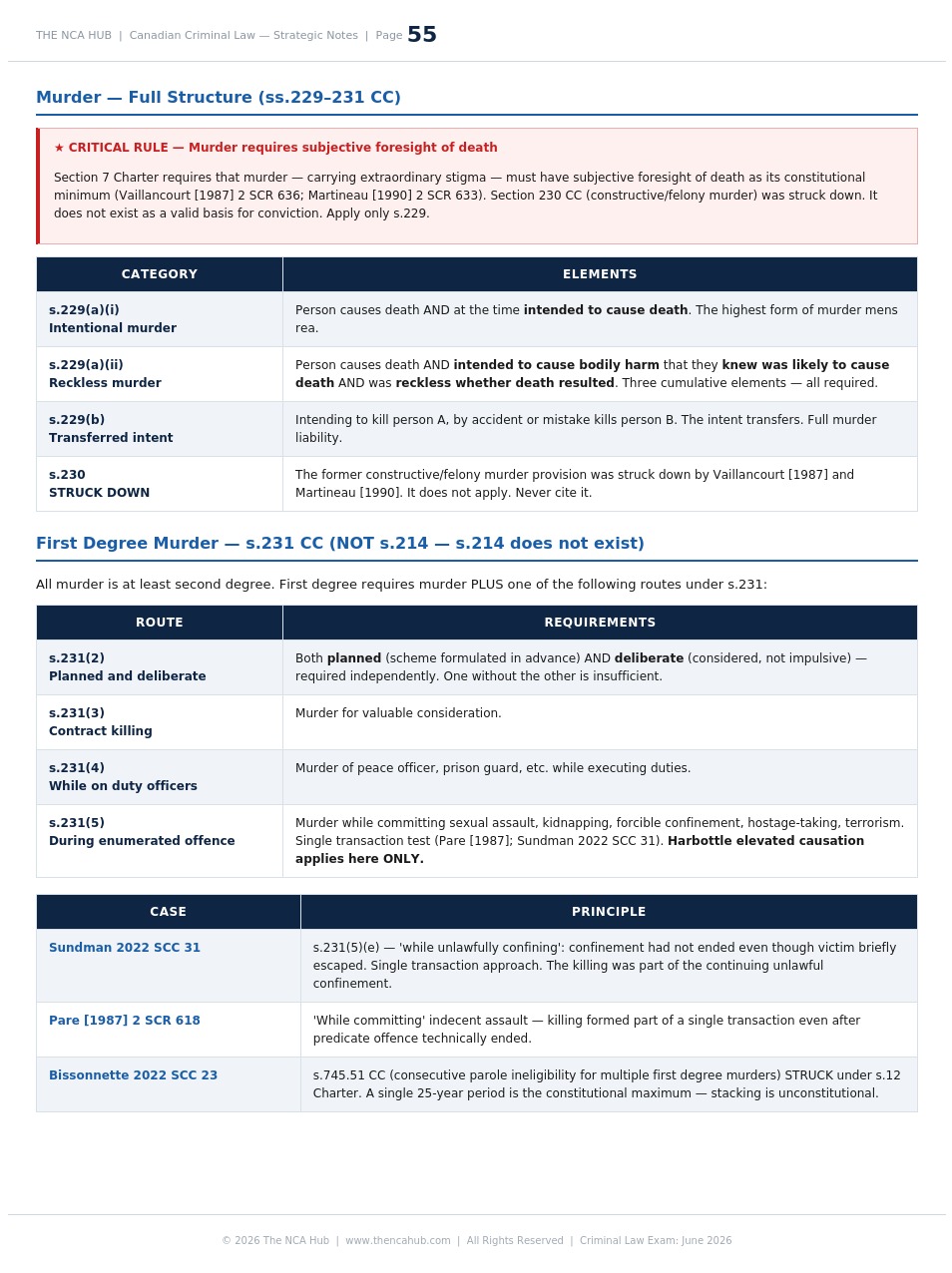
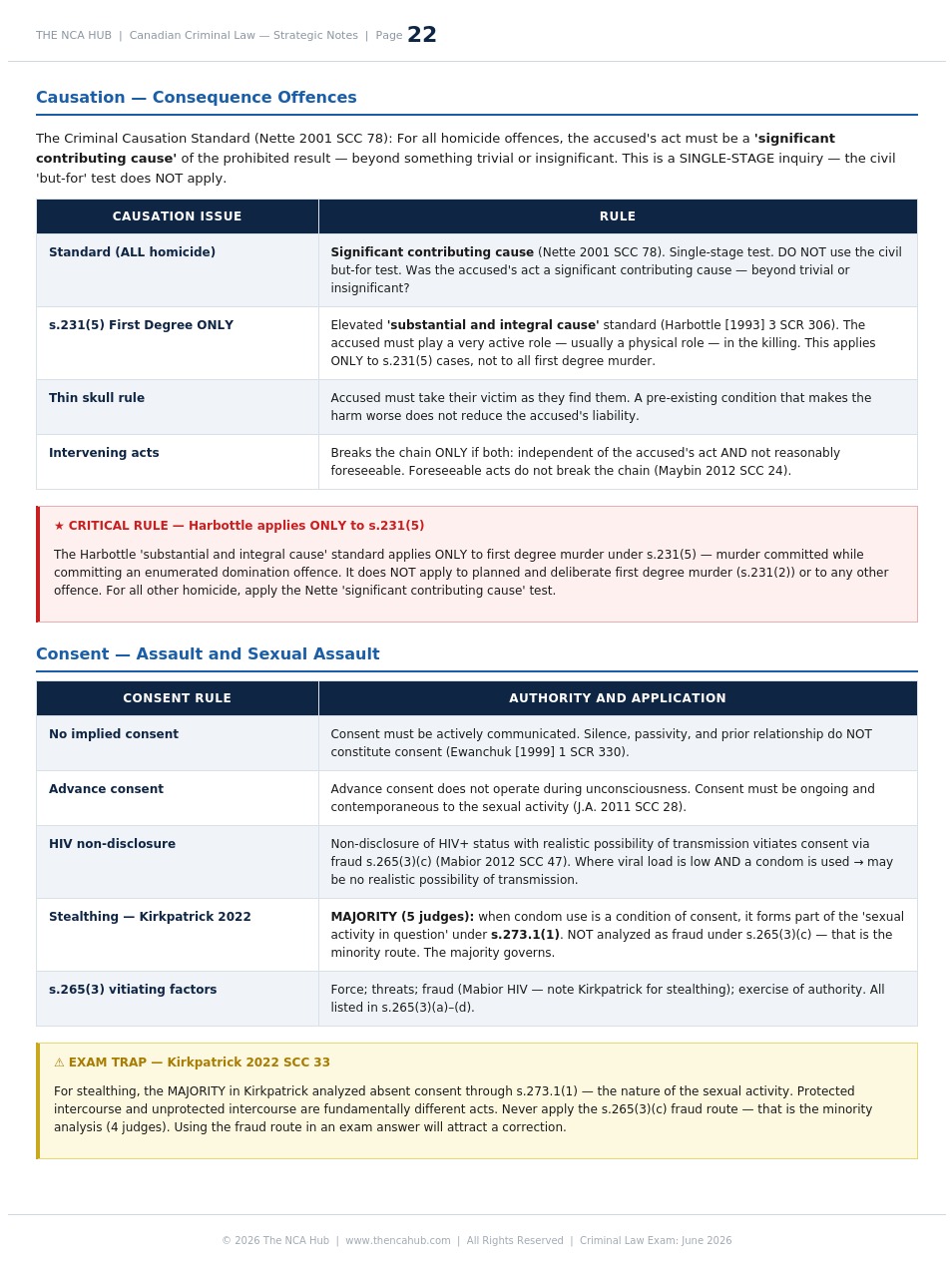
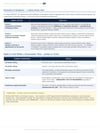
Covers every testable topic. Sources of criminal law and s.9 CC. Actus reus in full: voluntariness, possession under s.4(3), and causation on the two-stage Nette 2001 SCC 78 analysis, factual causation first and then legal causation on the significant contributing cause standard, with the elevated Harbottle [1993] substantial cause standard flagged as applying to s.231(5) only and not to first degree murder generally. Consent, including the Hutchinson 2014 and Kirkpatrick 2022 pair and which step of the analysis each one governs. Subjective mens rea: intention, wilful blindness (Briscoe 2010), recklessness, and the constitutional minimum fault for murder. Objective fault: marked departure for s.320.13 dangerous operation (not s.249, which no longer exists) against marked and substantial departure for s.219 criminal negligence.
Party liability: s.21(1)(b) aiding, s.21(1)(c) abetting, s.21(2) common intention with subjective foreseeability of the type of offence and the Logan [1990] constitutional limit, Cowan 2021 SCC 45 on its actual ratio (the Crown need not prove the identity of the principal offender), counselling under s.22 and s.464, attempt including Dynar [1997] on impossibility, and conspiracy including J.F. 2013 SCC 12 on party liability to a conspiracy.
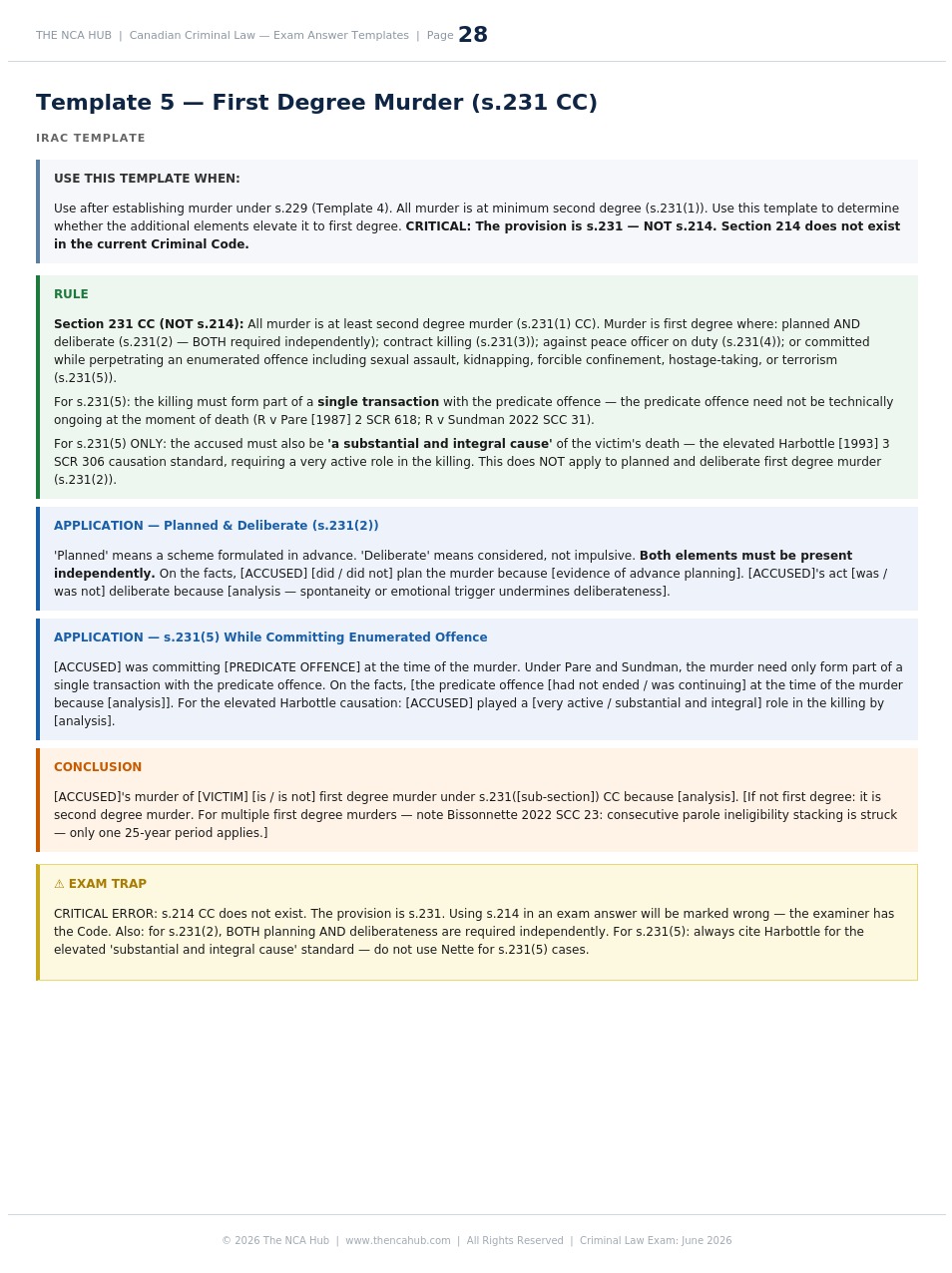
Specific offences: murder s.229, first degree murder s.231 (not s.214, which does not exist), manslaughter, sexual assault including Barton 2019, theft, robbery, fraud.
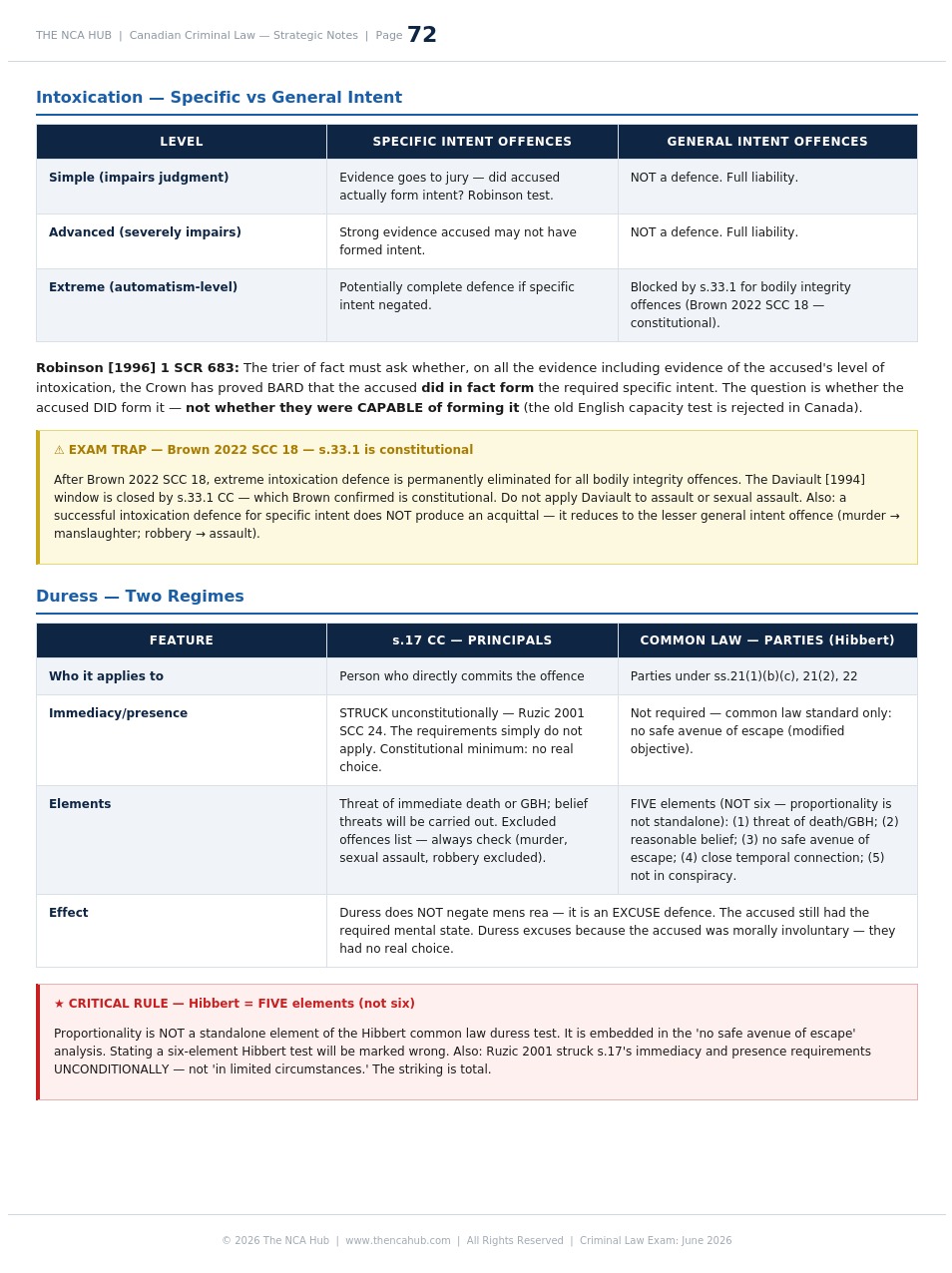
All defences: NCRMD including Oommen [1994], automatism on the Stone [1999] framework, intoxication including Robinson [1996] and Brown 2022 SCC 18 striking down s.33.1 unanimously under ss.7 and 11(d), with the replacement provision flagged as untested. Self-defence s.34 with every s.34(2) factor in its correct subsection, the Khill 2021 SCC 37 approach to the accused's role in the incident, and Cormier 2017 NBCA 10 on breaking an encounter into phases. Necessity, including where the burden actually sits. Duress, including Ruzic 2001 striking the s.17 immediacy and presence requirements, the six Ryan 2013 SCC 3 elements with proportionality included, the principal and party split from Paquette, and the unresolved Aravena and Willis conflict on murder. Provocation. Entrapment.
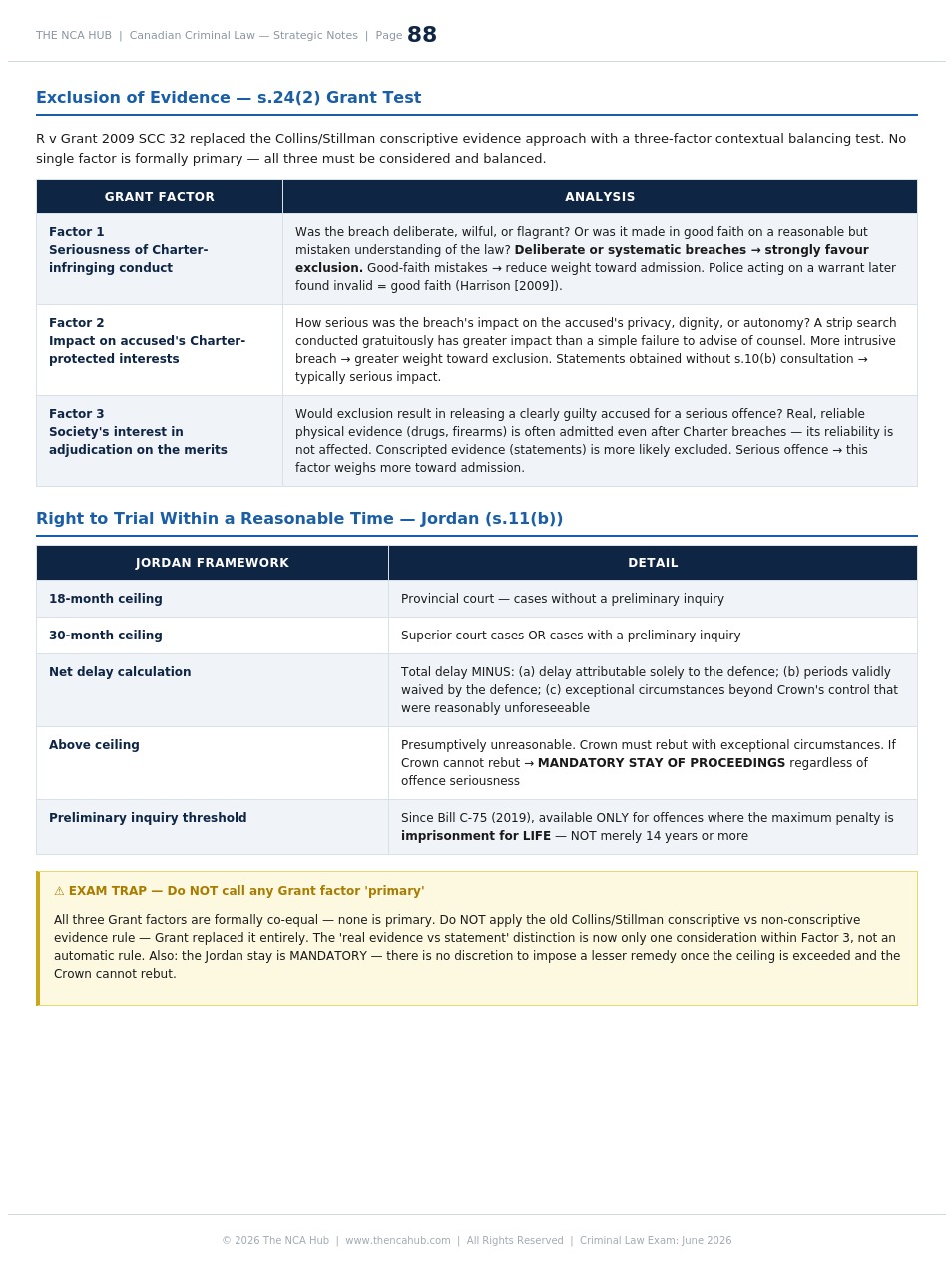
Criminal procedure in full: detention including Grant 2009 and Le 2019 SCC 34, search and seizure including Bykovets2024 SCC 6, the Grant s.24(2) three-factor test, the Antic 2017 bail ladder, Stinchcombe disclosure, and s.11(b) delay including Vrbanic 2026 SCC 19 on the particularly complex case exception. Plus the four procedure topics most bundles skip entirely: preliminary inquiries and the Arcuri prima facie standard, the jury trial after Chouhan 2021, trial participants and the neutral impartial trier (Gunning 2005, Hamilton 2004), pre-trial motions, and appeals and judicial review of interim decisions.
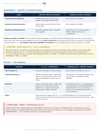
Sentencing: proportionality as the cardinal principle, Gladue mandatory for all Indigenous offenders, mandatory minimums under Nur 2015 with Hills 2023 SCC 2 struck and Hilbach 2023 SCC 3 upheld. Both are on the syllabus and candidates routinely confuse them.
EXAM TEMPLATES, 47 IRAC templates
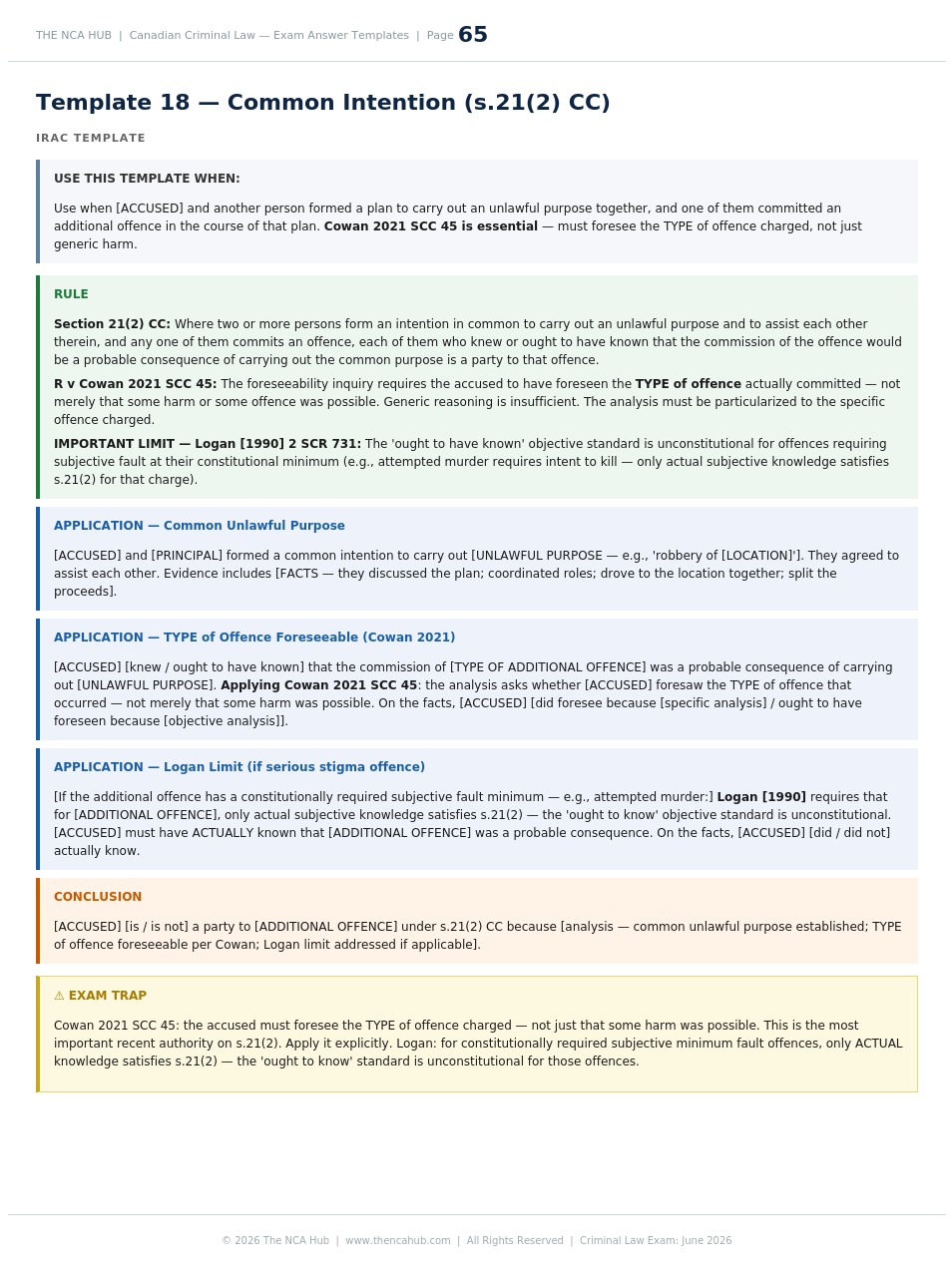
Every template has the statutory provision and leading case pre-loaded. Your job is to identify which template applies, fill in the parties and facts, and add the application sentences.
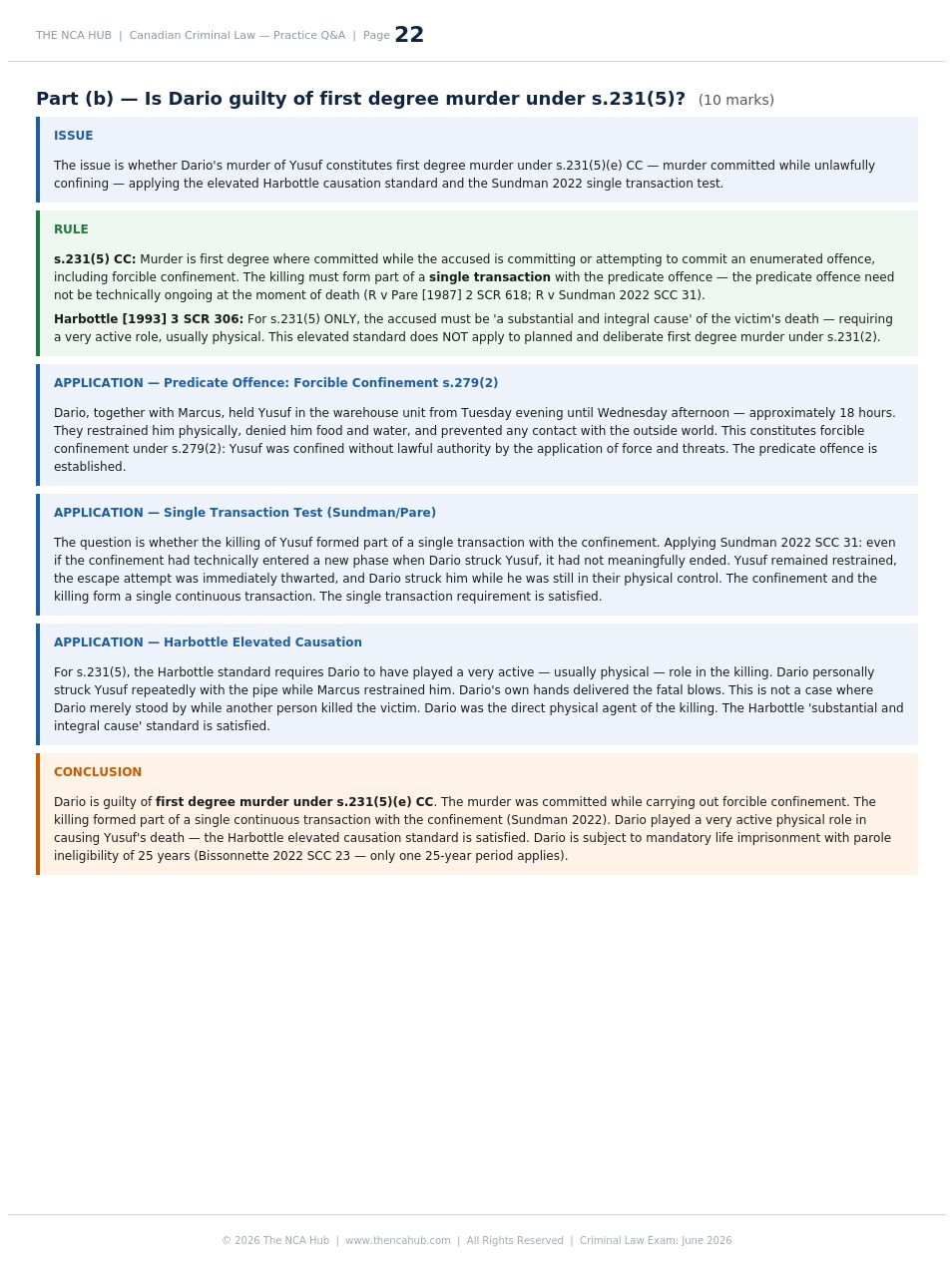
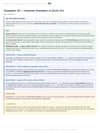
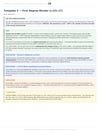
Includes Template 4 (murder s.229, all three routes), Template 5 (first degree murder s.231, planning and deliberation as two independently required elements, the s.231(5) single transaction test with Harbottle causation pre-mapped, and the exhaustive s.231(5) list so you do not route robbery through it), Template 18 (common intention s.21(2) with the Loganlimit built in), Template 21 (attempt, with Dynar on why the factual and legal impossibility distinction is not Canadian law), Template 24 (intoxication, with the post-Brown position on s.33.1), Template 25 (self-defence, every s.34(2) factor in its correct subsection for holistic application), Template 28 (duress, with the principal and party threshold question and the six Ryan elements), Template 37 (s.11(b), with Vrbanic and the 2026 remedy change), and five procedure templates: preliminary inquiries, the jury trial, trial participants, pre-trial motions, and appeals and judicial review.
PRACTICE Q&A, 17 full-length questions
Calibrated to NCA difficulty: open book, three hours, problem questions requiring full IRAC analysis on multiple issues each. Every question carries a model answer and a marking guide showing exactly where the points sit.
Covers murder and first degree classification, party liability, sexual assault including Kirkpatrick and Barton, Charter breaches and s.24(2) exclusion including a Bykovets IP address question, defences including intoxication, self-defence and duress, and sentencing with Gladue applied and Hills against Hilbach distinguished. Plus two full procedure questions: one running preliminary inquiry availability, the Arcuri standard, jury selection and a directed verdict error through a single fact pattern, and one working a multi-accused prosecution through the Jordan ceiling, the Vrbanic complexity exception, the remedy, and the route of challenge.
WRITTEN FOR THE AUGUST 2026 SYLLABUS
Every topic mapped to the NCA Canadian Criminal Law syllabus revised August 2026, including the four procedure topics and the 2026 Criminal Code amendments providing remedies other than a stay for a s.11(b) breach. Based on Roach, Criminal Law (8th ed, Irwin Law, 2022) and Coughlan, Criminal Procedure (5th ed, UTP, 2026), with the syllabus reading pages carried on the relevant topics.
Recent authority included: Vrbanic 2026, Bykovets 2024, Hills 2023, Hilbach 2023, Sundman 2022, Bissonnette 2022, Brown 2022, Kirkpatrick 2022, Cowan 2021, Khill 2021, Chouhan 2021.
ABOUT THE AUTHOR
Completed all five NCA exams. Passed the Ontario Barrister examination. LLM in International Commercial Law, University of Bristol. Litigation experience at Eversheds Sutherland, DWF and Keoghs in the UK.
YOUR COPY IS PROTECTED
Every page is stamped with your email address. Single user licence only.
Questions before buying? Email thencahub@gmail.com, answered within a few hours.