

NEXIE GEMS™
Facilitator Training — Universal Family Learning Through Play
Growth • Empathy • Mind • Service
One light. Many colours. Unlimited ways to shine.
Every child is a gem.
Every child brings their own strengths, interests, ways of connecting, ways of learning and emerging capabilities.
NEXIE GEMS™ is a universal, parent-present family learning and play program that helps families notice those strengths, understand development and create everyday opportunities for children to grow.
GEMS is designed for all families.
A diagnosis, referral or developmental concern is not required.
The NEXIE GEMS Facilitator Training prepares educators and facilitators to understand the GEMS approach, plan and facilitate the ten-session Sharing Circle program, work respectfully with families and demonstrate the capability required for authorised GEMS delivery.
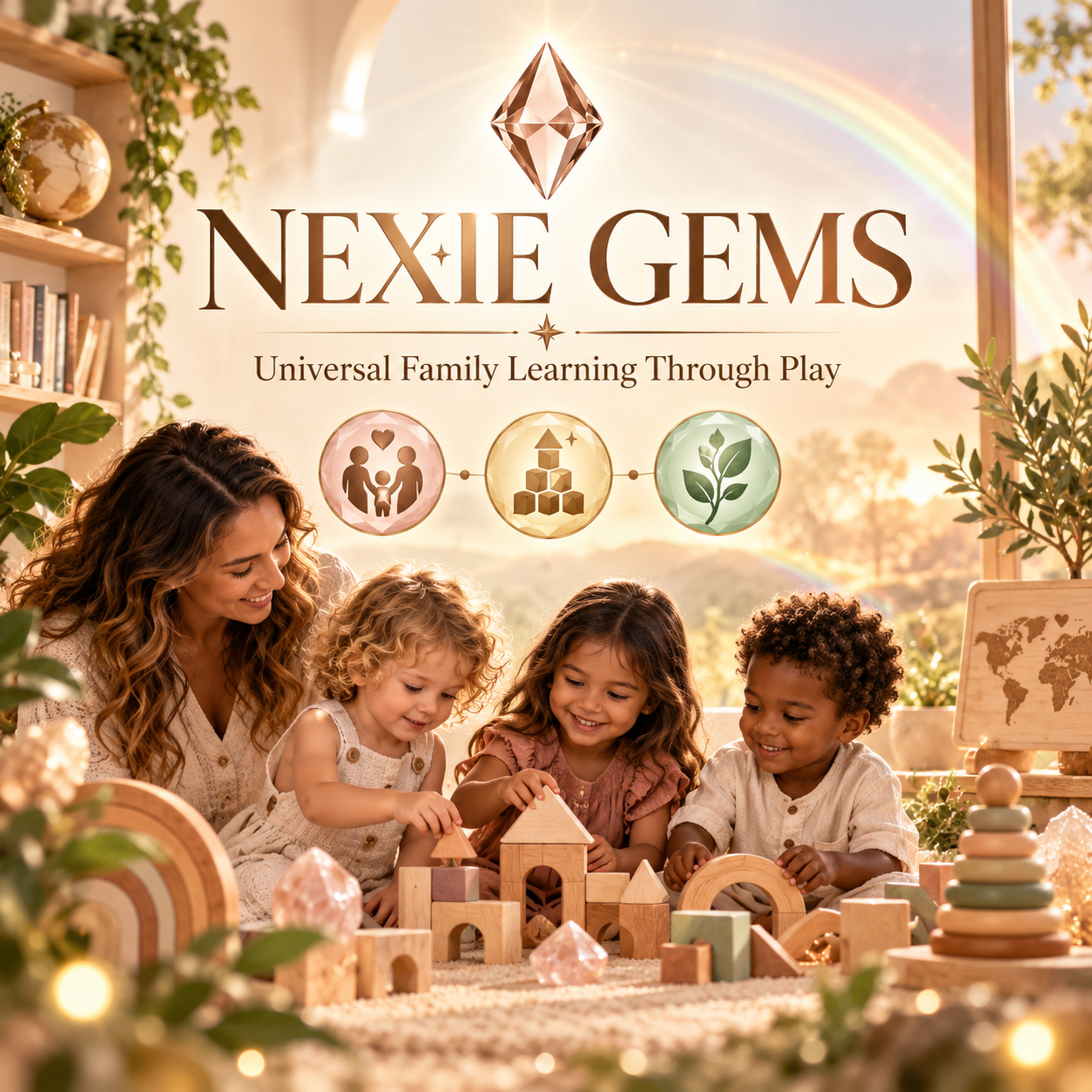
Discover the child through play, connection and shared experience
GEMS begins with a simple idea:
Children show us who they are through what they notice, choose, create, communicate, enjoy and return to.
Rather than beginning with what a child cannot do, GEMS helps adults notice:
- what comes naturally;
- what captures the child's interest;
- how the child connects;
- how they communicate;
- what conditions help participation;
- which developmental capacities are emerging;
- and what opportunities may help those capacities grow.
Families learn alongside their children through play.
Facilitators create the conditions for that discovery.
Choose a pricing plan
AUD $975
NEXIE GEMS™ Facilitator Training
This purchases the training pathway.
When a learner is ready to operate GEMS commercially, the existing NEXIE model can then apply:
$390 service activation
followed by the applicable annual NEXIE commercial licence while operating.
That keeps the commercial principle simple:
Learn once. Specialise as you grow. Pay for the NEXIE systems you use. Keep a licence while you operate commercially.
For employed educators using GEMS under an organisational NEXIE agreement, the organisation's licensing arrangement can govern delivery instead.
NEXIE Hub Membership — GEMS
A$49
per month
AUD $49/month. Includes the GEMS guided learning pathway, six Entry and Exit application lessons, the complete GEMS Playbook Series (G00–G09), Sharing Circle and family-learning activities, practical portfolio resources and access to the shared NEXIE Hub. Explore child-led play, belonging, inclusive environments, family participation and everyday learning. One selected pathway; subscription renews monthly until cancelled.
Your 12-lesson facilitator pathway
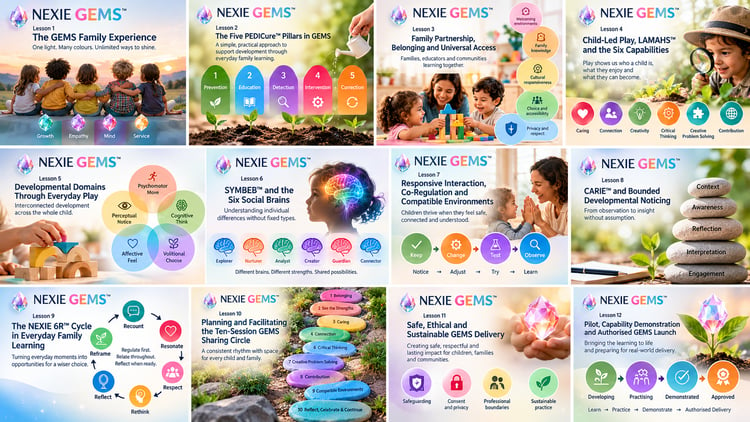
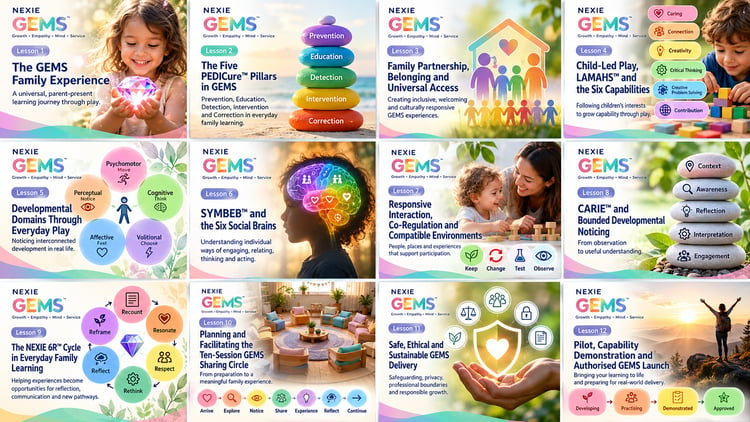
Lesson 1 — The GEMS Family Experience
Understand the universal parent-present GEMS experience, the role of play, belonging and family participation, and the distinction between mainstream GEMS and additional-support ECHOS.
Lesson 2 — The Five PEDICure™ Pillars in GEMS
Learn how Prevention, Education, Detection, Intervention and Correction operate within everyday family learning while keeping GEMS educational, developmental and non-clinical.
Lesson 3 — Family Partnership, Belonging and Universal Access
Build a welcoming program around family knowledge, cultural responsiveness, accessibility, privacy, choice and the NEXIE No-Duplication Rule.
Lesson 4 — Child-Led Play, LAMAHS™ and the Six Capabilities
Learn how to use child-led play to notice strengths and create opportunities for Caring, Connection, Creativity, Critical Thinking, Creative Problem Solving and Contribution.
Lesson 5 — Developmental Domains Through Everyday Play
Learn to notice Psychomotor, Perceptual, Cognitive, Affective and Volitional development as interconnected capacities rather than isolated checklist items.
Lesson 6 — SYMBEB™ and the Six Social Brains
Use the Social Brain Epigenetic Blueprint™ to deepen curiosity about individual ways of learning, engaging and relating without fixed typing or diagnosis.
Lesson 7 — Responsive Interaction, Co-Regulation and Compatible Environments
Explore responsive interaction, co-regulation and the physical, sensory, relational and cultural conditions that influence participation.
Use:
Keep → Change → Test → Observe
Lesson 8 — CARIE™ and Bounded Developmental Noticing
Use Context, Awareness, Reflection, Interpretation and Engagement to separate observation from assumption and keep family documentation useful and proportionate.
Lesson 9 — The NEXIE 6R™ Cycle in Everyday Family Learning
Learn:
Recount → Resonate → Respect → Rethink → Reflect → Reframe
and how to adapt the sequence through conversation, stories, play, drawing and symbols.
Remember:
Regulate first. Relate throughout. Reflect when ready.
Lesson 10 — Planning and Facilitating the Ten-Session GEMS Sharing Circle
Turn the learning into the actual family program.
Learn how to prepare the environment, manage session flow, provide flexible participation choices and facilitate the complete ten-session Sharing Circle.
Lesson 11 — Safe, Ethical and Sustainable GEMS Delivery
Prepare for responsible delivery through safeguarding, consent, privacy, accessibility, venue readiness, professional boundaries and accurate communication with families.
Lesson 12 — Pilot, Capability Demonstration and Authorised GEMS Launch
Bring the full training together through planning, simulated facilitation, feedback, capability review and a bounded GEMS pilot.
Distinguish:
course completion
from
demonstrated facilitator capability
from
NEXIE authorisation
from
commercial delivery rights.
The ten GEMS Sharing Circles
Once prepared for delivery, facilitators work with this shared developmental spine:
Week 1
Belonging & Getting to Know You
Week 2
See the Strengths
Week 3
Caring
Week 4
Connection
Week 5
Creativity
Week 6
Critical Thinking
Week 7
Creative Problem Solving
Week 8
Contribution
Week 9
Compatible Environments
Week 10
Reflect, Celebrate & Continue
The program remains flexible.
Children do not have to perform a weekly skill or reach a predetermined result.
The themes create opportunities for play, connection, observation and family learning.
The Gems Within
-
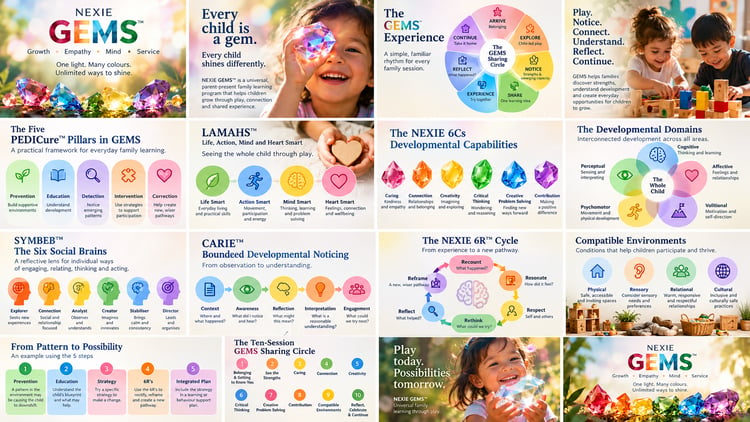
What makes GEMS different?
GEMS is not an assessment clinic, therapy program or diagnostic pathway.
It is a universal developmental education experience.
Families are invited to:
PLAY
Follow children's interests and exploration.
NOTICE
See strengths, communication, developmental patterns and emerging capability.
CONNECT
Strengthen relationships and shared understanding.
UNDERSTAND
Learn about development, environment and individual difference.
REFLECT
Consider what helped and what might be tried next.
CONTINUE
Carry useful ideas into ordinary family life.
-
The GEMS Sharing Circle
Every GEMS session uses a familiar rhythm:
ARRIVE → EXPLORE → NOTICE → SHARE → EXPERIENCE → REFLECT → CONTINUE
ARRIVE
Create belonging and a predictable welcome.
EXPLORE
Allow children to lead through play and interest.
NOTICE
Observe strengths, engagement and emerging developmental capacities.
SHARE
Introduce one short GEMS learning idea.
EXPERIENCE
Families try something together.
REFLECT
Notice what happened using simple NEXIE reflection.
CONTINUE
Take one realistic idea into everyday family life.
-
What you will learn
The facilitator training brings the wider NEXIE Method into a family-friendly mainstream program.
You will learn how to use:
PEDICure™
Prevention → Education → Detection → Intervention → Correction
to understand what may help without turning GEMS into a clinical service.
LAMAHS™
Life, Action, Mind and Heart Smart
to notice whole-person development through play.
The NEXIE 6Cs
Caring
Connection
Creativity
Critical Thinking
Creative Problem Solving
Contribution
as capability opportunities — never child scores.
Developmental Domains
Consider interconnected development across:
Psychomotor
Perceptual
Cognitive
Affective
Volitional
SYMBEB™
Use the Social Brain Epigenetic Blueprint™ as a reflective developmental lens for individual ways of engaging, relating, thinking and acting.
SYMBEB is not used to diagnose, permanently categorise or assign a fixed colour to a child.
CARIE™
Context → Awareness → Reflection → Interpretation → Engagement
to support careful developmental noticing.
The NEXIE 6R Intervention Cycle™
Recount → Resonate → Respect → Rethink → Reflect → Reframe
to help everyday experiences become opportunities for regulated reflection, communication and future capability.
-

GEMS and ECHOS are different pathways
GEMS™
Universal family learning through play
No diagnosis or developmental concern is required.
The emphasis is:
strengths → play → capability → connection → family learning
ECHOS™
Additional early-connections and participation support
ECHOS may use the same NEXIE foundation with more structured observation, participation support, environmental adaptation and service navigation where appropriate.
Families do not need to move from GEMS into ECHOS.
Each program has its own purpose.
-

What is included
Your NEXIE GEMS Facilitator Training includes:
12 facilitator learning lessons
Each lesson provides substantive learning, applied examples, activities, reflection and facilitator preparation.
Ten-session GEMS Sharing Circle model
A complete family-facing developmental sequence from belonging through the six capabilities to compatible environments and continuation.
NEXIE developmental framework integration
Including:
PEDICure™
LAMAHS™
6Cs
developmental domains
SYMBEB™
CARIE™
6R™
compatible environments
Facilitator capability pathway
Progress through:
Developing → Practising → Demonstrated → Approved
-

Who is this training for?
GEMS may suit:
- early childhood educators;
- early childhood teachers;
- Family Day Care educators and coordinators;
- community educators;
- family-learning facilitators;
- playgroup facilitators;
- existing ECEC providers;
- NEXIE Neuropreneurs developing a family-learning specialisation;
- appropriately experienced professionals working within their existing scope.
Relevant experience or qualifications may contribute to readiness but do not automatically confer NEXIE authorisation.
-

Learning pathway
The training moves through:
UNDERSTAND
Learn the GEMS developmental and family-learning foundations.
↓
NOTICE
Recognise strengths, individual difference and emerging developmental capacity.
↓
PLAY
Create child-led learning opportunities.
↓
CONNECT
Work relationally with children and families.
↓
REFLECT
Use CARIE and developmental reasoning.
↓
FACILITATE
Plan and rehearse the Sharing Circle.
↓
DEMONSTRATE
Show safe and capable facilitation.
↓
AUTHORISED DELIVERY
Move into the relevant NEXIE approval and licensing pathway where required.
Training is not authorisation
Completing the 12 lessons demonstrates engagement with the training.
It does not automatically provide:
- GEMS Facilitator authorisation;
- commercial NEXIE use rights;
- a NEXIE service licence;
- nationally recognised competency;
- clinical or allied-health status;
- government endorsement.
Where live or commercial GEMS delivery requires observed capability, service activation or licensing, those requirements are completed separately.
-

Professional Scope
GEMS is:
educational
developmental
relational
family-centred
strengths-focused
non-diagnostic
non-clinical
Observation is not diagnosis.
Educational support is not clinical treatment.
When another professional or service is more appropriately placed to help, facilitators remain within scope and support an appropriate next step.