
Context Kit
Every new session, your agent acts like it has never seen your project. You give it a rule. Next session, it breaks the rule again.
Context Kit sits down with you once, writes your project's rules and notes where your agent reads them, makes the important rules stick, and keeps the whole thing tidy week to week.
What you get
A setup interview about your project. It reads your repo first: the README, your build setup, your recent commits, any instructions you already have. Then it asks only what the repo didn't answer. What does the agent keep getting wrong? What must it never do? How do you test and ship? What's half finished? Skip any question you like. You end up with rules and notes written for your project, not blank templates. If you already have instructions, it merges them and backs up your originals first.
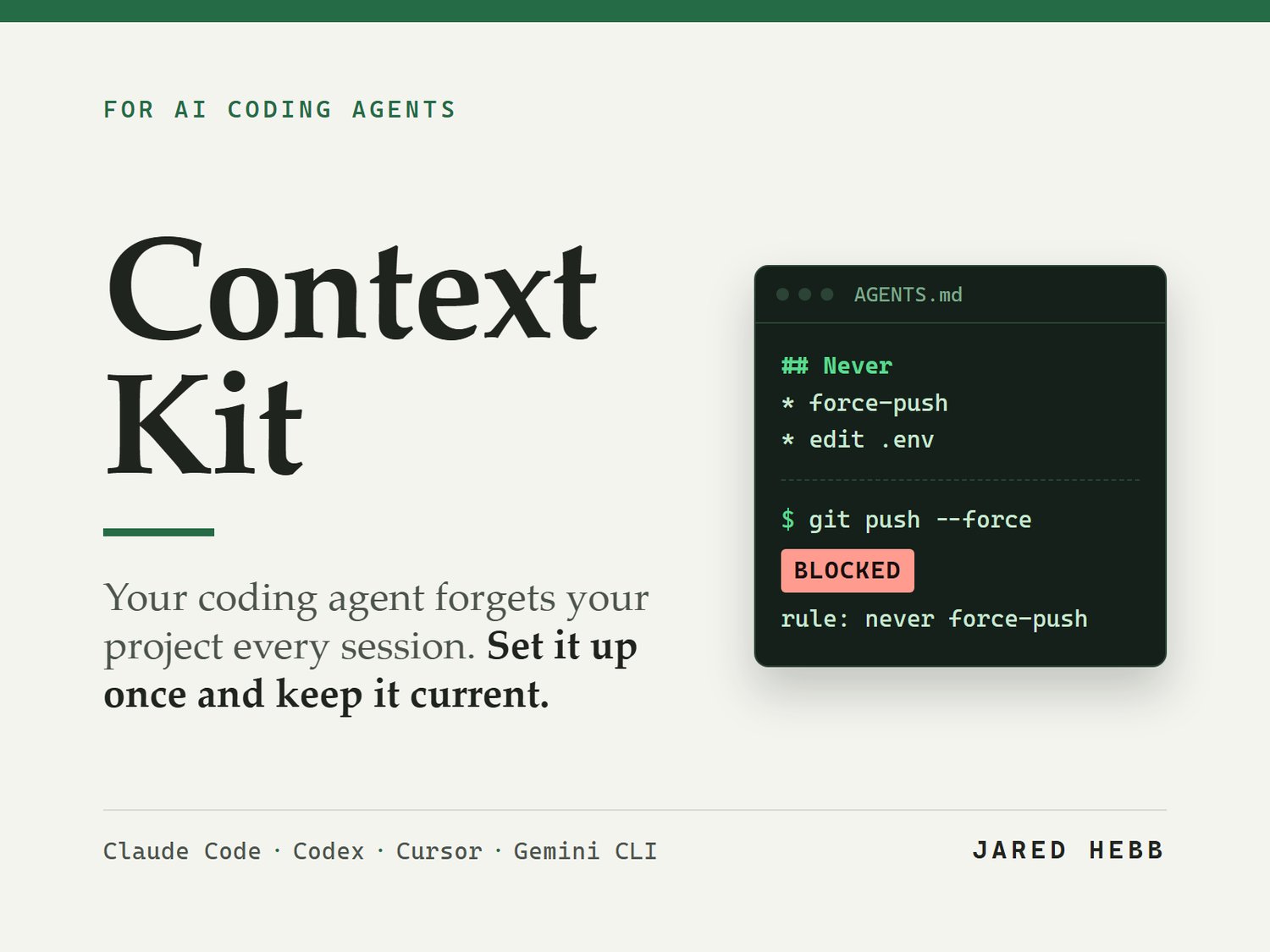
Rules that block, not just remind. Every rule gets sorted into one of two kinds. The ones a machine can check, like "never force-push" or "never edit .env", get wired in so the agent's ordinary attempts are stopped and it is told why. The rest stay as written guidance. You see which rule became which kind.
A handoff between sessions. Before a session compacts or ends, the kit writes down where you stopped: your branch, what's uncommitted, your recent commits, your last few asks. The next session starts with it.
A weekly upkeep. Once a week, at the start of a session, your agent offers a tidy-up. It looks for notes that point at things you deleted, tightens any rule that got broken three or more times, trims your instructions back under budget, and shows you one set of changes to approve.
One command to undo it. Uninstalling puts back everything the installer changed, byte for byte, including the instructions you had before. The notes it wrote for you stay, and it tells you which ones.
Works with
Claude Code and Codex, tested live (blocking in Codex starts after a one-time approval). Cursor and Gemini CLI, tested with sample hook data. At install it prints exactly which rules are blocked and which are advice only on each tool, so nothing is a surprise. On Cursor, rules about the agent's own edits are advice only and you run the handoff yourself.
Who it's for
You build your own projects with an AI coding agent and you're past the basics. You don't need to be a developer, and you don't need a terminal to install it: drag the kit's folder into your agent's chat and ask it to install. Needs Node 18 or later.
$47, one time.
Sold as-is for the agent versions it was tested on (Claude Code 2.1.308, Codex CLI 0.146.1). No support and no promised updates. If an agent changes how its hooks work, the kit lets the action through instead of blocking your work, and the weekly check tells you.