

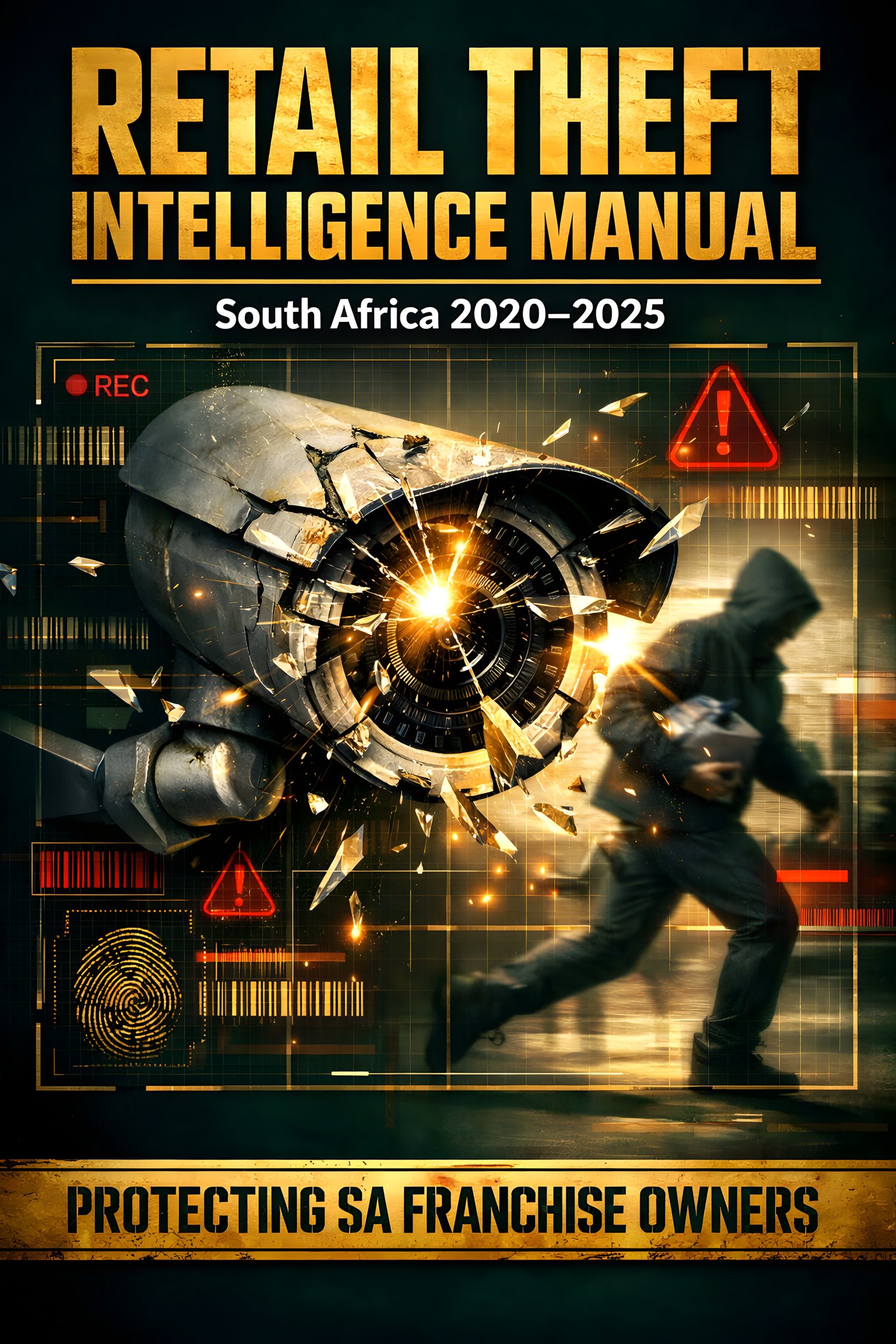
RETAIL THEFT INTELLIGENCE MANUAL
⭐⭐⭐⭐⭐ The Only Retail Security Manual South African Franchise Owners Actually Need
Reviewed in South Africa | Format: Operational Manual | Publisher: RIDBS (ridbs.co.za) | Version 1.0, 2025
Let me be direct: if you own or manage a retail franchise in South Africa and you don't have a structured loss-prevention system in place, this manual will save you money within the first month of use. Possibly a lot of it.
South African retailers collectively lose an estimated R23 billion annually to theft and shrinkage — roughly 2% to 2.5% of total retail turnover. That is not a background statistic.
That is the operating environment every franchise owner wakes up inside of every single day. This manual, compiled by RIDBS and drawing on data from SARRI, SAPS, CGCSA, TRACIT 2025, the Drinks Federation of SA, and SAHPRA, takes that reality and converts it into something genuinely usable: a room-by-room, shift-by-shift, day-by-day operational system.
What makes it different from every other security guide you've ignored
Most security manuals are written for someone else — a corporate head office, an insurer, a compliance auditor. This one is written for the person unlocking the store at 6am. The opening pages say it plainly: this is not meant to sit in a drawer. And the structure backs that up.
The manual's 22 sections split cleanly into intelligence you read once and tools you use daily. Sections 1 through 9 deliver the briefing: national theft data by product category, sector-by-sector breakdowns for FMCG supermarkets, pharmacies, liquor stores, and general retail, a full analysis of three-tier Organised Retail Crime (ORC) syndicate structures, the informal economy resale pipeline (goods move from your shelf to a township spaza shop within 2–4 hours), a ranked Top 50 most stolen products list, and a five-year trend analysis covering 2020 to 2025.
The intelligence is specific and the numbers are real
Meat and fresh protein accounts for R4.5–R5.5 billion in annual losses. Alcohol: R3–R4 billion. Baby formula retails at R350 and resells informally at R200 — which is precisely why ORC teams target it with "steal-to-order" precision.
A coordinated four-person team can remove R30,000 worth of stock from your meat and alcohol aisles in under five minutes during a busy Saturday. The manual tells you what the Distractor, the Collector, the Exit Runner, and the Driver each do — and what your staff should watch for.
The operational tools are the real value
From Section 10 onwards, this becomes a working document. There is a Daily Opening Checklist and a Daily
- Closing Checklist — signed by the manager on duty, filed for 90 days, structured into security systems, high-risk stock verification, staff readiness, and cash controls.
- A Weekly Management Checklist covers shrinkage analysis, CCTV review, and staff monitoring.
- A Monthly Loss-Prevention Checklist goes deeper on supplier reconciliation and technology audit. The Quarterly Security Audit scores your store out of 100 across 50 line items — below 60 requires an action plan; below 40 means critical risk.
- A Staff Induction Checklist ensures every new hire is briefed before they touch the floor. There are also dedicated logs for incident reporting, delivery receiving verification, refund and void monitoring, and a supplier risk register.
Sector coverage is thorough and honest
The pharmacy section doesn't soften the reality: WHO estimates 1 in 10 medical products in South Africa are substandard or falsified, often from diverted legitimate stock.
Armed robberies targeting Schedule 5/6 medicine safes are documented, with syndicate recruitment payments of R2,500–R3,000 per robbery on record.
The liquor section confronts the illicit alcohol market directly — R25.1 billion underground, 18% of all alcohol sold nationally in 2024, up from 37.6% illicit share in 2019. The load-shedding vulnerability data is SA-specific and important: a 15% increase in after-hours break-ins during extended outages between 2021 and 2024.
Minor limitations
Some statistics rely on industry models rather than independently audited figures, and the manual appropriately flags this. A few contact details will require periodic verification. The manual would benefit from a digital version with fillable checklist fields for stores managing paperless operations.
Bottom line
This is not a theoretical document. It is a system — intelligence briefing, daily habits, weekly reviews, quarterly audits, staff training, incident logging, and emergency protocols — packaged into a single coherent manual that any franchise owner can put into operation immediately. At R23 billion in annual industry losses, the cost of not having something like this is measurable. The cost of using it is a laminator and thirty minutes of management time per week.
Highly recommended for: FMCG franchise owners, pharmacy operators, liquor store owners, hardware retailers, and any independent store owner operating in a South African urban or peri-urban environment.
Published by RIDBS — ridbs.co.za | Sources: SARRI 2023 · SAPS · CGCSA · TRACIT 2025 · Drinks Federation SA · SAHPRA
Don't Miss Out—Unlock Epic Deals & Bundles Now!
To see all our other offers and bundles, check the links below: