
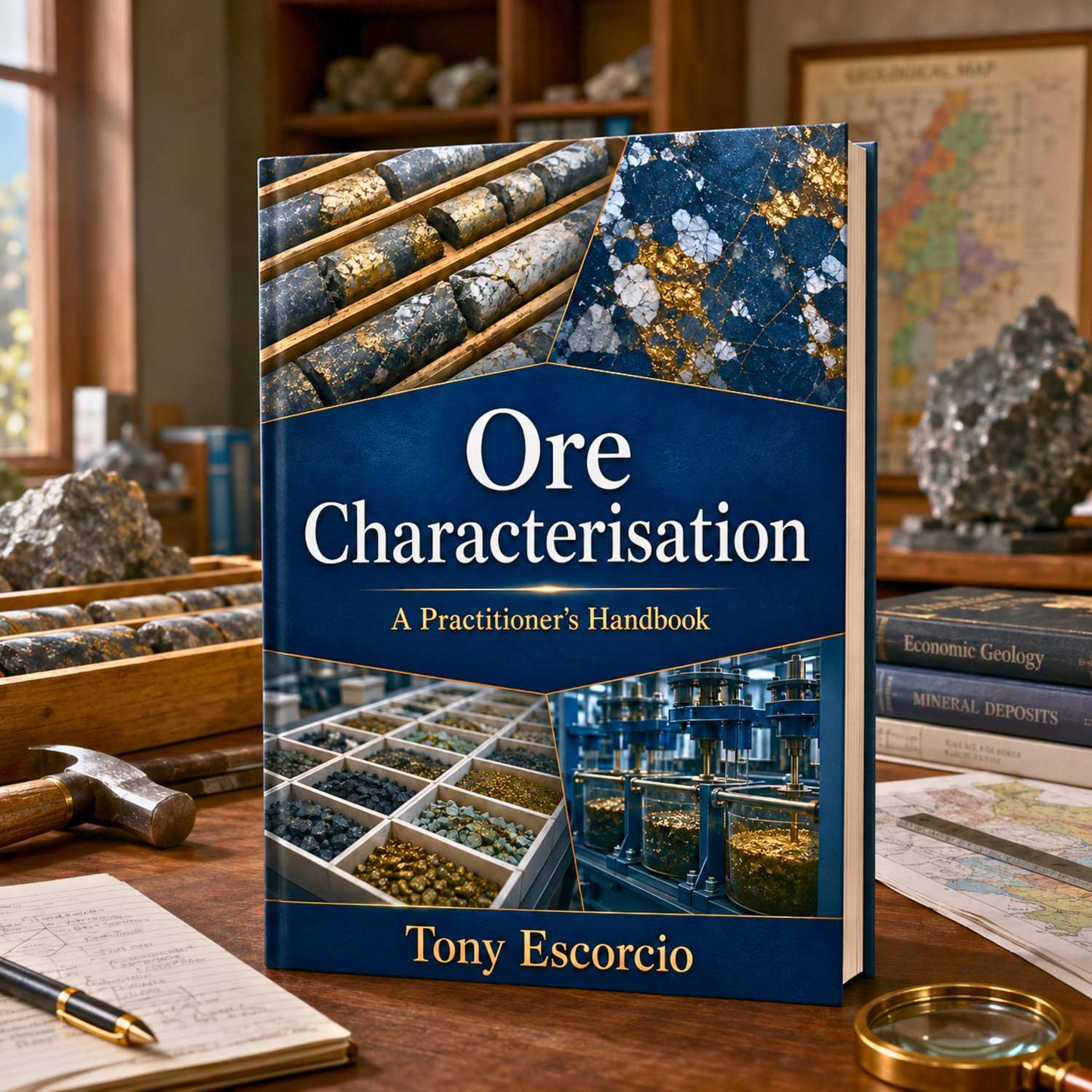
Ore Characterisation
Ore Characterisation: A Practitioner’s Handbook
Reliable mineral-processing decisions begin with a clear understanding of the ore.
Ore Characterisation: A Practitioner’s Handbook provides a practical guide to the sampling, testing, interpretation and integration of geological, mineralogical, physical, chemical and metallurgical data. It explains how ore characteristics influence comminution, gravity recovery, flotation, leaching, reagent consumption, materials handling, dewatering and overall plant performance.
Written for practising engineers, metallurgists, geologists, operators, consultants and students, the book connects laboratory testwork with real project and operating decisions. Rather than treating assays, mineralogy and metallurgical tests as isolated activities, it shows how the results should be combined to develop representative ore domains, suitable processing routes and defensible design criteria.
Topics include:
- Representative sampling and sample preparation
- Sampling errors and quality control
- Density, moisture, particle size and particle shape
- Optical and automated mineralogy
- Mineral associations, liberation and gold deportment
- Head-grade variability and deleterious elements
- Bond work indices, abrasion and breakage testing
- Gravity-recoverable gold testing
- Flotation and leach amenability
- Diagnostic leaching and refractory-gold assessment
- Preg-robbing identification and mitigation
- Geometallurgical domains, proxy models and block modelling
- Variability testing and design-percentile selection
- Translation of testwork into plant-design criteria
The handbook places particular emphasis on variability. Average values alone rarely provide a safe basis for design. Hard-ore zones, low-grade intervals, deleterious minerals, changing liberation behaviour and variable metallurgical response can all affect throughput, recovery, reagent demand and project economics.
Clear diagrams, decision trees, workflows and worked examples help readers understand not only what tests to conduct, but also why they are required, how the results should be interpreted and how they influence flowsheet and equipment decisions.
Ore Characterisation is a practical reference for anyone involved in evaluating mineral resources, planning metallurgical testwork, designing process plants or improving the performance of existing operations.