




When Love Ends
When Love Ends
A Self-Guided Workbook for Heartbreak
Nobody tells you how long this is supposed to take. Nobody tells you that the person who left might be just as undone as the person who was left. Or that you can know, with complete certainty, that ending it was the right thing — and still grieve it like a death. Or that the four-month relationship can hit harder than the four-year one. Or that you might be sitting on the kitchen floor six weeks later, still not entirely sure how you got there, still not entirely sure this is allowed. It is allowed. There is no set timeline for recovering from heartbreak. Not for the one who was left. Not for the one who did the leaving. Not even for the one who had no real choice — who left because staying was no longer safe, and is now grieving something that should never have needed to end that way. Your pain is not a sign that something is wrong with you. It is a sign that something mattered.
Who this is for
You are in the acute phase and you need something to hold onto — something that validates what you are feeling and gives you a framework for it.
You have been in this longer than you expected and you are starting to wonder what is wrong with you. Nothing is wrong with you. This section will explain why.
You were the one who ended it. You are grieving without permission. This workbook gives you permission.
You left because you had no choice. What you are feeling is complex and valid and this workbook holds space for all of it.
You are ready to do the active work — not just survive the grief but actually move through it, understand it, and come out of it with more self-knowledge than you went in with.
What this workbook does
When Love Ends is a self-guided neuropsychological workbook that takes you through the science of heartbreak, the specific factors that shape how hard and how long it hits, the established grief frameworks that help you locate where you are — and the active, embodied, evidence-based work of actually moving through it. Not around it. Through it.
What's inside
Introduction — There Is No Set Timeline
The central permission this workbook opens with: there is no correct speed for this grief. A clear, honest account of the specific factors that shape how intense and how prolonged heartbreak is. And a dedicated note on the leaver's grief — including those who left not freely, but because they had no other safe option.
Part 1 — Your Pain Is Real
The neuroscience that validates everything you are feeling. Heartbreak activates the same neural pathways as physical pain — documented on fMRI. The dopamine withdrawal parallel, the stress hormone cascade behind the chest tightness, the sleeplessness, the inability to eat. Eight peer-reviewed sources in this section alone. The most useful thing science provides: shift the question from what is wrong with me to this is what heartbreak does to a brain and body. That shift matters more than it sounds.
Part 2 — Why This One Hits the Way It Does
Not all heartbreaks are equal. This section validates the variation without hierarchy. The EMPRYNT™ Biographical Backpack and compound grief — when the relationship activated an old wound, you are not only grieving this loss, you are grieving the older one beneath it. That is why some breakups feel disproportionate. They are proportionate to the full weight of what is being carried. Includes the Grieving the Dream exercise: a four-step structured process for separating the grief for the actual person from the grief for the life you had imagined — and for reclaiming the dream as yours, not theirs.
The leaver's grief given its own full section, including those for whom leaving was not a free choice. The identity loss — when self-worth was organized around the relationship, the ending is an identity crisis as much as a relational one.
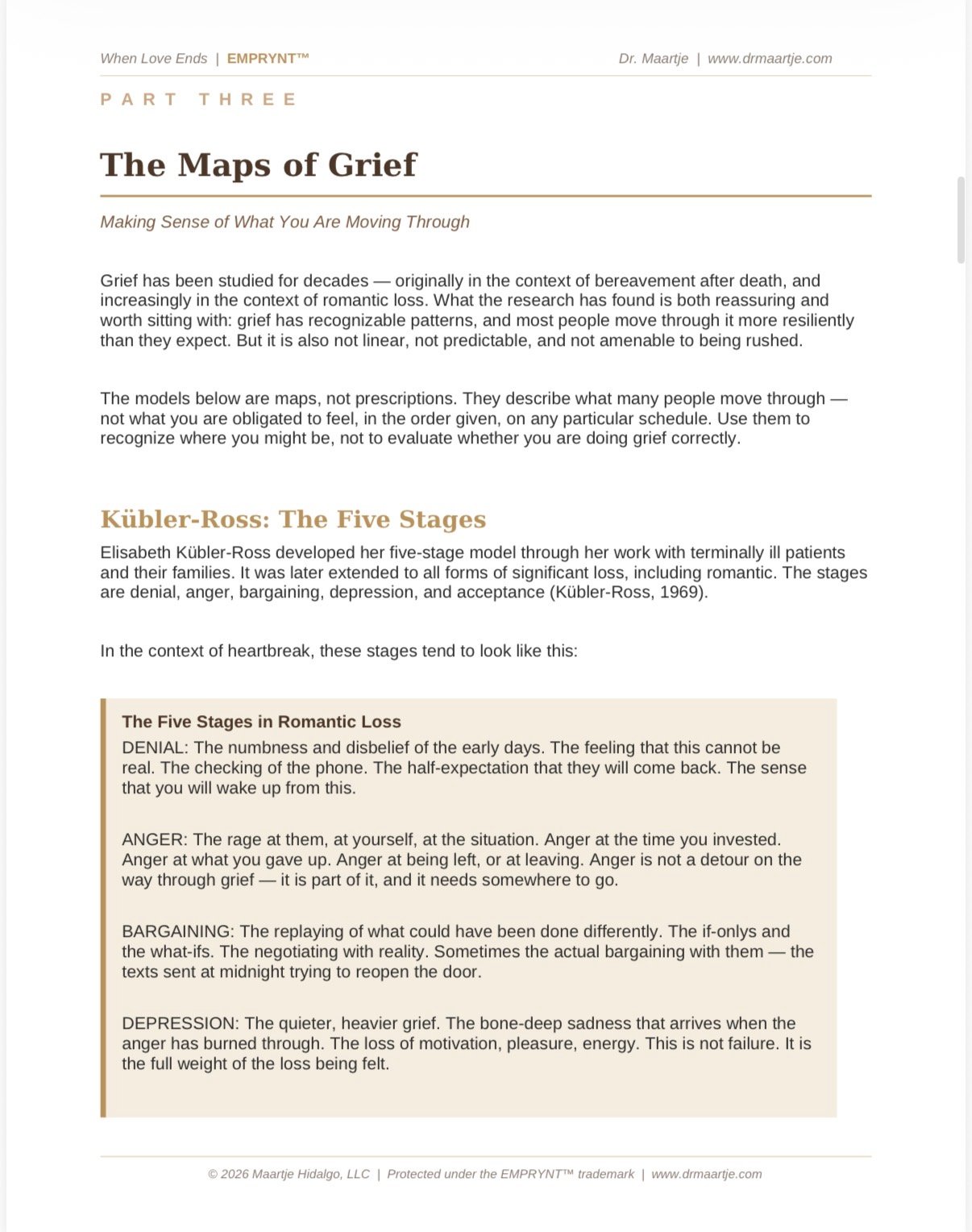
Part 3 — The Maps of Grief
Three frameworks — as maps, not prescriptions. Kübler-Ross's five stages, with the critical caveat she herself made: not linear, not obligatory, not a timeline. Worden's four Tasks of Mourning — more clinically useful than stages because they are active, non-linear, and returnable. Bonanno's three trajectories, with the finding most people need to hear: resilience, not prolonged grief, is the most common response to loss. Most people are more resilient than the worst moments make it feel. The EMPRYNT™ compound grief map closes the section: three layers that need to be grieved separately — the relationship, the dream, and the backpack beneath both.
Part 4 — The Body in Grief
You cannot think your way through heartbreak. This section explains why — and what the body actually needs. The nervous system after attachment disruption. The difference between numbing and healthy distraction: including a specific redirection principle. Two somatic practices for acute grief waves. Sleep, movement, and physical contact each explained with the neurobiological rationale behind them.
Part 5 — The Psychological Work
The active core of recovery. Rumination versus processing — what separates them, why the distinction matters, how to tell which one you are in. Narrative reappraisal: the research that shows restructuring the story of the relationship measurably reduces dopamine craving within weeks. The Dialectival Behavioral Therapy "Both/And" for ambivalence: you can miss someone and know the relationship was wrong simultaneously. Schema activation as a window — what the loss is showing you about what was really running underneath.
Part 6 — Rebuilding Yourself
Not back to who you were. Forward to who you are becoming. The EMPRYNT™ Biographical Backpack and Behavioral Neurofeedback backed by modern neuroimaging research. The pillars framework: the five things that fill you and make you feel like yourself. Structural integrity comes from within.
Part 7 — What This Is Teaching You
Integration without bypassing. You are not required to be grateful. You are not required to find the silver lining. But when you are ready — when enough of the grief has genuinely been moved through — this section offers the space to look at what the relationship revealed, update your backpack, and write two letters: one to the relationship, and one to yourself.
© 2026 Maartje Hidalgo, LLC | Protected under the EMPRYNT™ trademark