





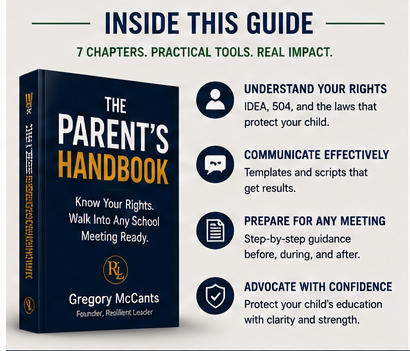






The Parent's Handbook: Know Your Rights. Walk Into Any School Meeting Ready
A verbal request is easy to overlook. A written request creates an obligation. A written request that cites the relevant law creates a deadline.
The moment your phone flashes with a school building’s number on the caller ID, your body reacts before your conscious mind can even register the notification. Your nervous system maps the pattern instantly. It has learned through raw experience that these calls rarely deliver neutral news, and so you brace yourself before you even say hello .
This isn't an overreaction. It is pattern recognition.
When you sit down in that school conference room, the asymmetry is glaring. You are one person sitting on one side of the table. You are surrounded by several school staff members who hold the official student file, the logged data, the institutional language, and the definitive home-court advantage. The room was engineered for them; you were simply invited into it. Too often, parents walk out of these high-stakes disciplinary or accommodation meetings feeling like the decision was completely finalized before they even walked through the front doors.
The systemic fallout of this design failure shows up clearly in the Federal Civil Rights Data Collection metrics. Nationally, students with disabilities represent just 17 percent of total school enrollment, yet they absorb a staggering 29 percent of all out-of-school suspensions. For Black students with disabilities, the structural risk intensifies dramatically: roughly 20 percent are suspended in a single school year, compared to 9 percent of all special education students.
You are not the problem, and this layout is not your fault. The system was simply never built to prioritize or ease this process for families. It communicates in institutional code and moves at an organizational speed designed to manage large numbers of children efficiently.
You do not need to know every single legal nuance of public education to protect your child. You just need access to the right information and the language the system is mandated to take seriously.
Written by a 23-year Title I teacher, dean, and assistant principal in the Maryland-DC region, The Parent’s Handbook shuts down the institutional shortcuts by shifting your communication framework from reactive to strategic. Stop relying on casual hallway conversations that leave your child unprotected. Equip yourself with the exact written templates, legal timeline constraints, and procedural boundaries required to step across the threshold as an equal partner.
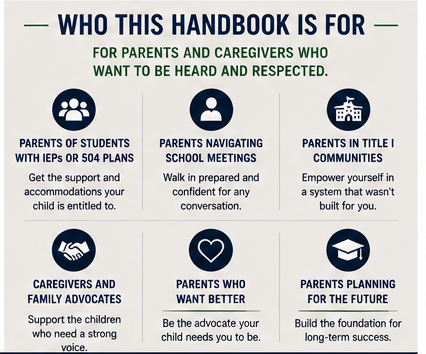
Who This Is For
- Parents & Guardians navigating the IEP or 504 process who feel outmatched by specialized jargon and want a grounded, clear translation of their federal rights.
- Families facing sudden school discipline actions or exclusions who need immediate, copy-and-paste scripts to halt administrative removals or force school reviews.
- Community Advocacy Leaders looking for a plain-language, rigorous field guide to help underserved families build institutional fluency and handle adversarial school dynamics.
What You Get
- 7-Chapter Systemic Roadmap: A complete parent manual detailing why meetings feel adversarial, what the system hides, and how to navigate building power dynamics.
- The Written Communication Principle: A tactical operational guide explaining why verbal requests carry no legal weight, and how to use timestamped written tracking to force institutional deadlines.
- The Core IEP Protections Brief: Plain-language guidance on your status as a mandatory team member, the execution of FAPE, and the triggering parameters of Prior Written Notice.
- The Manifestation Determination Review (MDR) Blueprint: Precise procedural steps detailing when a school crosses the 10-day cumulative removal ceiling and how to block unlawful suspensions.
- The 504 Accommodation Inquiry Scaffold: A strategy to audit missing classroom supports and shift individual teacher failures from personal preferences into strict compliance violations.
- The 5-Tier Institutional Escalation Path: Chronological guidance outlining exactly how to advance an unresolved issue from the classroom teacher to the principal, the district coordinator, the superintendent, and up to the Office for Civil Rights (OCR).
- The Parent Readiness Checklist: A pre-meeting audit document tracking agenda requests, non-negotiables, file reviews, and support personnel preparation.
- The Plug-and-Play Script Bank: A ready-to-use collection of copy-and-paste templates engineered to issue official demands for MDR Requests, IEP Assemblies, Records Retrieval, Accommodation Inquiries, and Executive District Escalations.
What It Pairs With
To construct an absolute, multi-layered defensive boundary for your family's educational tracking, this handbook links directly with:
- The Parent's Handbook & IEP Rights Guide: For anchoring these foundational communication structures to a highly specialized, hyper-focused manual tracking state-level special education criteria.
- Inside the Room: For mastering real-time behavioral pacing strategies, negotiation mechanics, and physical boundary-holding techniques when facing an entire school staff panel.
- Veteran AP Field Manual: For auditing the exact, legally defensible documentation standards that school administrators use behind closed doors to engineer student behavior logs.