

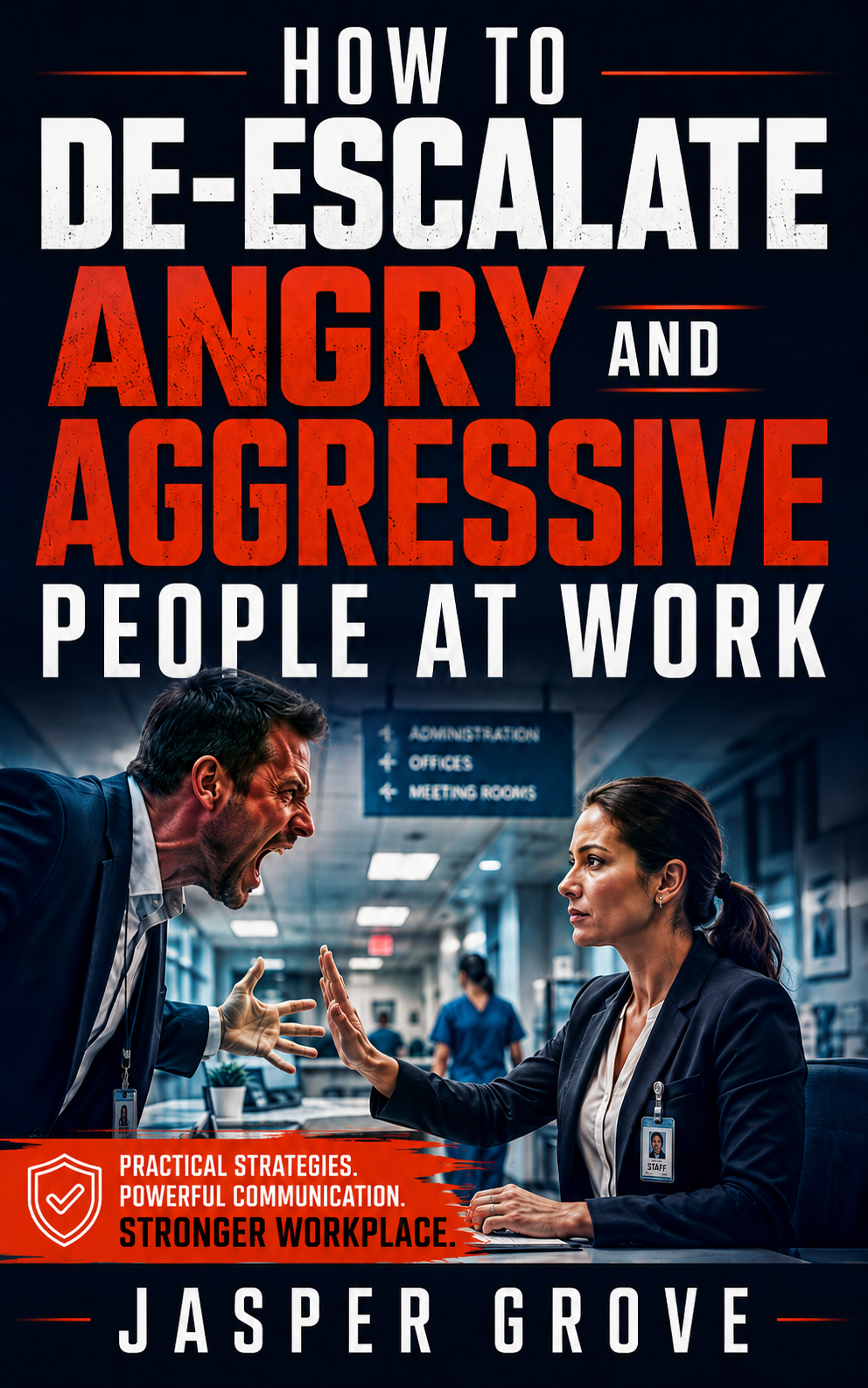
How to De-escalate Angry and Aggressive People at Work
How to De-escalate Angry and Aggressive People at Work is a practical, easy-to-follow guide for anyone who may face anger, hostility, confrontation, or aggressive behaviour in the workplace.
Whether you work in healthcare, security, retail, customer service, education, government, hospitality, transport, an office, or any other public-facing environment, difficult interactions can happen without warning. Knowing what to say, how to say it, and when to step away can make the difference between a situation calming down and one becoming more serious.
This ebook explains de-escalation in clear, straightforward language and focuses on practical techniques that can be used in real workplace situations. Readers will learn how to recognise early warning signs of escalating behaviour, maintain personal safety, control their own emotional response, communicate calmly, listen effectively, set boundaries, offer realistic choices, and respond appropriately to verbal abuse and threatening behaviour.
The guide also explores the psychology behind anger and aggression, helping readers understand why people may become confrontational and how feelings such as frustration, fear, embarrassment, disappointment, confusion, or loss of control can influence behaviour. Rather than trying to “win” an argument, the book shows how to reduce emotional intensity and create the conditions for safer, more constructive communication.
Practical workplace examples demonstrate how these techniques can be applied when dealing with angry customers, members of the public, colleagues, managers, callers, and people communicating through email or messaging. Readers are shown both ineffective responses and more constructive alternatives, making the advice easy to understand and immediately useful.
Inside, you will discover how to use tone of voice and body language effectively, demonstrate empathy without automatically agreeing, ask questions that redirect a confrontation, handle personal insults, establish clear limits, manage bystanders, recognise when de-escalation is failing, and decide when it is safer to disengage and seek assistance.
The ebook also includes a simple C.A.L.M.E.R. quick-reference model designed to help readers remember the key stages of de-escalation: Check Safety, Approach Calmly, Listen, Make Them Feel Heard, Establish Boundaries and Options, and Reassess.
A detailed de-escalation checklist, useful phrases, workplace scenarios, common mistakes, after-incident guidance, and a quick desk reference make this more than a book to read once. It can also serve as a useful refresher for employees, supervisors, team leaders, customer-service staff, security personnel, and anyone responsible for managing difficult interactions.
How to De-escalate Angry and Aggressive People at Work is about staying calm without being passive, setting boundaries without becoming confrontational, and protecting people without unnecessarily escalating conflict. It provides practical tools for handling challenging behaviour with greater confidence, professionalism, awareness, and control.
Designed for both individual readers and workplace teams, the guide is suitable for professional development, staff induction, refresher learning, and personal skill-building. Its emphasis is on safety: de-escalation does not mean tolerating abuse or remaining in danger. Readers are encouraged to recognise warning signs, follow workplace procedures, obtain assistance when necessary, and understand that ending an unsafe interaction can be the most appropriate response. If your work involves people, this is a practical skill set worth having.