Using Art to Express the Grief We Hold

A gentle, guided experience for the grief that words can't hold A self-paced online course • Approximately 3 hours of video • Begin whenever you're ready
Some grief doesn't want to be talked about. It wants to be made.
You've probably already tried to explain it. To a friend, a family member, maybe a counselor. And somewhere in the middle of the sentence you realized the words were too small — that what you're carrying doesn't fit into language.
That's not a failure of grief. That's the nature of it.
Grief lives in the body. It moves in color, in circles, in silence, in the pressure behind your eyes at a red light on a Tuesday. It has its own vocabulary, and most of us were never taught to speak it.
What's in the Course?
Expressing Grief Through the Arts teaches you that vocabulary — not through analysis or advice, but through creative practices that let your grief say what it needs to say, at your own pace, in your own space, with no one watching. You don't need to be an artist. You don't need to be "good at this." You only need to be willing.
Who this is for
- Anyone grieving a death — recent or long-carried
- Those grieving losses the world doesn't always name: a marriage, a diagnosis, a home, a future you expected
- People who feel stuck, numb, or exhausted by talking about it
- Those who sense that their mourning has been rushed, minimized, or timed by other people's comfort
- Caregivers, chaplains, counselors, and helping professionals who want a personal practice — or new tools for the people they serve
This is not for you if you're looking for a clinical treatment plan or a quick fix. Grief isn't a problem to be solved, and this course won't treat it like one.
What's inside?
A 1 hour 47 minute guided session
Grief education woven directly into practice — so you understand what's happening to you while you're moving through it. No lecture-then-homework. Learning and healing in the same breath.
Three creative activities
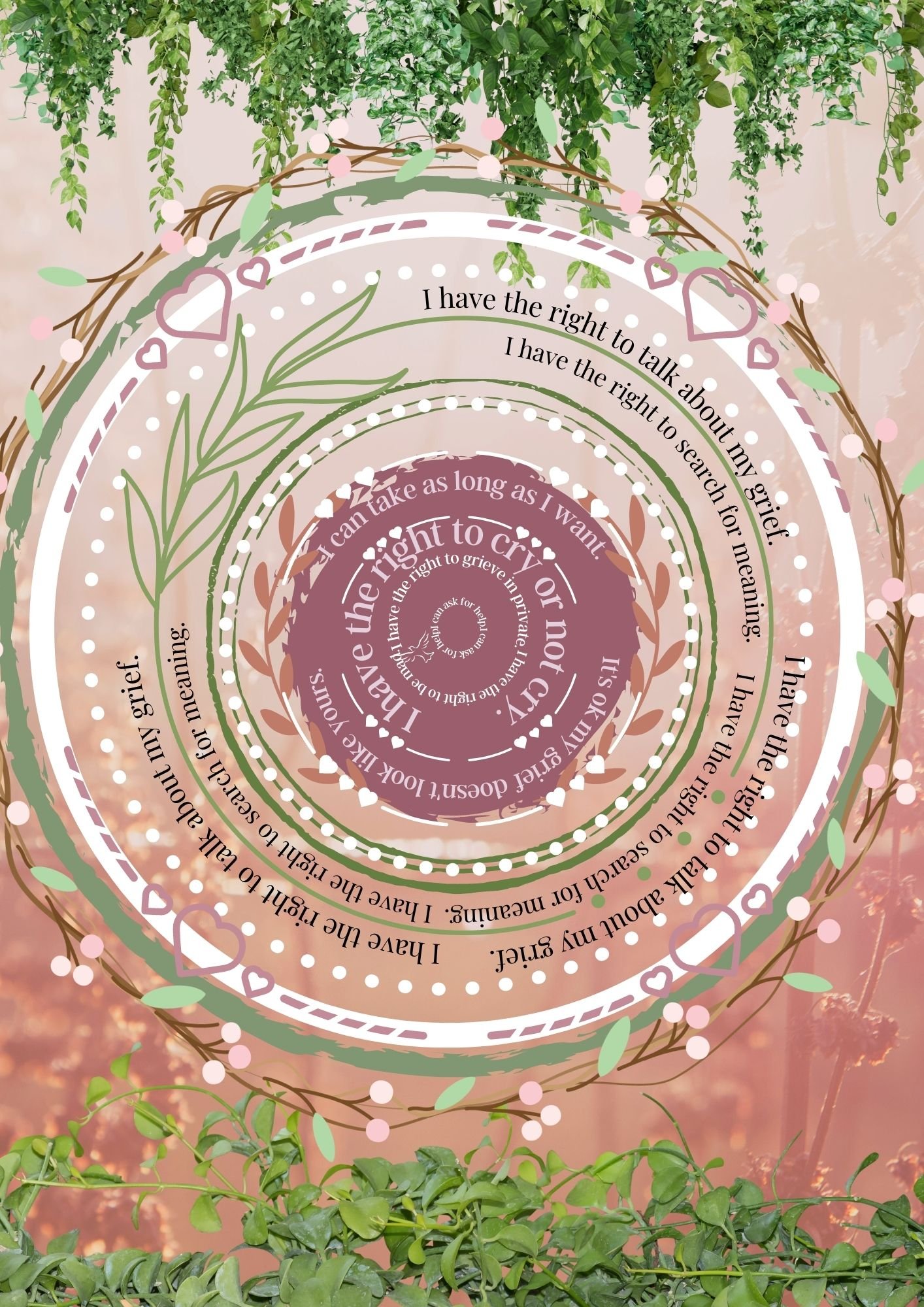
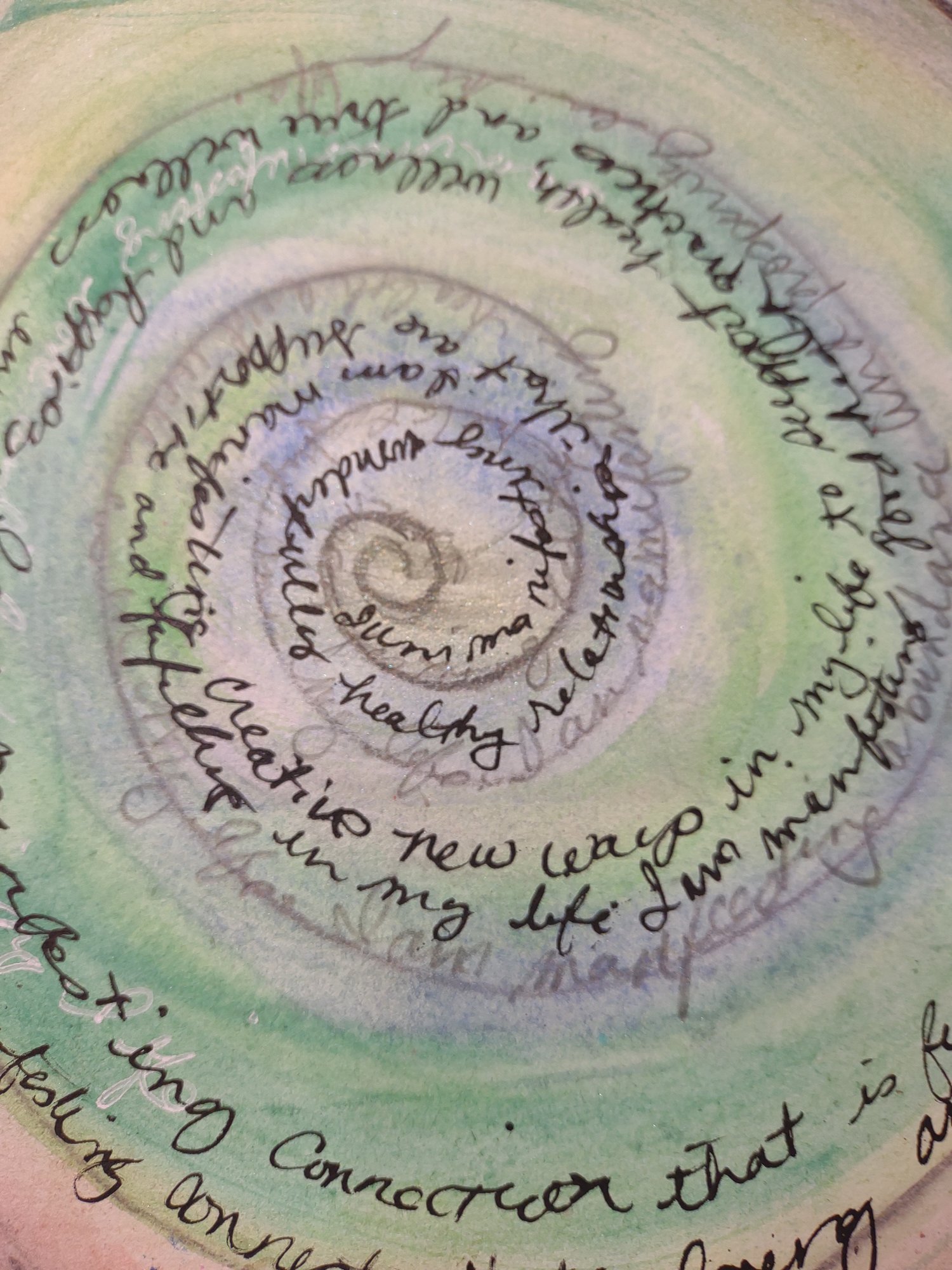
1. Concentric Circle Process Mandalas
2. Journal Reflection
3. A written and visual practice for identifying what you actually need right now, when nearly everyone else is telling you what you should need. You'll be guided step by step through both the reflection and the collage.
Nervous system and contemplative tools you'll keep for life
- Mindfulness meditation designed specifically for the grieving body
- The 2-Minute Quick Coherence technique — a HeartMath-based practice you can use in a parking lot, a hospital hallway, or the middle of the night to steady yourself when the wave hits
- How to set up sacred space — creating a place and a container for your mourning, so grief has somewhere to live besides everywhere
What you'll walk away with
- Language for what's happening to you — and the relief of learning it's normal
- Permission, in your own handwriting and your own colors, to mourn the way you actually mourn
- Two portable regulation practices you can use in under two minutes
- Physical, tangible artifacts of your grief — pieces you made, that hold what you couldn't say
- A repeatable creative process you can return to on hard anniversaries, in hard seasons, for years
Why the arts?
Because grief is not primarily a thinking problem.
The parts of us that hold loss are older and deeper than analysis. Image, color, rhythm, and metaphor reach them in ways that explanation cannot. Creative expression gives grief a form outside your body — and something that has a form outside your body is something you can finally look at, sit beside, and live with.
Every practice in this course is chosen for that purpose. Nothing here is craft for craft's sake.
About your guide
Jes Wen'de Waters, PhD, CAGCS, CCTP, LCAC
- PhD, Transpersonal Counseling
- Certified Advanced Grief Counseling Specialist
- Certified Chaplain and trained Hospice Chaplain
- Trained in the Compassion Practice
- HeartMath Certified Clinical Provider
I've sat at bedsides. I've sat with the families afterward. I've spent my career at the place where the clinical and the sacred meet — where grief is not a diagnosis to be managed but a human passage to be accompanied.
This course is the distillation of that work: everything I would offer you if we were sitting together in a quiet room with paper and colors between us.
I've sat by my own family members and watched them breathe their last breath, tending the body and soul. I've endured tragic, sudden grief in the loss of a family member from addiction and an accident. I've held the hands of those that are family and those that I do not know, listening to them, praying and blessing them, singing to them, in sacred ceremony as they prepare to cross over and let go. And I've dealt with my own grief after, my families, friends, neighbors, students and clients. I'm no stranger to grief. My ancestral line is steeped in the sacred and forbidden practice of Keening in Ireland and Scottland as well as animist practices from multiple traditions in my lineage.
Grief changes you, your life, and your world, forever. It doesn't have to be a limitation. There can be life and deeper meaning in living after.
What's included
- ~3 hours of video instruction, self-paced
- Guided meditation and Quick Coherence practice
- Downloadable worksheet
- Mourner's Bill of Rights reference
- Journal prompts and reflection guide
- Complete mandala and collage instructions
- Simple supply list — most of it you already own
- Lifetime access; return to it whenever grief returns
Supplies you'll need: paper, something to color with, magazines or printed images, scissors, glue. These activities can also be done digitally on an iPad or phone and in ProCreate or Dada. That's it.
Frequently asked questions
Do I need any artistic ability? None. The concentric circle process was chosen precisely because it removes the blank-page fear. No one will see your work unless you choose to share it. There is no wrong result.
How recent can my loss be? There's no rule. Some people find this helpful in the first weeks; others come to it years later, when the world has moved on and they haven't. Go at your own pace and stop whenever you need to.
Is this therapy or counseling? No. This course is educational and experiential, not psychotherapy, and it doesn't create a clinical relationship. It can beautifully accompany the work you do with a therapist, counselor, or spiritual director — and if you're in acute crisis, please reach out to a licensed professional or a crisis line for direct support.
Is this religious? It's spiritually open. "Sacred space" here means whatever holds meaning for you. Practices are drawn from contemplative and evidence-based traditions and are offered so that people of any faith or no faith can enter them.
How long do I have access? Lifetime. Grief comes in waves, and you should be able to come back when the next one does.
What if I start and can't finish? Then you stop. Nothing here is a test. The course will be waiting.
Your grief deserves more than getting through it.
It deserves a place to be witnessed — even if the only witness is you, some paper, and a quiet hour.
Whenever you're ready.
Course curriculum
-
1Getting Started
-
2Expressing Grief Through the Arts: Workshop Demonstration