

After-School Dysregulation Assessment Toolkit for BCBAs
After-School Dysregulation Assessment Toolkit for BCBAs
When a child appears regulated at school but consistently struggles after getting home, the immediate antecedent may not tell the whole story.
A long school day can include hours of social interaction, academic responding, transitions, sensory input, executive-function demands, physiological needs, and ongoing behavioral regulation. By the time a child gets home, the same instruction, sibling interaction, denied access, or unexpected change may occur within a very different physiological and environmental context.
The After-School Dysregulation Assessment Toolkit for BCBAs is an FBA-informed clinical decision-support resource designed to help clinicians systematically examine these patterns without assuming masking, sensory overload, poor interoception, or behavioral function before the data support it.
Rather than relying on vague ratings such as “seems overwhelmed” or “social interaction is exhausting,” the assessment emphasizes observable and measurable patterns, cross-setting comparison, contextual variables, interoceptive reporting, and ABC data.
What's Included
Interactive Excel Clinical Assessment
- Parent/Caregiver Assessment with operationally defined, observable items
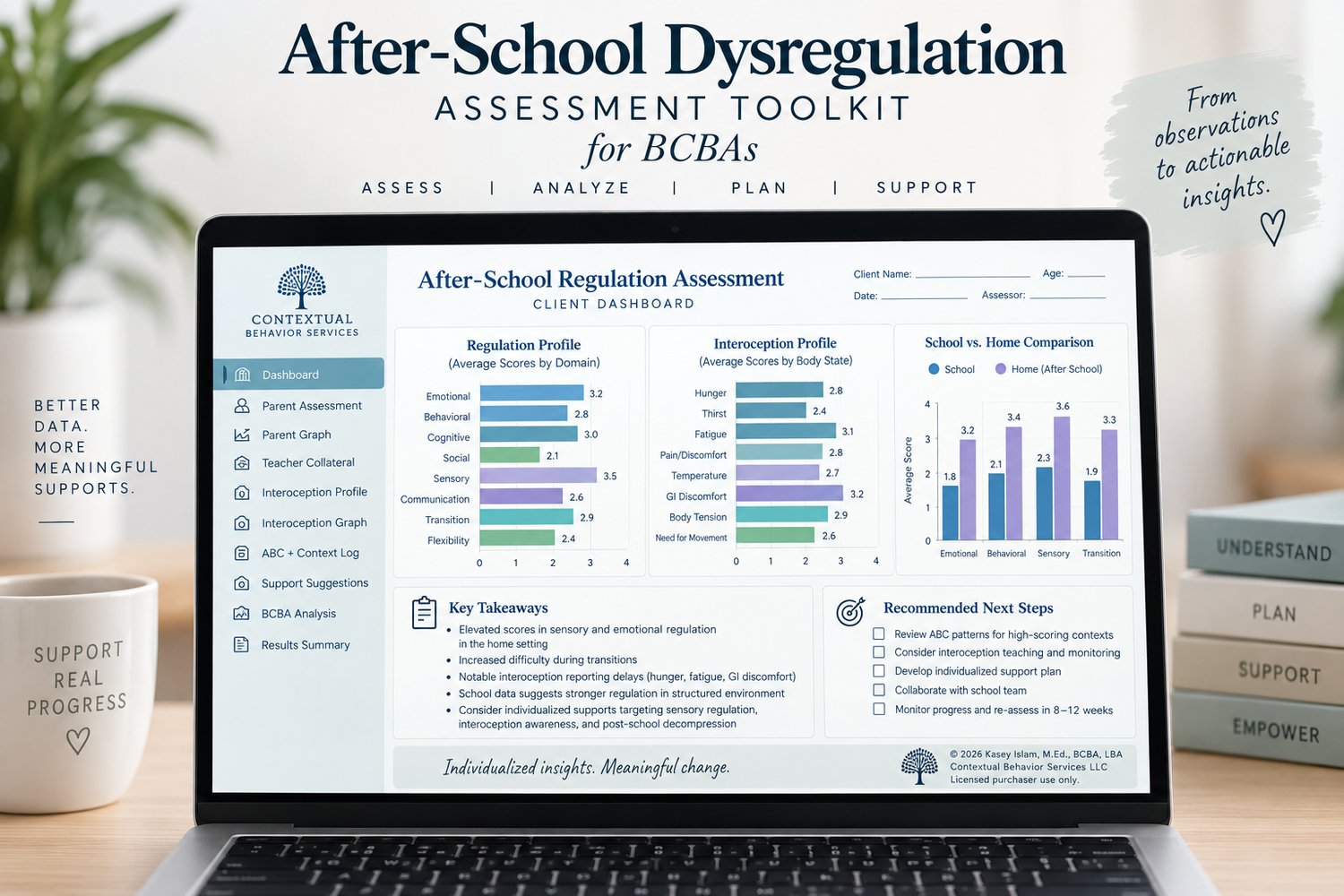
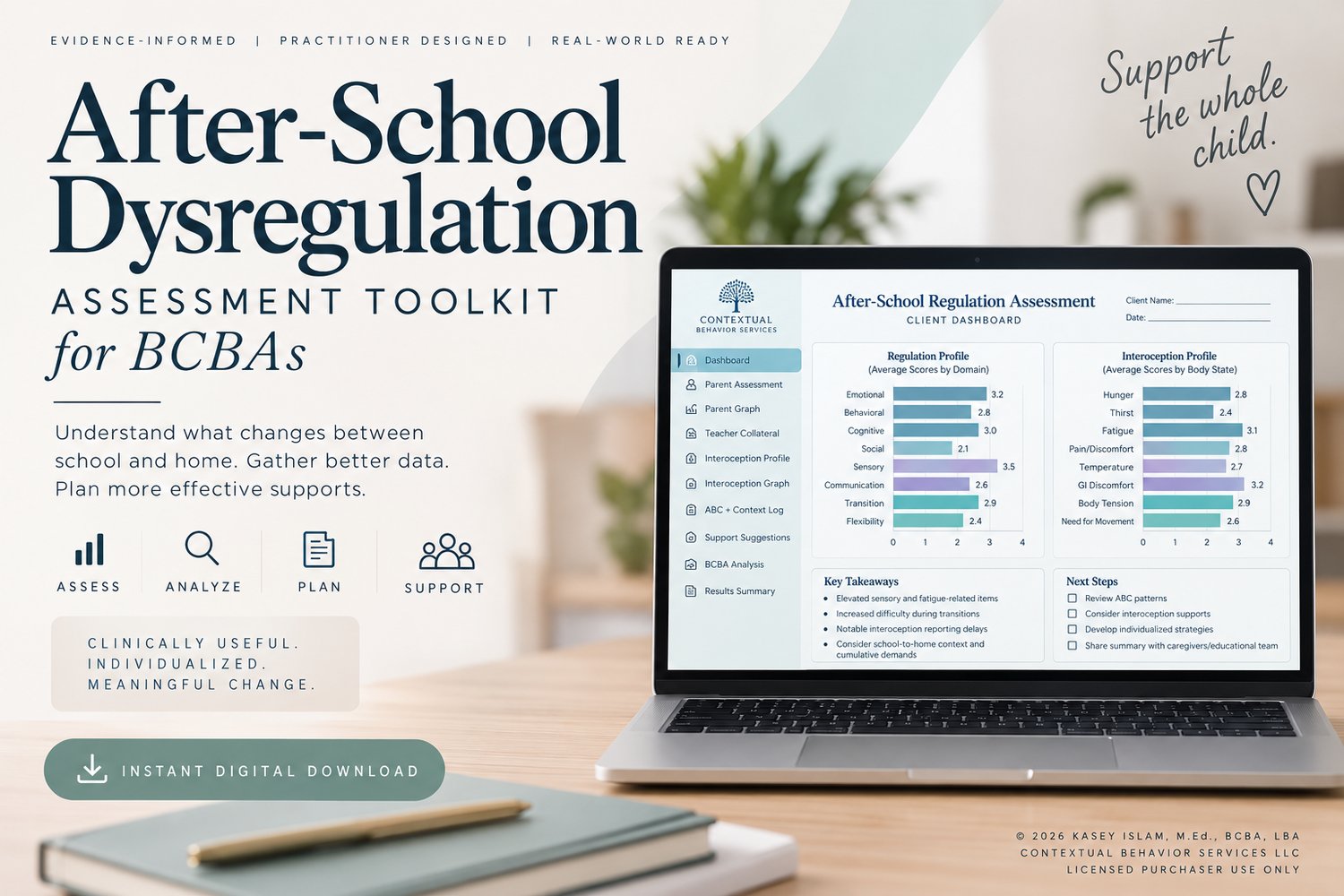
- Automatic School-to-Home Regulation Profile graph
- Individualized Parent Regulation Profile
- Optional Teacher Collateral Questionnaire
- Interoception Profile covering 12 physiological/body-state areas
- Automatic Interoception Profile graph
- ABC + Context Event Log
- BCBA Clinical Analysis section
- Automated Results Summary
- Domain-specific clinical support considerations
- State-specific interoception teaching and support suggestions
Interoception Assessment & Support Planning
Go beyond asking whether a child has “good” or “poor” interoception. The toolkit examines the level of prompting or physiological intensity typically associated with reporting specific body states, including hunger, thirst, toileting, fatigue, pain/discomfort, temperature, GI discomfort, heartbeat/breathing changes, body tension, and need for movement or rest.
Results are graphed by body state and paired with individualized teaching considerations, measurement targets, and clinical cautions.
FBA-Informed Context Analysis
Examine whether behavior varies according to:
- School days vs. weekends and breaks
- Earlier vs. later portions of the day
- School-to-home transition
- Social interaction patterns
- Academic and cognitive demands
- Sensory/environmental conditions
- Physiological variables
- Immediate antecedents and consequences
- Recovery patterns
- Independently selected regulation strategies
This helps clinicians investigate an important question:
Why might the same antecedent produce very different responding depending on the context in which it occurs?
Designed for Individualization — Not Autism Stereotypes
Not every autistic child needs silence after school. One child may regulate through solitude while another seeks an hour of conversation with a trusted caregiver. Movement may help one child and increase arousal for another.
The toolkit is intentionally designed to identify what the individual child actually does, seeks, avoids, reports, and responds to rather than prescribing a generic “sensory break” or “decompression routine.”
Also Included
Your download includes:
- Excel Assessment & Clinical Planning Tool
- Clinician Administration & Interpretation Guide
- Printable Optional Teacher Collateral Form
Who Is This For?
Designed primarily for BCBAs and other qualified behavior-analytic clinicians working with school-aged children who demonstrate meaningful differences in behavior or regulation across school and home environments.
It may be particularly useful when caregivers report concerns such as:
"They hold it together all day and fall apart when they get home."
"School says they don't see any of this."
"The smallest thing sets them off after school."
"I can't figure out whether they're hungry, exhausted, overstimulated, or something else."
Important Clinical Note
This is a clinician-developed, FBA-informed decision-support tool, not a standardized or psychometrically validated assessment. Scores should not be interpreted as diagnostic cutoffs, severity ratings, proof of behavioral function, or evidence that a particular private physiological state is occurring.
The toolkit is intended to organize clinical inquiry, identify patterns worth investigating, guide direct measurement, and support individualized clinical decision-making. It does not replace a functional behavior assessment, medical evaluation, or individualized professional judgment.
Created by Kasey Islam, M.Ed., BCBA, LBA
Contextual Behavior Services LLC
Digital download. Licensed for individual purchaser use. Redistribution, resale, or sharing of the original files is prohibited.