

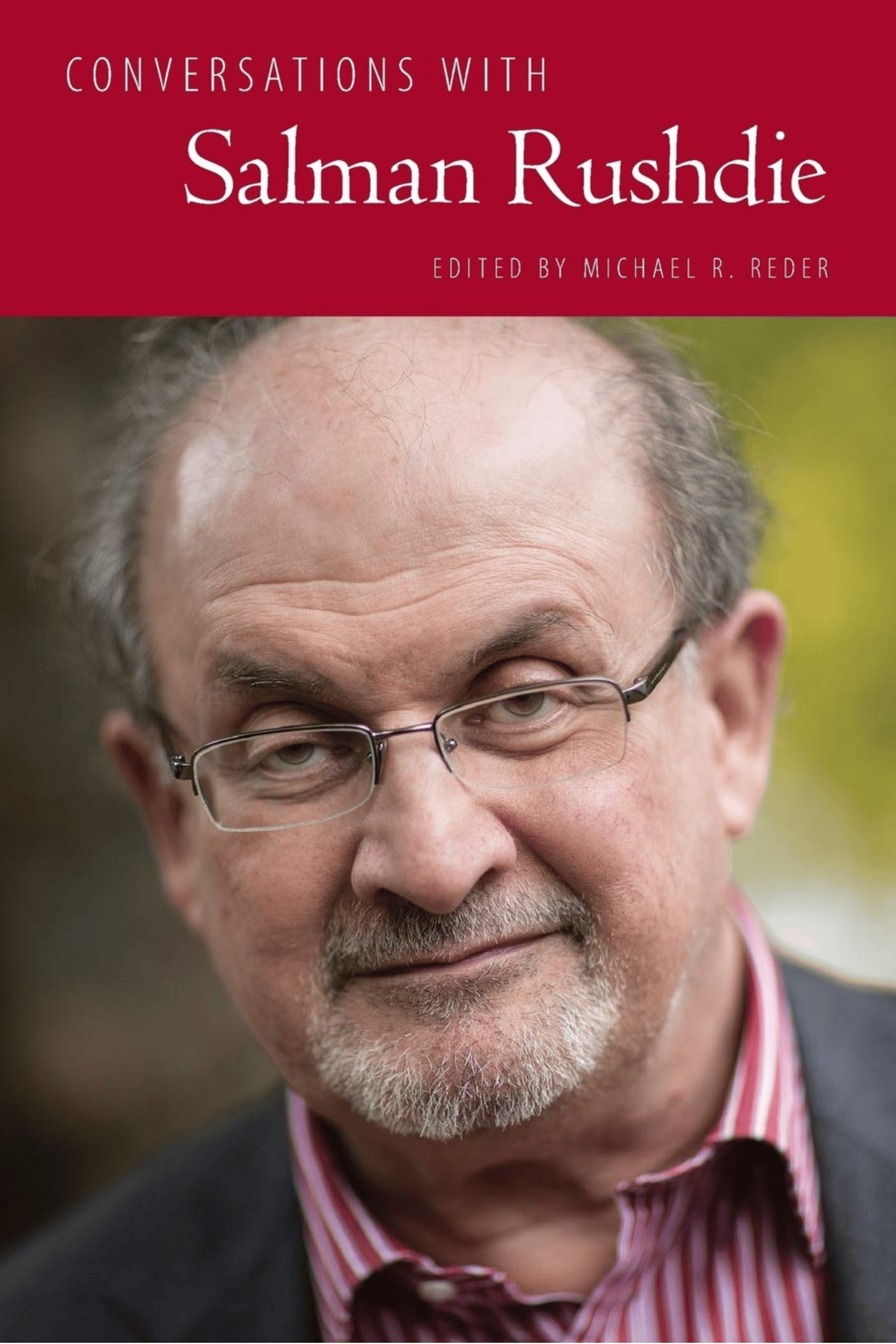
Michael R. Reder - Conversations With Salman Rushdie PDF
Salman Rushdie is one of the most famous and arguably the most important
novelist writing in English today. This fame has come at a price beyond the
obvious toll on the normalcy of his life: his writing, like the author himself,
is often terribly misjudged by people who, although familiar with his name
and situation, have never read a word he has written. Most people are unaware
of the breadth of Rushdie' s writing and thinking; he is known as Salman
Rushdie the novelist, a writer of contemporary (and always controversial)
fiction. But there are many other Rushdies: the travel writer, the crafter of
short stories, the filmmaker, the "children' s" storywriter, the essayist and
reviewer, and the unflinching commentator upon contemporary culture, par
ticularly upon issues of race and inequality. His impact on contemporary
writing as a whole cannot be underestimated; his writing has influenced an
entire generation of authors, those that now help comprise the "empire writ
ing back, " the new British and postcolonial literary canon.
In these interviews, Rushdie offers insight into all of his books, from his
first novel Grimus to his recent, best-selling The Ground Beneath Her Feet.
Rushdie participated in numerous interviews even before the controversy sur
rounding his novel, The Satanic Verses, and many of his most insightful
interviews appeared in smaller publications spread throughout the globe: not
only in England and the United States, but also in India, Canada, and Europe.
This collection brings together the best-and some of the rarest-of the over
1 00 interviews that Rushdie has given throughout his career. Often autobio
graphical in nature, they deal extensively with Rushdie' s creative process, his
views on art and politics, and his life both before and after the fatwa. Of
interest to both the specialist and to a more general audience, this book covers
a wide range of topics. Some of the interviews are academic, in which Rush
die speaks in detail about his work; many are political in nature, when he
discusses contemporary politics or the relationship between the artist and the
state; most are also of general interest, as he often addresses world politics,
his life in hiding, and contemporary culture. Above all, these interviews re
veal a man with a powerful mind, a wry sense of humor, and a compelling
commitment to social justice.