Your Cart
Loading
Only -1 left

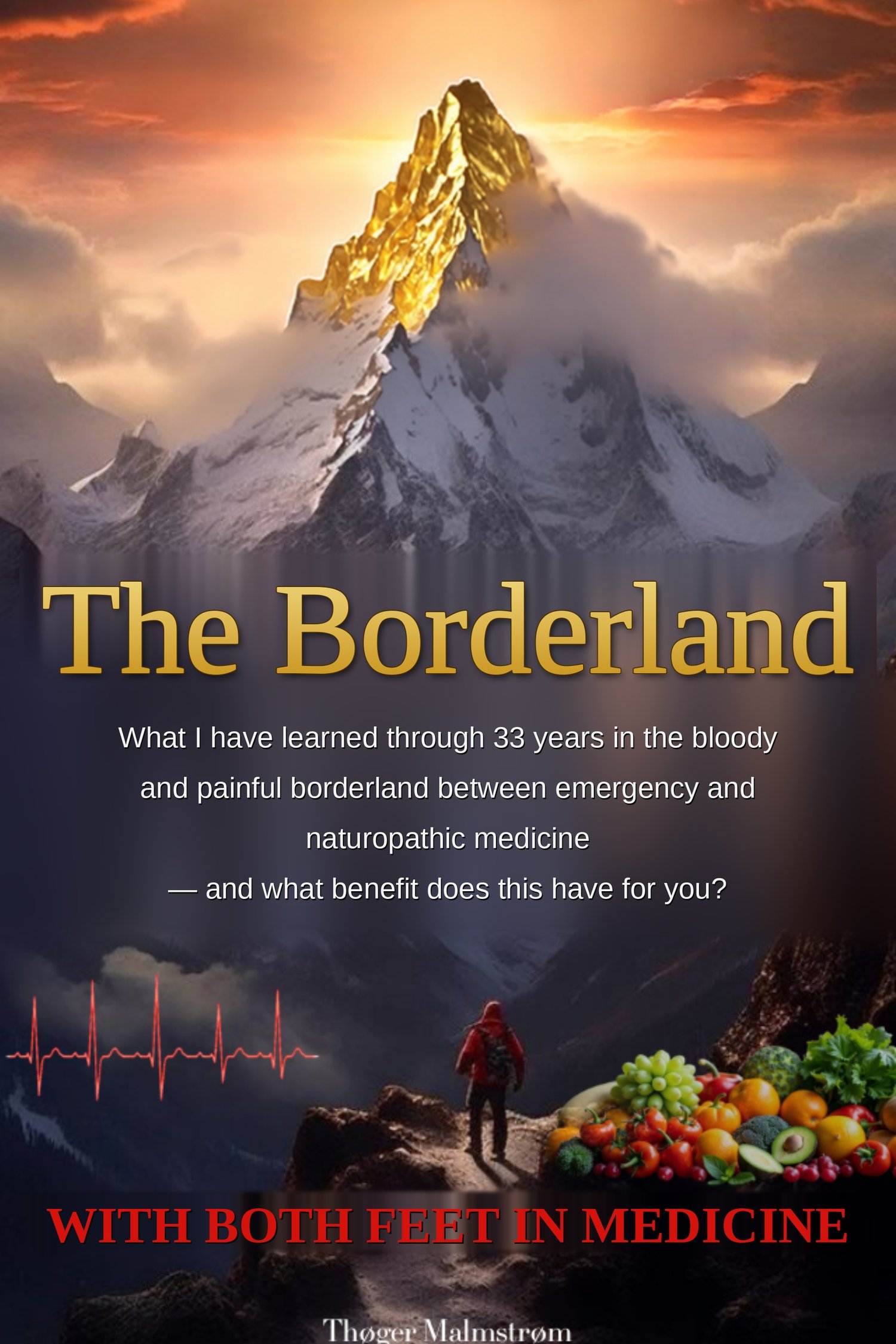
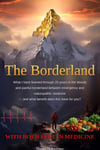
The Borderland

On Sale
NOK399.00
NOK399.00
Added to cart

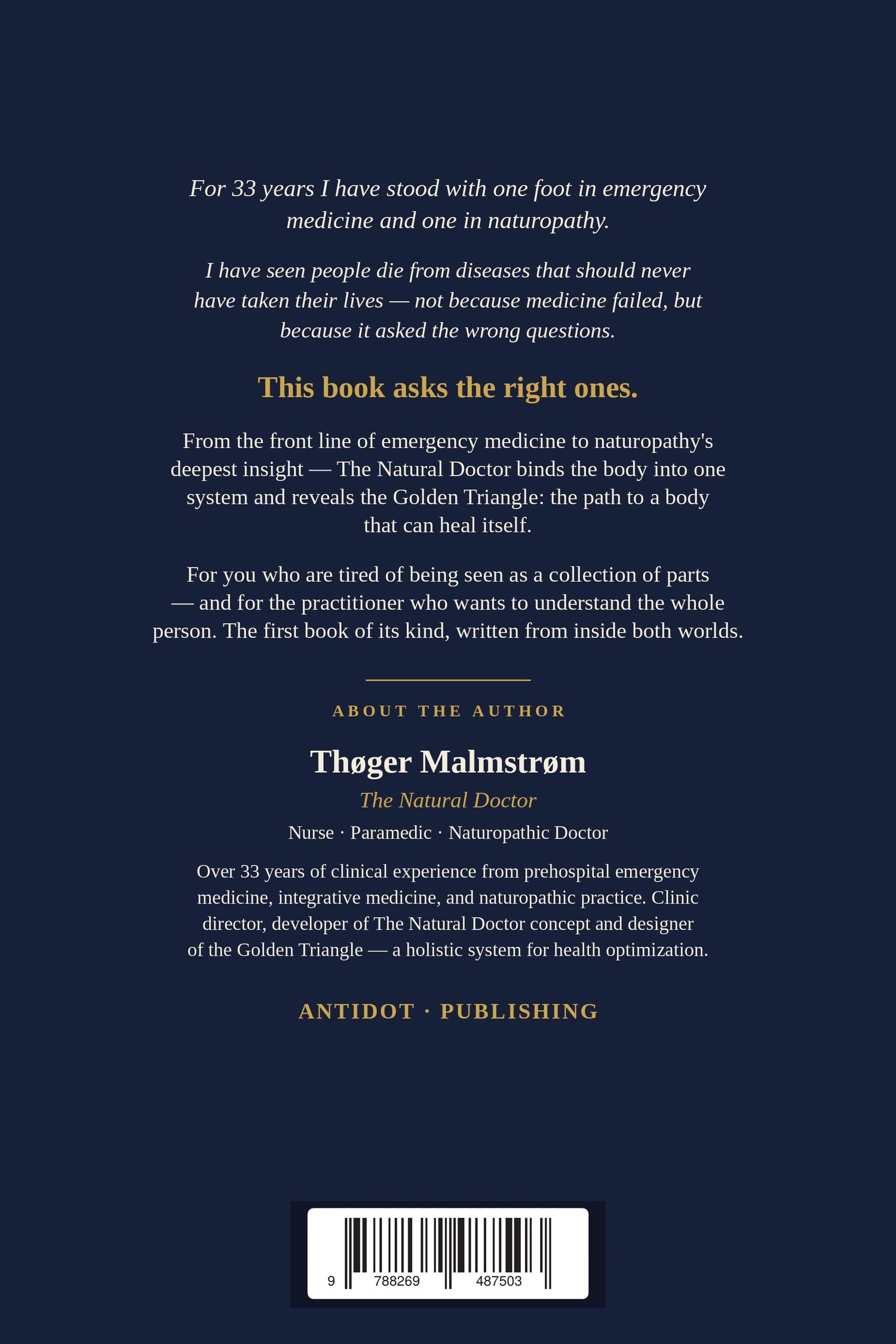
THE NATURAL DOCTOR What I have learned through 33 years in the bloody and painful borderland between emergency and naturopathic medicine — and what use this has for you? Thøger Malmstrøm ANTIDOT PUBLISHING Skien · 2026 The Natural Doctor Thøger Malmstrøm 1st edition, 1st printing — 2026 ISBN 978-82-694875-0-3 Antidot Publishing Holmsvegen 65, 3721 Skien post@thenaturaldoctor.clinic © Thøger Malmstrøm / Antidot Helse AS 2026 All rights reserved. No part of this book may be reproduced, stored in a retrieval system, or transmitted in any form or by any means — electronic, mechanical, by photocopying, recording, or otherwise — without written permission from the publisher, except for brief quotations in reviews and scholarly discussion in accordance with § 22 and § 29 of the Norwegian Copyright Act. Medical Disclaimer This book is a professional presentation based on the author's 33 years of clinical experience and published research. It is not intended as a substitute for individual medical assessment, diagnosis, or treatment from qualified health personnel. The reader is always encouraged to consult a physician or other qualified clinician before initiating changes in diet, lifestyle, medication, or supplementation — especially in cases of chronic illness, pregnancy, breastfeeding, or in children. The author and publisher disclaim any responsibility for loss, harm, or other consequences that may arise directly or indirectly from the use of the information in this book. Typesetting: Georgia · A5 royal (156 × 234 mm) Book design and typography: Antidot Publishing Cover design: Thøger Malmstrøm Printing: [printer's name], [location] To Those Who Have Carried Me To my family — and to my faithful companions on four legs, the dogs and horses who taught me to listen without words. To the true friends who stood firm, and to the patients who showed me the greatest trust one human being can give another. To the colleagues who respected the work and contributed professional backbone. To the seekers of truth — you who do not let established truths block new understanding. And to all who have criticized, ridiculed, and tried to stop this work: Thank you. You made me stronger than any course, any book, or any title ever could. But it is all those I could not manage to help who have driven me onward — all the way. They are the reason this book exists. The truth needs no defense. It needs only time. — Thøger Malmstrøm Contents ♦ ♦ ♦ Preface 1 The Body as a System • Homeostasis and Allostasis • Constitution and Individuality • Vis medicatrix naturae • The Practical Consequences of the Systemic Perspective Case Story: When the System Was Stronger Than the Parts 2 The Story of Two Medicines • Before the Split • The Rupture • The Biomedical Model • Naturopathic Medicine • Evidence, Epistemology • A Personal Reflection Case Story: Two Systems, One Patient 3 Inflammation • The Biology of Inflammation • The Silent Signature of Inflammation • What Drives the Chronic Fire? • NF-κB • Inflammation and the Disease Burden • Resolution • Clinical Tools for Addressing Chronic Inflammation • Inflammation as a Biological Compass Case Story: The Body That Could Not Extinguish the Fire 4 Metabolic Syndrome and Insulin Resistance 1 14 32 45 68 • Insulin Resistance • From Insulin Resistance to Metabolic Syndrome • The Liver at the Center • Mitochondrial Dysfunction • The Role of the Gut • Diet, Lifestyle, and Reversibility • Pharmacology Versus Root Cause Treatment • Naturopathic Approach Case Story: The System That Was Not Seen 5 The Gut Microbiome • Eubiosis • From Eubiosis to Dysbiosis • Drugs and the Microbiome • Leaky Gut • Akkermansia muciniphila • Faecalibacterium prausnitzii • The Gut-Brain Axis • The Microbial Fingerprint in Chronic Disease • Dietary Fiber, Polyphenols, and Prebiotic Modulation • Fermented Food • The Microbiome's Circadian Rhythm • Next Generation Probiotics • The Gut Microbiome as a Clinical Priority Case Story: The Microbiome as the Key 6 The Heart and the Gut • Atherosclerosis • LPS: The Gut Bacteria's Trojan Horse in the Arterial Wall • TMAO • Short-Chain Fatty Acids • The Gut Barrier and the Endothelial Barrier • The NLRP3 Inflammasome and the Cardiovascular Paradox • hsCRP • Homocysteine • From Biomarker to Biology Case Story: The Heart the Gut Forgot 7 The Mitochondria • The Mitochondria • ATP • The Electron Transport Chain • Reactive Oxygen Species • PGC-1α • NAD⁺ • Ubiquinol • PQQ • R-Alpha-Lipoic Acid • Magnesium • Mitophagy • Cardiolipin • The Gut Mitochondria Axis • Mitochondrial Aging Case Story: When the Body Got Its Energy Back 86 112 132 8 The Gut Barrier 154 • The Gut Barrier • Leaky Gut • SIBO • The Microbiome and Drug Response • The Microbiome and Immunotherapy • The Microbiome and the Immune System • Prebiotics, Probiotics, and Postbiotics • The Microbiome's Determinants Case Story: The Gut That Opened the Whole System 9 The Gut-Brain Axis and Psychoneuroimmunoendocrinology • The Enteric Nervous System • The Vagus Nerve • The Microbiome as a Neurochemical Factory • Psychoneuroimmunoendocrinology • The HPA Axis • Neuroinflammation and the Role of the Gut • The Anatomy of Stress • Sleep, Circadian Rhythm, and the Gut-Brain Axis • Clinical Approach Case Story: When Psychiatry Met the Gut 10 Sleep • The Architecture of Sleep • The Glymphatic System • Melatonin • Sleep Deprivation • Sleep Disorders • Cortisol, Adenosine, and the Biochemistry of Sleep Pressure • Sleep and the Microbiome • Light, Temperature, and the Physiology of Sleep Hygiene • Nutraceutical Sleep Optimization • Clinical Sleep Assessment Case Story: When Sleep Was the Key to Everything 11 Stress Biology and Adaptogenic Pharmacology • The HPA Axis • The Sympathetic Nervous System and the Catecholamine Axis • Allostasis and Allostatic Load • Adaptogens • Ashwagandha • Rhodiola rosea • The Cortisol Day Curve • Phosphatidylserine and L 174 193 214 Theanine • Magnesium • The B-Vitamin Complex and the Stress Response • DHEA and the Cortisol-DHEA Ratio • Stress, Telomeres, and Biological Aging Case Story: Biological Stress with Five Diagnoses 12 Neuroscience and Cognitive Optimization • Neuroplasticity • Mitochondrial Function • Neurotransmitters • The Gut-Brain Axis and Cognitive Function • The Blood-Brain Barrier • Neuroinflammation • Methylation and Epigenetic Regulation • Cortisol and Cognitive Function Case Story: When the Brain Got Its Raw Materials 13 Cardiology and Cardiovascular Protection • Atherosclerosis • Endothelial Function • Cholesterol • Heart Failure and Mitochondrial Energy Failure • Hypertension • Arrhythmia, Electrolytes, and Membrane Stability • Thrombosis, Coagulation, and Natural Fibrinolysis • Metabolic Syndrome and Cardiovascular Risk • Heart Rate Variability and the Autonomic Nervous System Case Story: The Heart That Got Its Foundation 14 Aging, Longevity, and Biological Reversibility • What Is Aging • Telomeres • NAD⁺ • Sirtuins • Epigenetic Aging • Mitochondrial Aging and Energy Failure • Inflammaging • Hormones and Biological Aging • Sarcopenia and Bone Mass • Biological Reversibility 236 257 278 Case Story: When Aging Biology Became Clinical 15 Oncology and Cancer Prevention • Cancer Is Not Bad Luck • The Warburg Effect • Epigenetics • Immune Surveillance • NF-κB, Curcumin, and the Inflammatory Line of Defense • Glutathione, Nrf2, and the Redox-Biological Line of Defense • Omega-3 • The Microbiome • What the Research Actually Says • Clinical Approach Case Story: When the Biology Was Restored 16 Nutrition as Information • From Calorie Counting to Information Biology • Transcription Factors • Epigenetics and Nutrition • Nutrients as Enzymatic Cofactors • Glycemic Biology and Insulin Signaling • Phytochemicals • Chronobiology and Nutrient Timing • Nutrigenetics • Precision Nutrition • Nutrient Synergies • A Clinical Turning Point Case Story: When Food Became Medicine 17 Movement as Medicine • Skeletal Muscle as an Endocrine Organ • Mitochondrial Biogenesis and the PGC-1α Axis • Movement and Metabolic Health • Neurological Effects • Movement and the Immune System • Musculoskeletal and Osseous Response • Epigenetic Effects of Movement • Telomeres, Aging, and Movement • Dosing • Movement and Nutrition • Sedentary Behavior • Movement as Prevention • Movement Pharmacology Case Story: Movement as the First Prescription 300 320 343 18 Detoxification in Clinical Practice 364 • The Biological Foundation • The Phases of Detoxification • Genetics and Individual Detoxification Capacity • The Six Detoxification Organs • Clinical Presentation of Detoxification Failure • Clinical Detoxification Protocol • The Six Classic Errors in Detoxification Practice • Special Populations • Detoxification and Chronic Disease • The Glymphatic Dimension Case Story: Toxic Burden Behind Five Diagnoses 19 Mitochondrial Medicine in Clinical Practice • The Biology of the Mitochondria • Mechanisms of Mitochondrial Dysfunction • The Clinical Picture of Mitochondrial Dysfunction • Mitophagy • Mitochondrial Biogenesis • The Mitochondrial Nutrient Toolbox • Physical Activity as Mitochondrial Medicine • Fasting, Ketosis, and Mitochondrial Autophagy • Sleep, Circadian Rhythm, and Mitochondrial Repair • Mitochondrial Medicine and Aging • Mitochondrial Dysfunction and Neurodegenerative Disease • Lactic Acidosis Case Story: The Energy That Disappeared 20 Clinical Gut Restoration • The Microbiome's Composition and Function • The Gut Barrier • H. pylori • The Gut-Brain Axis • Dysbiosis • SIBO • The Oxalate-Microbiome Interaction • Leaky Gut • The Microbiome and the Immune System • The Microbiome and Metabolic Health • Gut Health and Cancer Risk • Clinical Protocol for Microbiome Restoration • Fecal Transplantation Case Story: The Microbiome's Systemic Reach 386 413 439 21 Nephrology and the Kidneys' Role in Nutrient Metabolism • The Kidneys' Anatomy as Functional Architecture • The Pathophysiology • The Acid-Base Balance and the Diet as a Driver • Toxic Burden, NSAIDs, and Heavy Metals • The Gut as the Kidneys' Silent Ally • Mitochondrial Rehabilitation • The Omega-3 Fatty Acids and Glomerular Protection • Clinical Presentation and the Naturopathic Assessment • Nutritional Strategies and Clinical Protocol Case Story: The Kidneys as a System 22 Pulmonology and Lung Health • The Lung's Anatomy as Functional Architecture • The Lung Microbiome and the Gut-Lung Axis • Oxidative Stress, the Mitochondria, and the Lung Tissue • Asthma • COPD • Breathing as a Therapeutic Tool • Herbal Medicine and Respiratory Botanical Agents • Environmental Toxins and the Lungs' Detoxification Burden Case Story: The Breath That Came Back 23 Rheumatology and Autoimmune Disease • Immunological Self-Tolerance and Its Breakdown • The Gut as the Immunological Headquarters • Rheumatoid Arthritis • Lupus • Ankylosing Spondylitis and the Spondyloarthropathies • Mitochondrial Dysfunction in Autoimmune Disease • Nrf2, Oxidative Stress, and Autoimmunity • Herbal Medicine and Autoimmune Disease • Autoimmune Disease and the Fat-Soluble Vitamin Foundation Case Story: When the Immune System Learned to Stop Attacking 24 Psychiatry and Mental Health 457 480 503 • Inflammation and Depression • The Gut-Brain Axis • Mitochondrial Psychiatry • Nutrients and Neurochemistry • Lion's Mane, Reishi, and the Neurotrophic Dimension • The Omega-3 Fatty Acids and the Psychiatric Brain • Anxiety, GABA, and the Autonomic Nervous System • Sleep, Glymphatic Cleansing, and Psychiatric Rehabilitation Case Story: The Brain That Got the Biological Preconditions 25 Musculoskeletal Health and the Locomotor System • The Skeletal System as a Metabolic Organ • Cartilage and Joint Biology • Muscle Physiology and Sarcopenia • Tendons, Ligaments, and Fascial Integrity • Inflammation Biology in Musculoskeletal Disease • Botanical Adaptogens and Anti-Inflammatory… • Integrated Protocol for Musculoskeletal Health Case Story: The Bone That Repaired Itself 26 Dermatology • The Skin as a Biological Interface • The Skin's Microbiome • The Gut-Skin Axis: The Invisible Connection • The Skin's Nutritional Biology • Oxidative Stress, Nrf2, and the Skin's Aging Process • The Skin's Botanical Pharmacology • Inflammation, Microbiome, and the Most Common Skin Conditions • Collagen, Elastin, and the Skin's Structural Aging Case Story: The Skin That Spoke, the Gut That Answered 27 Pediatrics and Developmental Biology • The First 1,000 Days • The Gut Microbiome • Neurological Development • Immunological Programming 524 546 569 • Growth, Mineralization, and Skeletal Development • Behavior, Cognition, and the Nutritional-Psychological… • Clinical Conditions in Pediatrics • Veterinary Parallel • Practical Clinical Considerations in Pediatric… Case Story: The Biology That Was Repaired in the Open Window 28 Sports Medicine and Performance • Mitochondrial Capacity • Oxidative Stress, Nrf2, and Training Adaptation • Inflammation and Recovery • Muscle Synthesis, Proteometabolism, and Anabolic Signaling Pathways • The Gut Microbiome and Athletic Performance • Adaptogens and Stress Biology in Sport • Sleep, GH Secretion, and Nightly Recovery • Bone Mass, Collagen, and Structural Integrity • Cognitive Performance and Neuromuscular Precision Case Story: The Athlete Who Started to Recover 29 Gerontology and Healthy Aging • The New Framework of Aging Biology • The Twelve Hallmarks of Aging • The Naturopathic Paradigm Shift: From Symptom to… • The Clinical Protocol for Healthy Aging • Clinical Observations and Results Case Story: The Aging That Slowed Appendix — Health Profile Subject Index 599 622 649 668 ⬥ 1 PREFACE On 33 Years in the Borderland Between Emergency Medicine and Naturopathy ❦ «He who would heal must first understand what is to be healed. He who would understand what is to be healed must first understand the human being. He who would understand the human being must first understand nature — for the human being is not exempt from nature's laws; the human being is nature's law made manifest.» How It Began I was 23 years old the first time I stood over a human being who was dying, and realized that all the medical knowledge I had learned was of no help. It was on a street in Telemark, an autumn evening in the early '90s. The patient was in his f ifties. He had gone to his doctor with pain, received a diagnosis, received medication, received a plan. And yet here he lay on the asphalt before me, and whatever we did in the ambulance, it made no difference. There are two things I learned that evening, and they have followed me through the rest of my working life. 2 The first: that the medicine I was trained in — modern, Western emergency medicine — was extraordinarily good at what it was good at. Repair. Stabilization. Keeping someone alive through the first critical hours after a heart attack, a traffic accident, a hemorrhage. What I did as an ambulance nurse could save people who would otherwise have died. That is not something I deny, and not something I will deny in this book. The second: that the same medicine was fundamentally poor at what matters most. Prevention. Real healing. Understanding why the patient was lying on the asphalt in the first place. The 50-year-old man who died that evening had lived a life that led him there — the diet, the sleep, the stress, the environment, the inner landscape he had carried. No one had ever spoken with him about any of this. He had been given medications that dampened the symptoms. He had never been helped to understand what created the symptoms. I worked 25 years as an ambulance nurse. I saw the same pattern thousands of times. I saw patients who had gone to their doctor for ten years, for twenty years, with ever more medications, ever more diagnoses, ever poorer health — only to end up with me when the body could finally no longer compensate. I could stabilize them, drive them to the hospital, hand them over. But I knew I had only delayed the next call. It was somewhere within this realization that I began to search for something else. 3 ❦ The Journey to Naturopathy My path into naturopathy did not come through a sudden awakening. It came through years of questions I could not f ind answers to in conventional medicine. Why do some people fall ill and others not, from the same environment, the same genetics, the same age? Why does a treatment work perfectly on one patient and not at all on the next? Why does modern medicine produce so many chronically ill people when it is technologically more advanced than ever before? I found the answers not in one tradition, but in many. First in acupuncture and classical Chinese medicine, where I discovered a logic that explained things Western medicine never could. Then in homeopathy — and later homotoxicology — which taught me to see the disease picture as a development over time, an imprint of the whole person's history, not a snapshot. In orthomolecular medicine, which gave me the biochemical tools to understand how the body actually works at the cellular level. In frequency medicine and bioelectricity, which opened my eyes to the fact that the body is not only chemistry, but also an electrical and energetic field. Each of these traditions gave me part of the picture. But it was only when I began to see the connection between them — how they were complementary descriptions of the same reality, not competing paradigms — that I began to understand what naturopathic medicine truly is. 4 It is not alternative medicine. It is not complementary medicine. It is not holistic medicine in the watered-down sense the word has acquired. Naturopathic medicine is the medicine that takes the human being seriously as an integrated biological system — physical, biochemical, bioelectrical, energetic — and that works with the body's innate capacity for self-healing rather than overriding it. Vis medicatrix naturae. That was Hippocrates' expression 2,400 years ago, and it remains naturopathic medicine's cornerstone principle. I am not a practitioner who cultivates symptoms. I am a practitioner who tries to understand the patient's biological terrain well enough that the body can begin to recover its own homeostasis. The difference is fundamental. It is the difference between the medicine that silences a fire alarm and the medicine that finds the fire. ❦ Why the Borderland Of all I have learned through 33 years on this journey, there are few things I am as deeply convinced of as the value of having stood with one foot in each of the two medicines at once. That says a great deal, for I have seen many things that have convinced me. It is a position almost no one holds. Most doctors have never worked a single shift in the borderland between life and death in an ambulance at minus twelve degrees. Most naturopaths have never held a patient's life in their hands while the heart fibrillated and the minutes ran out. And most 5 who have stood in emergency medicine have never gone on to understand what actually went wrong in the body's biology in the twenty years before the patient ended up in the ambulance. I have done both. Every week for 33 years. And it is this duality that has taught me what I know today — because it has forced me to see two things at once that the rest of the health system sees only separately. I have seen the 58-year-old man with a massive anterior-wall infarction, where emergency medicine saved his life with thrombolysis and PCI — and I have seen the same kind of patient ten years earlier in the clinic, where homocysteine was 22, hsCRP over 8, the omega-3 index below 3 percent, and the entire metabolic trajectory toward this infarction already laid down. These are not two different patients. They are one patient at two different stages of the same biology. Emergency medicine saves him. Naturopathy could have ensured he never needed saving. This duality is what the book is about. Not one against the other. Not a rejection of one tradition in favor of the other. But a clinical reality in which both are necessary — each on its own terms, for its own patients, at its own points in the course of illness. Emergency medicine saves people in crisis. Naturopathy prevents the crisis from arising in the first place, or restores the body's biological terrain after the crisis is over so that it does not recur. Research now systematically confirms what I have seen clinically for 33 years. Chronic low-grade inflammation underlies all the major diseases of civilization. The microbiome regulates half the immune system and the entire 6 gut-brain axis. Mitochondrial dysfunction is the common denominator behind fatigue, neurodegeneration, and metabolic syndrome. This is no longer naturopathic speculation — it is published in The Lancet, Nature, NEJM, and Cochrane. The integrative perspective is not alternative medicine. It is modern medicine as it ought to be practiced. ❦ Why This Book There is no book in Norwegian written from this position. There are excellent Norwegian books on naturopathy. There are excellent Norwegian textbooks in emergency medicine. There are translations of American and English integrative medicine works. But there is no book written by someone who has stood with both feet planted in both traditions across an entire career — and who can therefore tell what actually happens when the two medicines meet in a living clinical reality, not as a theoretical construct. Internationally, there are the works of Pizzorno and Murray, Hechtman, Rakel, Bland. They are fundamental, and they are cited systematically throughout this book. But none of them is written from the borderland between prehospital emergency medicine and the naturopathic clinic. They are written from naturopathy's side of the border, or from integrative medicine as practiced within an American or Australian clinical framework. The Nordic reality — with our health system, our culture, our eating habits, our climate, our patients — demands its own formulation. 7 This is the book I have wanted to read for 33 years. It did not exist. So I had to write it myself. There is one more thing the book must do, and it is perhaps more important than all the rest. It must place the borderland in its rightful position within a whole naturopathic clinical architecture. The integrative perspective alone is not the solution — no more than acupuncture alone, or herbal medicine alone, or supplements alone. It is the system that heals. If this book contributes to confusing the position in the borderland with healing itself, then I have failed. ❦ The Clinical Architecture Let me establish here at the outset — briefly, and then elaborate throughout the book — the architecture on which everything I write rests. It consists of three layers, and they must be understood in this order: The bedrock is lifestyle and nutrition. Whole food. Sleep aligned with the circadian rhythm. Movement every day. Sunlight. Grounding. Breath. The human being is a biological organism, and biological organisms operate by certain laws. When we break these laws systematically — as modern life invites us to — the body breaks down. No clinical intervention can compensate for a fundamentally broken foundation. That is the first principle of naturopathic clinical practice. 8 The Golden Triangle is the three biological axes that determine whether the body can heal at all: the mitochondria, which produce the energy of life; the microbiome, which regulates half the immune system and the entire gut-brain axis; and inflammation-resolution, which determines whether the body can bring an immune reaction to a close or remains stuck in chronic inflammation. In an ideal world, these axes are maintained through the bedrock alone. We do not live in an ideal world. Industrial food production has depleted the soil of trace elements. Glyphosate and microplastics are ubiquitous. EMF exposure disturbs the mitochondria. Three generations of antibiotic use have damaged the microbiome. The integrative clinical practice — which this book is about — sits atop this foundation as specific modulators. When the bedrock and the Triangle are in place, acupuncture, herbal medicine, orthomolecular protocols, frequency medicine, and targeted manual techniques act as real therapeutic interventions in a category pharmaceutical preparations cannot compete with. When the foundation is not in place, the same interventions act only marginally. It is not the intervention that has changed. It is the biological terrain that determines whether the remedy can work. This is the clinical architecture on which this book rests. It is not something I have invented. It is the observed reality of 33 years of clinical practice. Patients who come to me with chronic conditions and expect me to give them «a pill that works» — these patients are sometimes disappointed at first. Patients who come to me and are willing to build the 9 foundation — these patients experience things they did not think were possible. ❦ Who This Book Is For This book is written with four groups of readers in mind, and I have tried to make it useful for all four. For the informed patient who wants to understand what is actually happening in the body, what the options are, and what choices one has — for you I have written the main text in a language that demands interest and attention, but not a medical degree. The chapters on the Golden Triangle, on sleep, on stress, on food as information, and on the major diseases of civilization are written so that you can read them and understand your own body better afterward. You can read the book cover to cover, or you can look up the chapter that concerns your situation right now. For naturopaths, acupuncturists, orthomolecular therapists, posturologists, and other integrative practitioners who want a daily clinical handbook — for you I have built in reference intervals for functional blood analysis, clinical boxes with root-cause analysis, and a consistently systemic approach to the conditions you meet every week. The book is structured so that it can be used as a reference work: each of chapters 6 through 29 ends with the section «The Golden Triangle in Practice» that gives you the clinical bottom line for that specific condition. 10 For general practitioners, hospital doctors, and other health professionals who seek integrative perspectives on patient care — for you I have anchored every clinical recommendation in tier-1 evidence: Cochrane reviews, GRADE-assessed meta-analyses, RCTs published in NEJM, The Lancet, JAMA, Nature, and BMJ. You will see source references with full DOI and PMID throughout the book. Not because I need to prove anything, but because it is the difference between medical literature and dietary advice. The book is an invitation to see what exists beyond the clinical framework you were trained in — without abandoning what actually works in emergency medicine. For students of naturopathy, nursing, paramedicine, nutrition, and the health sciences — for you this book is a complete course in what systemic integrative clinical practice is. You can read it cover to cover and come out with an understanding of the body as one integrated biological system. It takes years to build this competence through isolated courses. This book gives you the architecture. There is one group of readers the book is not for: those looking for miracle cures, easy solutions, or confirmation that a single intervention — one herb, one supplement, one diet, one device — can cure chronic disease on its own. This book is honest about what the evidence says, and the evidence says that the integrative perspective is extraordinarily valuable as a clinical system — not that it works miracles in itself. If you are looking for miracles, there are other books. If you are looking for clinical reality, you have come to the right place. 11 ❦ A Note on Scientific Grounding This book rests on what I call the tier-1 gold standard. This means that the evidence I refer to comes from Cochrane reviews, GRADE-assessed meta-analyses, randomized controlled trials published in journals such as The New England Journal of Medicine, The Lancet, JAMA, Nature, BMJ, and peer-reviewed specialty journals in oncology, immunology, nutrition, and integrative medicine. You will not f ind references to conspiracy theories, predatory journals, or speculative websites. Every claim I make about a clinical effect is tied to a source you can look up and verify for yourself. This comes at a cost. It means that I must sometimes say: «the evidence for this claim is limited» or «clinical experience suggests an effect not yet confirmed in an RCT». That is not a weakness of the book. It is a strength. A clinical handbook that does not distinguish between what is evidence-based and what is experience-based is a dishonest handbook. I would rather you, the reader, trust what I say — because I am transparent about the basis — than have you misled by a bombastic claim that later proves unconfirmed. In the same way, you will see that I am honest about where classical clinical experience and modern research converge, and where they diverge. The borderland between emergency medicine and naturopathy has a long clinical tradition, and much of this tradition is now confirmed by modern 12 molecular-biological research. Some of it is not confirmed, or is confirmed only in part. And some of it can never be tested within the reductionist RCT model because the effect is too complex, too systemic, too individualized. All of these categories have their place in clinical practice — but they must not be confused. ❦ A Personal Note I will close the preface with something personal, because this book is not an academic exercise for me. It is the culmination of a working life. At my clinic in Skien, patients come in every day who have gone from doctor to doctor, from specialist to specialist, through a health system that is extraordinarily skilled at naming diseases and extraordinarily poor at healing them. These patients are not ill because they are weak or lazy or have done something wrong. They are ill because we all live in an environment that is biologically hostile — industrial food supply, chronic stress, sleep disturbance, environmental toxins, social fragmentation, light pollution, EMF burden. The body compensates for twenty, thirty, forty years — and then it breaks down. That is not a defect of the body. It is a response to a reality the body was not built for. My job — what I have devoted my life to — is to help these patients recover the biological wholeness the body was built for. It is not always possible. Some patients come too late. Some patients are not willing to do the work. Some patients have diseases that are too far advanced. But in most cases — 13 especially if we catch them early enough, and especially if they are willing to build the foundation — I am allowed to witness something extraordinary to see. A body that remembers how it is meant to be. The integrative clinical practice is what this book is about. One part of a larger system. But a central part — perhaps the most important competence a modern naturopath can develop. To you, the reader: thank you for choosing to take this journey with me. I hope that what you find in the pages that follow helps you — whether you read as a patient, as a therapist, as a doctor, or as a student — to understand your own body, or your patient's body, in a way that opens new possibilities for healing. That is the greatest thing I can hope for as an author. Peace & Health Thøger Malmstrøm The Natural Doctor Antidot Helse AS Skien, Norway — 2026 1

You will get a PDF (10MB) file