The Roland Drum Collection From 1970-2001
The Roland Rhythm Revolution: 1970–2001 A Complete History of the Sounds That Defined Modern Music
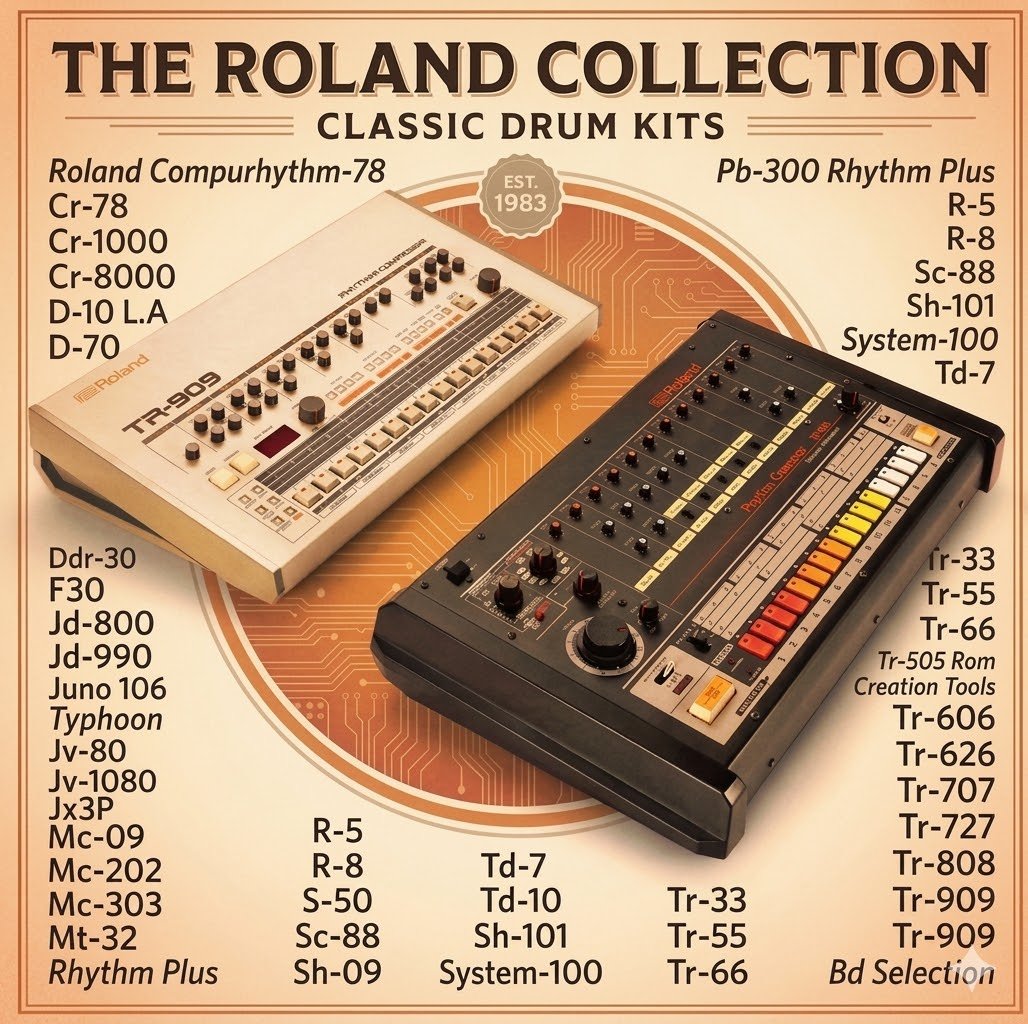
Overview This comprehensive breakdown covers the legendary Roland drum machines that built the foundation of everything from Hip-Hop and Techno to Pop and Rock. From the warm transistor ticks of the 70s to the booming sub-bass of the 80s and the digital grit of the late 90s, this is the ultimate history of modern rhythm.
[ONLY 100 COPIES AVAILABLE]
Included: The Roland Ghost Tracks PDF With this purchase, you receive the "Ghost Tracks" PDF featuring 50 iconic songs that utilized these specific Roland sounds. This document breaks down exactly which machines were used on world-famous hits so you can hear the history in action.
PREMIUM UPSELL: The TR-505 Hardware Hacker Toolkit (Take your collection to the next level with our Deluxe Edition) Go beyond the DAW with our exclusive TR-505 ROM Creation Toolset. While the standard kit gives you pristine audio files for your software, this premium upsell provides the actual batch scripts, SoX audio formatters, and PCM encoders needed to physically mod an original 1986 Roland TR-505. Compile your own custom drum hits into a raw .bin file, ready to be burned to an EPROM chip and installed directly onto the vintage drum machine's motherboard. This is the ultimate toolset for hardware modders looking to build a completely custom rhythm box.
The Collection Breakdown
The Early Era: Transistor Pioneers (1970–1978) Before the "Boom," there was the "Tick." Roland’s early machines used analog synthesis to mimic percussion, creating a charming, rhythmic foundation for early electronic and psych-rock.
- TR-33 / TR-55 / TR-77 (1972): Roland’s first dedicated rhythm performers. These were preset-based machines using diode-matrix circuit logic.
- The Sound: Warm, "pillowy" kicks and metallic, sharp hi-hats.
- Major Impact: JJ Cale ("Call Me The Breeze") and Shuggie Otis ("Inspiration Information").
The Analog Gold Standard (1980–1984) This era represents the peak of analog drum synthesis. Roland moved from presets to fully programmable interfaces, changing the role of the "drummer" forever.
- TR-808 Rhythm Composer (1980): The most famous drum machine in history.
- The Sound: A deep, booming sine-wave kick; a "snappy" noise-based snare; and the iconic, metallic "cowbell."
- Major Impact: Marvin Gaye ("Sexual Healing"), Afrika Bambaataa ("Planet Rock"), and Phil Collins ("One More Night").
- TR-606 Drumatix (1982): Designed as a companion to the TB-303 bass synth.
- The Sound: Tinny, high-pitched, and "acidic."
- Major Impact: Aphex Twin and Autechre (Early IDM and Acid House).
The Digital Hybrid Shift (1983–1985) As the industry demanded "realism," Roland began using 12-bit digital samples for cymbals while keeping analog circuits for the drums.
- TR-909 Rhythm Composer (1983): The bridge between analog and digital. Analog oscillators for the kick and snare, but 6-bit samples for hi-hats and cymbals.
- The Sound: The "thump" of the kick and the "crack" of the snare—the heartbeat of House and Techno.
- Major Impact: Inner City ("Good Life") and Daft Punk ("Revolution 909").
- TR-707 / 727 (1985): Fully digital (PCM) machines focusing on standard kit sounds and Latin percussion.
- Major Impact: Marshall Jefferson ("Move Your Body").
The Professional Studio Era (1986–2001) Roland transitioned into high-fidelity rack units and workstations, moving away from "groovebox" sequencing toward massive sample libraries.
- The R-8 Human Rhythm Composer (1989): Introduced "Feel Patches" to mimic human timing.
- The Sound: Pristine 16-bit samples that could be heavily edited.
- Major Impact: Nine Inch Nails ("Pretty Hate Machine").
- The Groovebox Series (MC-303/505) (1996–2001): "All-in-one" sounds from the 808, 909, and 606 designed for the rave and trance scene.
- Major Impact: The Prodigy and Fatboy Slim.