
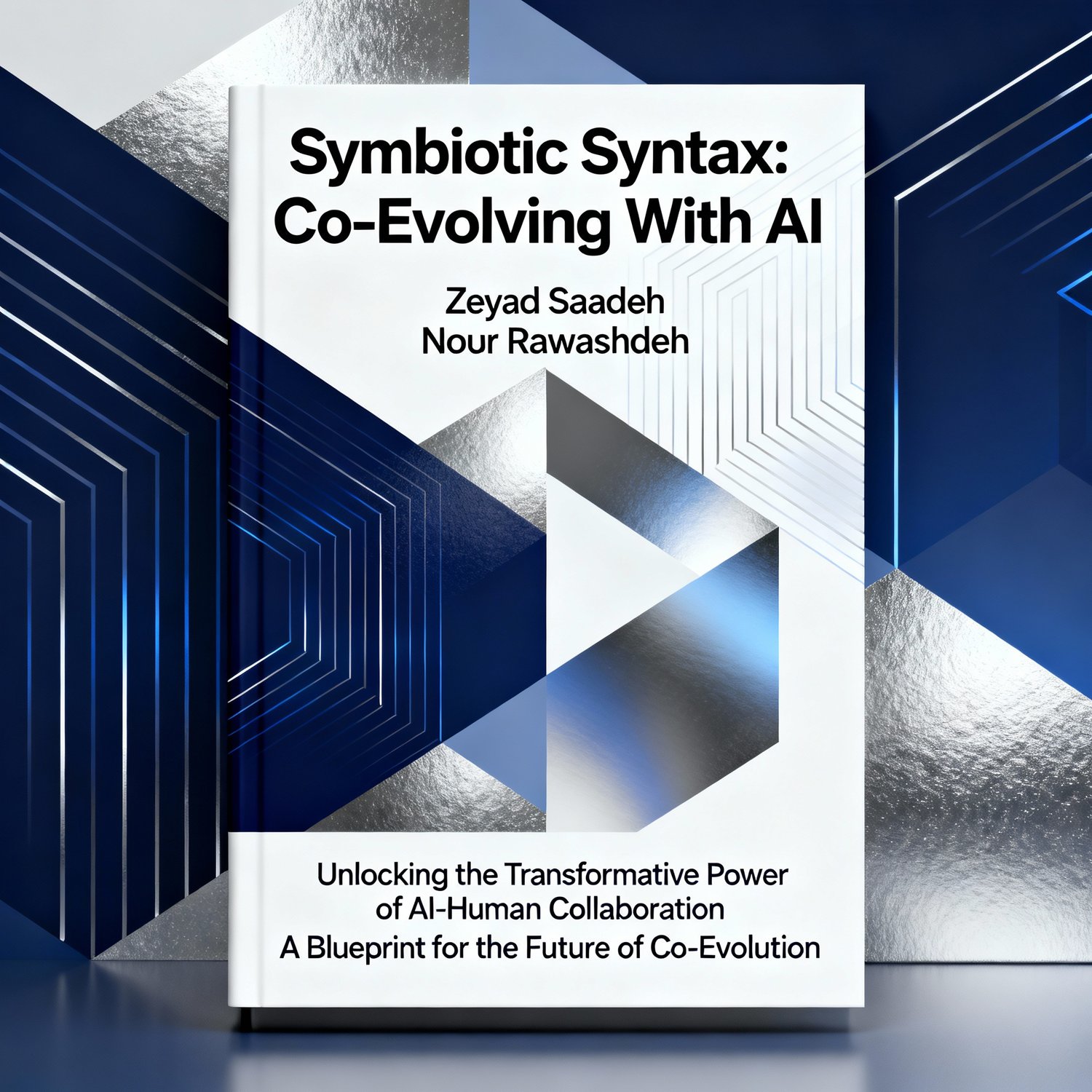
THE SYMBIOTIC SYNTAX A Programmer's Guide to Co-Evolving with AI
THE SYMBIOTIC SYNTAX
TABLE OF CONTENTS
Part I: The Foundation
Chapter 1: The Inevitable Abstraction: A History of Programming Paradigms
· The Loom and the Loop: A Prologue
· 1.1 The Four Great Leaps: A Historical Framework
· 1.2 The Law of the Vanishing Artisan
· 1.3 The Cognitive Dividend: What We Gain
· Case Study: The Evolution of a "Sort"
· Conclusion: The Inevitability of Symbiosis
Chapter 2: The Cognitive Science of the Symbiotic Mind
· The Two-Hemisphere Model of Modern Development
· 2.1 The Human Advantage: Intuition, Context, and the Ethical Frame
· 2.2 The AI Advantage: Fluency, Exhaustive Recall, and Combinatorial Speed
· 2.3 The Symbiotic Loop: The OODA Loop for Human-AI Teams
· 2.4 The Superposition Principle: Holding Multiple Architectural Possibilities at Once
· Practical Exercise: Mapping Your Cognitive Biases
Part II: The Toolkit of the Symbiotic Architect
Introduction: Forging New Instruments
Chapter 3: The Grammar of Goals: Writing Intentional Pseudocode
· 3.1 Beyond Comments: From Describing How to Declaring What
· 3.2 The Seven Primitives of Intent
· 3.3 Structuring for Parsability: A Formal Grammar for AI
· Practical Workshop: Deconstructing a Monolith
Chapter 4: Painting with Constraints: The Four Canvases
· 4.1 The Philosophy of Boundaries: Why Constraints Liberate Creativity
· 4.2 The Security Canvas: Building the Fortress
· 4.3 The Performance Canvas: Engineering for Speed and Scale
· 4.4 The Resilience Canvas: Designing for Failure
· 4.5 The Ethics Canvas: Programming with Conscience
· Practical Workshop: Building the Canvases for a Peer-to-Peer Payment System
Chapter 5: The Dialogic Debugger: Troubleshooting the Partnership
· 5.1 The Death of the Stack Trace: A New Class of "Symbiotic Bugs"
· 5.2 Cognitive Gap Analysis: A Diagnostic Flowchart
· 5.3 The Iterative Refinement Protocol: A Five-Step Method
· 5.4 The Debugging Dialogue Journal
· Practical Workshop: Debugging a Flawed Authentication Module
Chapter 6: Curating Context: Teaching Your AI Partner
· 6.1 From Generalist to Domain Specialist: The Art of the Project Bible
· 6.2 Anatomy of a Project Bible: What to Include
· 6.3 The Context Management Loop: A Continuous Process
· 6.4 Building a Shared Vocabulary: Domain-Specific Verbs
· 6.5 Context Injection Patterns for Common Scenarios
· Practical Workshop: Creating a Project Bible for a Genomic Data Pipeline
Part III: The Symbiotic Project Lifecycle
Introduction: From Blueprint to Living System
Chapter 7: Inception - The Genesis Dialogue
· 7.1 The Genesis Document: Capturing the Soul of the System
· 7.2 Hosting the First Architectural Dialogue
· 7.3 Drafting the Foundational Constraint Canvases
· 7.4 The Iterative Genesis Process
· 7.5 The Inception Deliverables
· End-to-End Example: Project Icarus Inception
Chapter 8: Expansion - Building the Symbiotic System
· 8.1 The Layered Approach: From Macro-Architecture to Micro-Specifications
· 8.2 Managing Emergent Design: When AI Reveals Better Paths
· 8.3 The Art of the Prompt-Chain: Breaking Down Complex Builds
· 8.4 Quality Assurance through Intent Validation
· End-to-End Example: Project Icarus Core Pipeline
Chapter 9: Co-Evolution - Maintenance as a Living Dialogue
· 9.1 Evolutionary Directives: Writing Code That Adapts
· 9.2 Handling Changing Requirements: The Refinement Ritual
· 9.3 Continuous, AI-Assisted Refactoring
· 9.4 The Living Documentation System
· 9.5 The Evolution Dashboard
· End-to-End Example: Responding to Regulatory Changes
Part IV: The Ethics of a Shared Mind
Introduction: The Weight of the Architect
Chapter 10: The Weight of the Architect: Accountability in Symbiosis
· 10.1 The Buck Stops Here: Why the Human is Ultimately Responsible
· 10.2 The Illusion of Understanding: Techniques for Probing AI "Reasoning"
· 10.3 Intellectual Property in the Age of Co-Creation
· 10.4 Preventing "Intent Leakage": Securing Your Strategic Genesis
· 10.5 The Accountability Framework
· Case Study: The Recruitment System
Chapter 11: The Symbiotic Conscience: Bias, Fairness, and Society
· 11.1 The Two-Layer Bias Problem: Auditing Both Human Intent and AI Output
· 11.2 Building Fairness Guards into the Ethics Canvas
· 11.3 The Precautionary Principle for AI-Assisted Systems
· 11.4 The Societal Impact Assessment
· Case Study: Auditing a Hiring Algorithm Built Using Symbiotic Syntax
Chapter 12: A Manifesto for Symbiotic Creation
· 12.1 Beyond Efficiency: Solving Grand Challenges
· 12.2 The Future of Education: Raising a Generation of Architects, Not Typists
· 12.3 The Final Ascent: From Programmers, to Architects, to Digital Philosophers
· The Digital Philosopher's Manifesto
A Programmer's Guide to Co-Evolving with AI
The age of the solo programmer is over. The age of the Symbiotic Architect has begun.
We stand at the edge of a new continent of human potential. For decades, we have been the sole authors of the digital world—the thinkers, designers, and laborers of software creation. That era is over. A new partner has arrived: artificial intelligence. It possesses total recall of every API, endless fluency in syntax, and the ability to generate a hundred variations on a theme in the time it takes to drink a coffee.
This disruption has left many developers asking the same anxious question: Is this the end of my career, or the beginning of something new?
The Symbiotic Syntax provides the answer. It is the first book to treat AI not as a simple autocomplete tool or a search engine, but as a true cognitive partner. Moving beyond the hype, it offers a coherent philosophy and a structured, repeatable methodology for the new reality of human-AI collaboration.
Drawing on 200 years of technological history—from the Jacquard loom to high-level languages—this book demonstrates that abstraction is not a threat. It is a Cognitive Dividend. Just as the assembly programmer evolved into the C architect, today’s coder must evolve into the Symbiotic Architect: a professional who defines problems with exquisite clarity, establishes intelligent boundaries, and orchestrates a partnership with a non-human intelligence.
Inside, you will discover the tools to make that evolution a reality:
- The Grammar of Goals: Move from writing code to declaring intent with the Seven Primitives of Intent (ENSURE, TRANSFORM, ORCHESTRATE). Stop describing how and start declaring what.
- Painting with Boundaries: Use the Four Constraint Canvases (Security, Performance, Resilience, Ethics) to encode your non-negotiable requirements. Give your AI a worldview, not just a task.
- Debugging the Partnership: Apply the Dialogic Debugger to fix the misalignments between your intent and the AI’s interpretation—a new class of "symbiotic bugs."
- Curating Institutional Memory: Build a Project Bible to turn a brilliant generalist AI into a domain-specific expert that understands your company’s unique rules and history.
- The Superposition Principle: Hold multiple architectural possibilities in a state of analysis, exploring parallel realities without the immense cost of implementation.
- The Digital Philosopher’s Manifesto: Navigate the profound responsibilities of co-creation with frameworks for bias auditing, fairness, and societal impact.
Through the end-to-end example of "Project Icarus," you will see how these methods transform not just how we code, but how we conceive, execute, and adapt software over time—from inception to evolution.
Power without a framework is chaos. This book ensures that your systems are not just built fast, but built right: secure, resilient, fair, and worthy of the trust placed in them.
The 10x coder, celebrated for encyclopedic syntax knowledge, is fading. The new premium is on the 10x Architect. Your journey from programmer, to architect, to digital philosopher is the great professional adventure of our time.
This book is your map.