

ECHOS™ Early Connections Hub Outreach Supports
Connection first. Understanding before intervention.
ECHOS™—Early Connections Hub Outreach Supports—is a flexible, parent-present early-connections and supported-playgroup service for families with children from birth to school entry.
ECHOS brings guided developmental play, parent learning, peer connection and relationship-based support into the everyday places families can access—including community venues, early childhood and education settings, mobile and outreach locations, approved home-based gatherings and facilitated online learning environments.
The service recognises parents and carers as children’s first educators. Families participate alongside their children while trained ECHOS facilitators help them observe, understand and respond to development, behaviour, communication, relationships and environmental needs.
ECHOS is particularly suited to families experiencing developmental concerns, developmental differences, disability or early signs associated with autism, as well as families in rural, remote, isolated and under-served communities. A diagnosis is not required to participate.
What ECHOS Means
E — Early
Support begins early, before concerns escalate and without requiring families to wait for a label.
C — Connections
ECHOS strengthens connections between children, parents, carers, educators, peers, communities and appropriate services.
H — Hub
Each ECHOS service creates an accessible local or virtual hub where families can learn, participate and build supportive relationships.
O — Outreach
Support can travel to the places where children live, learn and play rather than depending on one permanent service centre.
S — Supports
ECHOS provides practical, family-centred education and capacity-building that strengthens confidence, participation and understanding without creating dependency.
What ECHOS Provides
ECHOS may include:
- professionally facilitated, parent-present supported playgroups;
- developmentally appropriate and relationship-based play experiences;
- parent and carer learning;
- guided, non-clinical observation of development and behaviour;
- CARIE™ connection and reflection circles;
- practical home-learning experiences;
- neurodevelopmental and trauma-aware education;
- peer connection between families;
- inclusive participation and transition support;
- connections and referrals to appropriate community, education, health, allied-health or disability services; and
- mobile, outreach and facilitated online learning options.
Who ECHOS Is For
ECHOS is designed for:
- parents, carers and children from birth to school entry;
- families seeking greater understanding of their child’s development or behaviour;
- children with developmental concerns, developmental differences, disability or emerging support needs;
- autistic children and children who may be on a developmental-assessment pathway;
- families who would benefit from supported play, parent learning or peer connection;
- rural, remote, isolated and under-served communities; and
- early childhood services, preschools, schools and community organisations seeking accessible family-support options.
Intended Outcomes
ECHOS is designed to contribute to:
- stronger parent and carer confidence;
- more responsive relationships between children and adults;
- increased understanding of development and behaviour;
- greater participation in everyday play, learning and community life;
- earlier recognition of when additional support may be helpful;
- clearer connections with appropriate services;
- stronger continuity between home, early learning, school and community; and
- increased local workforce and community capability.
Thriving Kids and NDIS Positioning
ECHOS is designed to align with the family-centred, strengths-based and everyday-environment principles emerging through Thriving Kids.
It can complement the National Disability Insurance Scheme (NDIS) early childhood approach by building family capability, inclusion, community connection and participation in natural settings.
ECHOS is not represented as an approved or government-funded Thriving Kids service, an NDIS early childhood partner, an NDIS access pathway or a substitute for qualified clinical or allied-health services.
Any commissioned, funded or NDIS-related delivery must be established through a separate compliant agreement with the responsible provider or commissioning body.
Opportunities Through ECHOS
ECHOS creates a structured service pathway through which suitably trained people may contribute as:
- ECHOS Lead Facilitators;
- ECHOS Assistant Facilitators;
- parent or carer peer-support facilitators;
- early childhood educators and education-support workers;
- family and community-support workers;
- outreach coordinators;
- program or site coordinators;
- practice supervisors;
- contracted facilitators; and
- authorised Neuropreneurs™ delivering ECHOS under licence.
Opportunities may include employment with a participating provider, supervised work experience, contract facilitation or licensed self-employment.
Completion of training does not guarantee employment or authorisation to deliver ECHOS independently.
Employment and Training-Provider Opportunity
ECHOS provides employment and training providers with a defined service environment in which learners and workers can develop practical capability in:
- child- and family-centred practice;
- supported-playgroup facilitation;
- parent engagement and adult learning;
- inclusive and neuro-affirming practice;
- guided developmental observation;
- relational and trauma-aware communication;
- community outreach;
- professional boundaries and referral;
- safeguarding and ethical practice; and
- collaborative service delivery.
NEXIE Institute provides the proprietary ECHOS method, learning resources, facilitator preparation, practice requirements, quality framework and licensing pathway.
Where nationally recognised training is included, it is delivered and assessed by the relevant approved registered training organisation (RTO).
Employers and host providers remain responsible for recruitment, supervision, safeguarding, insurance, operational governance, recordkeeping and service compliance.
Scope and Professional Boundaries
ECHOS is an educational, relational and developmental capacity-building service.
ECHOS does not provide diagnosis, therapy, clinical assessment, medical treatment, crisis support, trauma treatment, NDIS eligibility decisions or personalised clinical advice.
Developmental screening or assessment may only be undertaken where it falls within the qualifications, professional scope and governance arrangements of an appropriately authorised practitioner or partner organisation.

Why ECHOS exists
Families often have questions about a child's communication, play, learning, regulation or participation before they know which service to approach. Others are already navigating developmental support, the NDIS early childhood approach or the changing Thriving Kids landscape. A useful first connection can be a welcoming place to play, meet others, learn alongside a capable facilitator and find a next step when needed.
ECHOS starts with the parent or carer as the child's first educator. The group creates opportunities to notice a child's interests, try practical ideas and build connections without making a diagnosis a condition of belonging.
Understanding Before Intervention
Choose a pricing plan
ECHOS Hub
A$49
per month
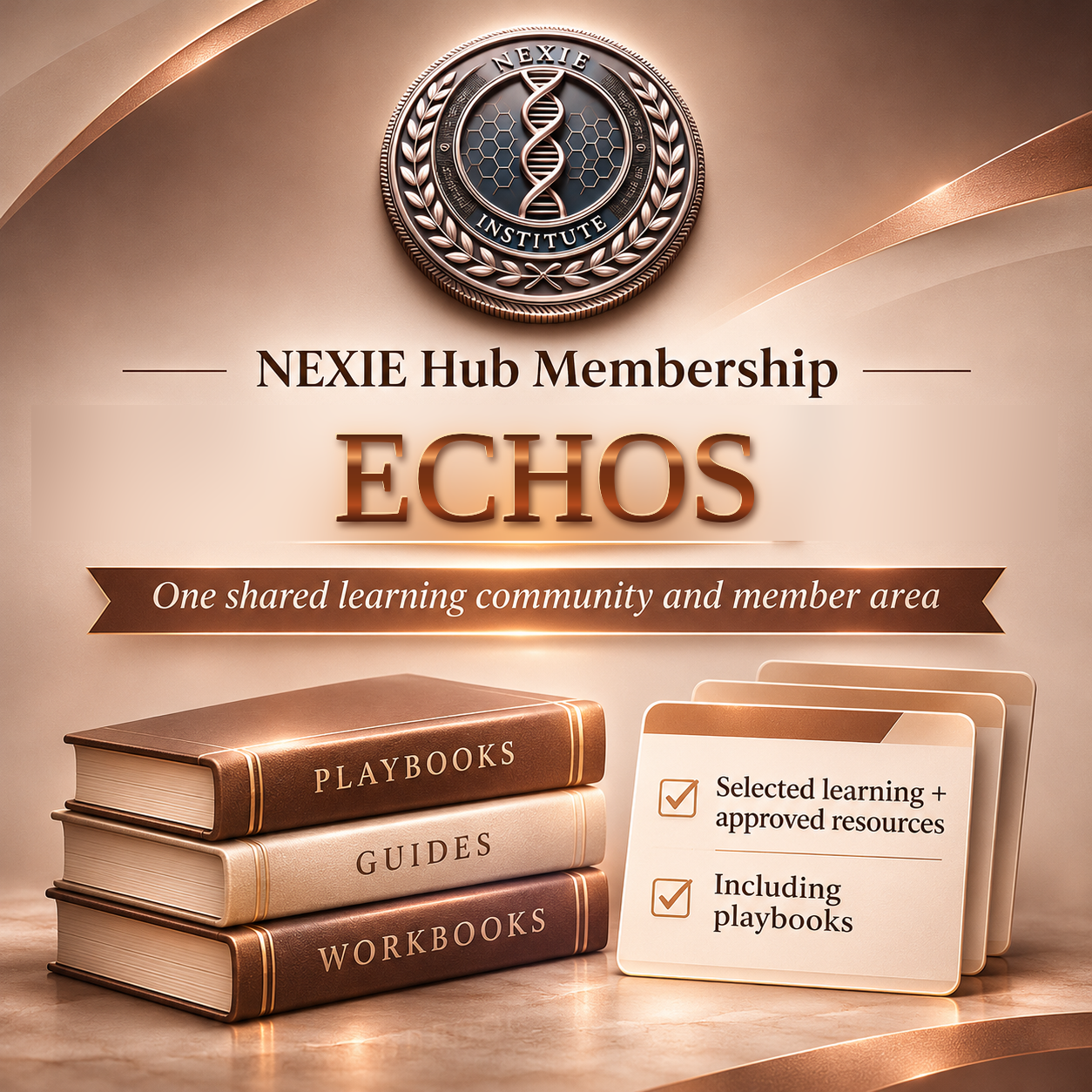
AUD $49/month. Includes the 12-lesson ECHOS learning course, its Entry and Exit application activities as released, the complete ECHOS Playbook Series (E00–E09), and access to the shared NEXIE Hub. Learn about responsive play, family partnership, developmental participation and ECHOS implementation at your own pace. One selected learning pathway with its corresponding playbooks included. Renews monthly until cancelled.
Course curriculum
01 · The ECHOS Family Experience
Explain the parent-present service, the ten-session offer and how families can choose to take part without a diagnostic assessment.
02 · The Five Pillars in ECHOS
Apply Prevention, Education, Detection, Intervention and Correction to everyday family learning while keeping Phase 1 within its educational scope.
03 · Family Partnership and Access
Create a welcoming access conversation and make practical adjustments for different families, languages, cultures and ways of participating.
04 · Child Led Play and the Six Capabilities
Design varied low-cost play invitations that support Caring, Connection, Critical Thinking, Creative Problem Solving, Contribution and Creativity without assigning a type to a child.
05 · Responsive Interaction and Co Regulation
Practise noticing cues, pausing, modelling and supporting a caregiver's own relationship with their child.
06 · CARIE and Bounded Observation
Use Context, Awareness, Reflection, Interpretation and Engagement to discuss everyday participation while separating observations from assumptions.
07 · Planning the Ten Session Group
Prepare a consistent group rhythm, family learning themes, staff roles, accessible play options and a delivery calendar.
08 · Warm Referral and Service Navigation
Build a current local support map and practise a consent-based conversation when a family wants further advice.
09 · Safeguarding Privacy and Scope
Identify the operator's child-safe procedures, recording permissions, privacy responsibilities and conditions that must be met before live delivery.
10 · Choosing a Delivery Setting
Compare community, education, outreach and approved home-hosted delivery with online learning and at-home activities as separately defined options.
11 · ECHOS Business Model and Ethical Marketing
Identify the purchaser, staffing, costs and operating roles; test a realistic offer without promising family outcomes, income or public funding.
12 · Pilot Review and Authorised Launch
Bring your portfolio together, rehearse facilitation and decide what is ready for a bounded pilot, what needs revision and what requires separate approval.
ECHOS Early Connections Hub Outreach Supports
-

Who this course is for
- Aspiring Neuropreneurs who want to develop an ECHOS enterprise, lead its operations and engage suitably capable facilitators.
- Early childhood educators and education support staff who want to learn ECHOS practice for an approved school, preschool or early childhood setting.
- Community and disability-service providers considering a parent-present family learning service within their own governance and professional scope.
- Parents and carers with lived experience exploring a supported route into community engagement, co-facilitation, employment or enterprise.
- Facilitators and team leaders preparing to deliver or supervise ECHOS under an authorised operator.
You can own or manage an ECHOS enterprise without personally leading every group. Whoever facilitates must have appropriate field capability, supervision and operator approval.
-

What you will develop
By the end of Phase 1, you will have drafted:
- a clear ECHOS service explanation and family journey;
- a ten-session group calendar and one detailed delivery run sheet;
- welcoming, accessible play invitations across the Six Cs of Capability;
- a bounded CARIE observation and caregiver reflection process;
- local service-navigation and warm-referral routes;
- a setting-specific safeguarding and privacy readiness plan;
- an operator, staffing and delivery-mode model;
- a first cost, price and sustainability test; and
- a small pilot plan with feedback and improvement measures.
These become your ECHOS Implementation Portfolio. Your role determines whether you use it to seek internal approval, supervised facilitation or separate enterprise activation.
-

The ECHOS journey
The family service follows a recurring sequence:
Connect → Play → Observe → Understand → Respond → Link
Connection comes first. Children are free to play, watch or take a break. Facilitators notice what happens with the family's permission, listen to the caregiver's account, try ordinary adjustments together and offer current local support information when wanted. The sequence runs through the ten family sessions; it is not a diagnostic test.
A ten-session family experience
The service design brings families together for approximately 90 minutes per session, with the actual group size, staffing, accessibility and venue confirmed by the accountable operator. Themes move from welcome and child-led play through everyday environments, responsive interaction, communication, relationships and transitions, ending with reflection and continuation.
-

What is involved in the course
Work through twelve separate downloadable lessons in your own time. Each lesson explains a practical ECHOS idea, uses a fictional family example, asks you to build a usable part of your portfolio and includes a short knowledge check. The separate family session guides show how the educational ideas translate into a facilitated group.
The learning cycle is Understand It → Build It → Test It → Do It → Review It → Improve It. You can take the owner-manager, facilitator or provider implementation route through the activities. Practice tasks use fictional or approved de-identified examples until an operator authorises work with real family information.
-

Resources included
- Twelve individual learner lesson PDFs,
- Ten family session guides with activities and a common run sheet.
- ECHOS service architecture and decision register.
- Family welcome, play reflection, CARIE, referral and review templates.
- A Six Cs play invitation planner and environment walk-through.
- Operator guidance for staffing, settings, safeguarding, costs and evaluation.
- A simulated facilitation task and practice-review rubric.
Resources are provided for learning and planning. The operator must complete its local consent forms, staff checks, insurance, referral information and child-safe procedures before using the service with families.
-

Choose how you may use ECHOS
- Neuropreneur enterprise Own, establish, staff and manage an ECHOS service Confirm capability, operator readiness, written activation and commercial licence.
- Educator or facilitator. Practise the educational method and ten-session format. Field capability, observed practice, supervision and the host's approved use rights.
- Existing organisation. Evaluate ECHOS for an internal site or team. Organisational agreement, approved sites and staff, local safeguarding and governance.
Learn It + Share It does not include Phase 2 Apply It. Specialist NEXIE assessment tools, individual reports and advanced intervention functions require separate preparation and express authorisation where available. Course completion alone does not grant commercial or clinical rights.
-

Prerequisites and access
You can access Phase 1 to learn about the service without an early childhood qualification or a completed Business Blueprint. If you intend to lead groups, supervise staff, use ECHOS within an organisation or establish an enterprise, your actual role will require further field-capability, safety and permission checks. The NEXIE Business Blueprint can help an independent founder build the enterprise model; it is a separate course.
The lessons are supplied as individual PDFs. You can move through them in order and save your implementation work as you go. Real-family observation, filming and sensitive records are not required to complete the learning activities.
-

Questions families and future operators often ask
Do families need a diagnosis to join ECHOS? The general ECHOS educational model does not require one. A particular funded site may have its own lawful access criteria, which the operator must explain.
Can I run the business and employ facilitators? Yes. The owner remains accountable for the enterprise and must engage staff with suitable role capability under the approved licence and operating arrangements.
Does the course authorise me to work with individual child assessment tools? No. Phase 1 teaches bounded, family-led educational observation. Protected assessments and advanced application sit outside this course.
Can our school, childcare service or provider use the materials with families? A staff member may learn the method through a course seat. Organisational service use needs the appropriate written agreement, staff approval and local governance.
Can ECHOS be delivered online? Facilitated online family learning and optional at-home activities can support connection. An online-first version of the full service needs a separate fidelity, safety, access and service-classification review.
Is ECHOS funded through the NDIS or Thriving Kids? No approval or funding status is established by purchasing this course. Any provider must verify current rules and its particular service and payer arrangements before making a claim.
Is there a guaranteed business income or client number? No. The course includes a financial test so you can assess the costs, capacity and demand of your own proposed service.
Build a place where families can connect, play and find their next step
Begin with the ECHOS method. Build an implementation portfolio that fits your role and setting. Then follow the appropriate route to supervised practice, organisational use or an authorised enterprise.
Access the twelve ECHOS lessons