









The Parent's Handbook & IEP Rights Guide: Know Your Rights and Protect Your Child
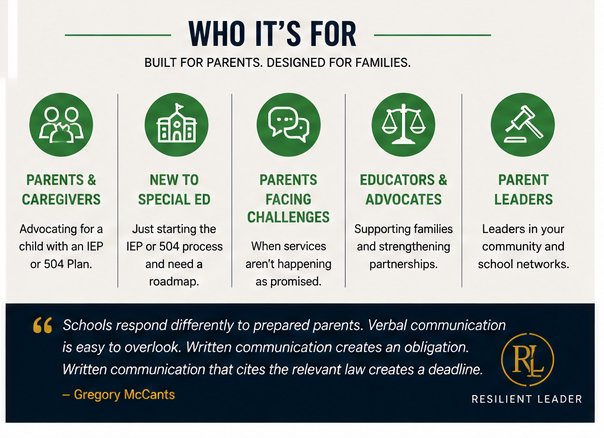
Schools respond differently to prepared parents. Verbal communication is easy to overlook. Written communication creates an obligation. Written communication that cites the relevant law creates a deadline.
The school conference room was never designed with family partnership in mind. It was built to function as an efficient administrative assembly line, processing large numbers of families through special education and disciplinary decisions that the institution has usually already finalized behind closed doors. The meeting agenda arrives late or never shows up at all. The school staff completely outnumbers you across the table. The dense, bureaucratic text sitting in front of you belongs to a system that has been speaking its own specialized language for decades. None of this is an accident. It is the structural design of the institution.
The consequence of this lopsided design shows up clearly in national civil rights data. Students with disabilities make up just 17 percent of school enrollment across the country, yet they absorb a staggering 29 percent of all out-of-school suspensions. For Black students with disabilities, the system's structural bias intensifies: roughly 20 percent are suspended in a single school year, compared to 9 percent of all special education students.
By the time you get called in for a meeting, the school already holds the data logs, the official file, and the home-court advantage. This structural asymmetry leaves parents completely unprotected , forcing them to absorb sudden "surprise" discipline decisions when options are already off the table.
You do not have to know the system perfectly to advocate effectively for your child. You just need to change the communication infrastructure. Under federal law, verbal requests carry zero legal weight. If you ask for help in a hallway conversation, nothing binding happens. But when you put it in writing and cite the explicit legal statute, the clock starts running.
Written by a 23-year Title I teacher, dean, and assistant principal, this handbook translates dense institutional legal code into plain, weaponizable practitioner strategies . Stop walking into high-stakes school meetings outmatched by specialized jargon. Equip yourself with the exact written formulas and legal boundaries needed to turn your parental instinct into binding institutional action.
Who This Is For
- Parents & Guardians of Children with IEPs or 504 Plans who are navigating complex special education settings and feel overwhelmed by institutional power dynamics.
- Families Facing School Discipline or Exclusions who need immediate, clear instructions to block illegal out-of-school removals or expulsions.
- Community Parent Advocates searching for a rigorous, plain-language legal reference guide to support underserved families in special education hearings.
What You Get
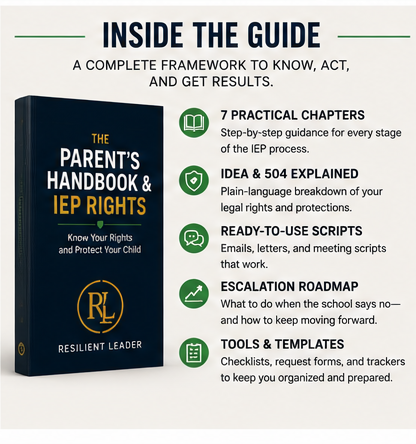
- 8-Chapter Family Advocacy Manual: A step-by-step navigational blueprint breaking down the institutional vocabulary and structural mechanics of school meetings.
- The Follow-Up Email Formula: A ready-to-use communication framework deployed within 24 hours of a meeting to freeze verbal agreements into a permanent, undeniable text record.
- The Cumulative 10-Day Discipline Tracker: Actionable metrics to audit how the school counts out-of-school suspensions, in-school services, and administrative removals before they trigger federal protections.
- The Manifestation Determination Review (MDR) Protocol: An explicit tactical guide to forcing a mandatory manifestation review under IDEA when cumulative removals cross the 10-day threshold.
- Section 504 Enforcement Blueprints: Direct strategies to transform vague accommodation plans from optional teacher preferences into legally binding compliance mandates.
- The Plug-and-Play Script Matrix: Hyper-targeted, copy-and-paste email templates engineered to instantly issue timestamped demands for MDR Requests, Student Records, IEP Team Assemblage, Accommodation Reviews, and Director Escalations.
- The 7-Step Institutional Escalation Path: A precise hierarchy matrix instructing parents exactly when and how to move past building-level roadblocks up to the District Director, State Department of Education, or the Office for Civil Rights (OCR).
What It Pairs With
To build an absolute, bulletproof defense for your child across both home and school environments, this guide pairs natively with:
- The Parent's Handbook: For grounding your tactical legal protections within a broader framework of long-term academic tracking and home-to-school communication.
- Inside the Room: For mastering real-time behavioral cues, negotiation postures, and boundary-holding strategies when sitting across from an entire school team.
- Veteran AP Field Manual: For auditing the exact, legally defensible documentation standards that school administrators use behind the scenes to build student files.