

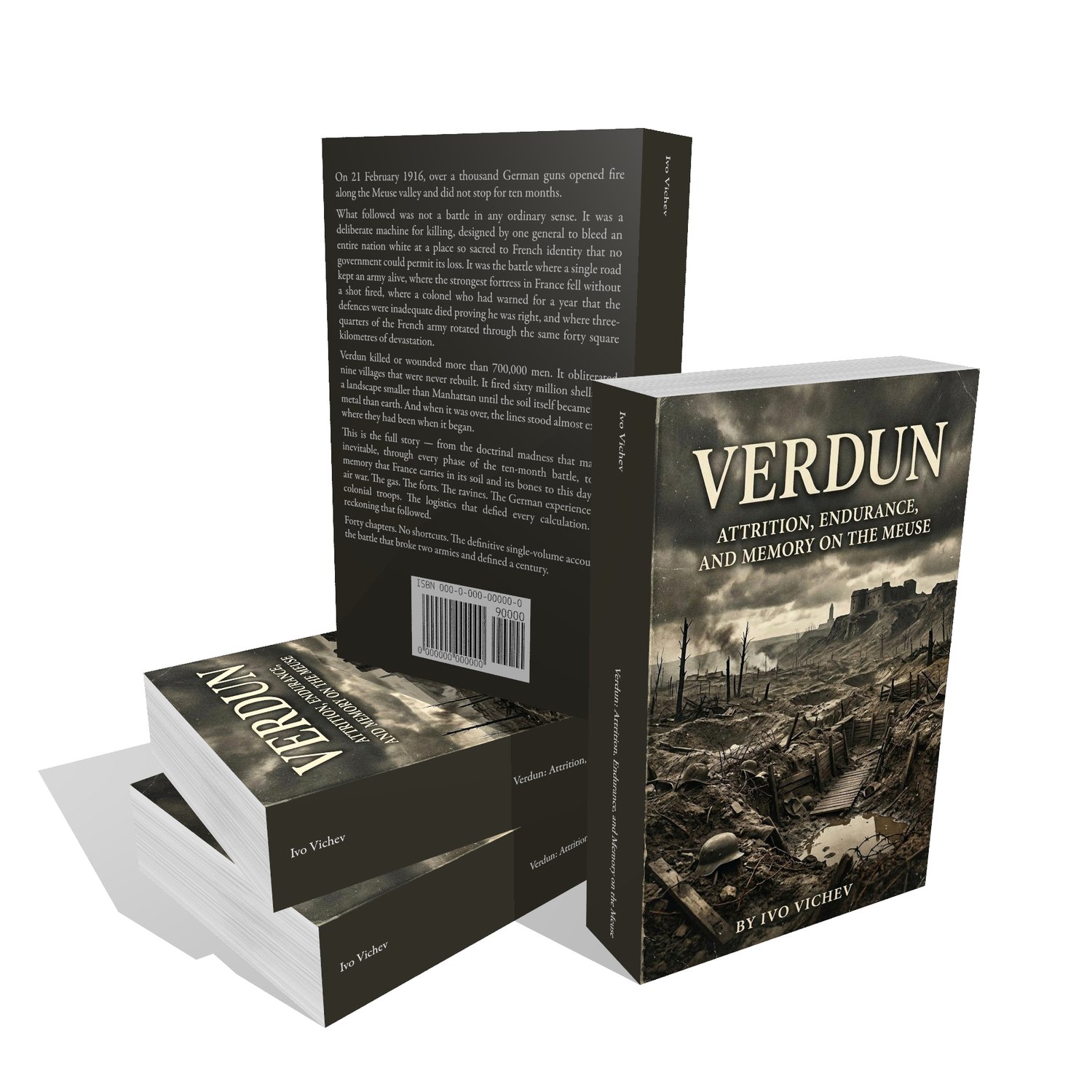
Verdun Attrition, Endurance, And Memory on the Meuse
On 21 February 1916 over a thousand German guns opened fire along the Meuse valley and did not stop for ten months. What followed was not a battle in any ordinary sense. It was a machine designed by one general to bleed an entire nation white at a place so sacred to French identity that no government could permit its loss. By December, when the guns finally fell silent, more than 700,000 men had been killed or wounded, nine villages had been obliterated from the map and never rebuilt, and the lines stood almost exactly where they had been when it all began. The ground between them contained the remains of 300,000 dead in soil so saturated with metal and chemical residue that a century later it still refuses to yield its harvest.
This is the complete story of the Battle of Verdun told across 40 chapters and 724 pages with nothing left out. It begins with the doctrine that made the catastrophe inevitable, the cult of the offensive that sent French infantry in red trousers into German machine guns, the Schlieffen Plan that failed at the Marne, and the year of futile breakthroughs in 1915 that convinced Erich von Falkenhayn he could win the war by turning French courage into a weapon against France itself. It follows the stripping of the strongest fortress system in the world until Fort Douaumont, the mightiest fortification in France, was left defended by fifty-seven elderly reservists under a warrant officer with no infantry and no orders.
It tells the story of the nine-hour bombardment that fired a million shells on the first day, of Colonel Émile Driant who spent a year warning that the defences were inadequate and then died proving he was right in a two-day last stand with twelve hundred chasseurs in a wood that ceased to exist as a wood. It tells how Fort Douaumont fell without a shot fired to a German sergeant who walked through an unguarded door and ate the garrison’s abandoned dinner. It tells how Philippe Pétain arrived at Souilly with double pneumonia and a system that saved an army, how a single road carried a truck every fourteen seconds for ten months keeping Verdun alive, how seventy of France’s ninety-six divisions rotated through the same forty square kilometres of hell in a system called the noria that preserved each division from destruction while spreading the trauma across an entire generation.
It covers the air war above the Meuse where observation meant life and blindness meant death. The savage fighting for Mort-Homme and Hill 304 on the west bank where the dead lay in layers and the hills themselves were physically shortened by shellfire. The agony of Fort Vaux where Major Raynal’s garrison fought for seven days without water, men drinking their own urine, sending carrier pigeons through the shellfire until the last one carried a message that read simply this is my last pigeon. Gas and flame and the shell zone where seventy percent of all casualties came from artillery no one could see. The German experience from the other side of the wire, divisions kept in line until they were hollow, replacements arriving among strangers, the growing conviction that the high command had forgotten them. The colonial troops who bled for a republic that had not yet decided what it owed them.
It follows the battle to its end. The Somme offensive that broke the stranglehold. The command changes that removed Falkenhayn. The October counteroffensive that retook Fort Douaumont with railway guns named Alsace and Lorraine. The December battles that closed the account. The counting of the dead. The question historians have debated for a century of whether Falkenhayn planned attrition from the start or invented the explanation after the machine he built consumed both armies. And the memory that endures in the ossuary at Douaumont where the bones of 130,000 unidentified men are visible through the windows, in the nine destroyed villages that France maintains as communes without inhabitants, in the soil that still yields shells and human remains every spring.
This is the definitive single-volume account of the battle that broke two armies, ended careers, shaped a nation, and left a crater in the twentieth century that the twenty-first has not yet filled. Drawing on French, German, and English-language sources, Verdun Attrition Endurance and Memory on the Meuse by Ivo Vichev is the book for readers who want everything in one place told straight and told in full.