
NEXIE IN
Bring understanding into the places where life happens.
The NEXIE Method in Natural Environments
Same principles. Many places. One connected approach.
NEXIE IN is a practical implementation course for people who want to move from reactive responses towards informed, relational, environmental and developmentally aligned practice.
It shows you how to consider the person, participation, relationships, current capacity and environment before choosing what to do next.
The NEXIE Method provides the lens. PEDICure provides the connected pathway. NEXIE IN helps you bring that understanding into context.

Understanding in context
People live, learn, work and relate within environments.
A response that appears difficult in one setting may change when communication becomes clearer, relationships become safer, demands become more predictable or the environment becomes easier to access.
NEXIE IN does not begin by asking, "How do we stop this behaviour?"
It begins with better questions:
- Who is participating?
- What is happening in this context?
- What strengths and supports are already present?
- Which conditions may be increasing pressure?
- What can this setting responsibly change?
- What needs another person, authority or professional pathway?
This is Understanding Before Intervention in practice.
What is a natural environment?
A natural environment is an everyday setting where people participate and relationships develop.
NEXIE IN may be relevant to:
- homes and family settings;
- early childhood services;
- schools and classrooms;
- community and early-support settings;
- training and employment environments;
- workplaces and teams;
- professional practices and organisational systems.
The same principles can travel across these settings, but the activities, authority, safeguards and responsibilities must fit the context.
Choose a pricing plan
Course curriculum
Lesson 1 - NEXIE IN: Understanding in Context
Discover how NEXIE IN carries one developmental lens into many everyday environments while preserving role, setting and professional boundaries.
Lesson 2 - Person, Participation and Place
Map how strengths, relationships, activities, expectations and systems interact to influence participation.
Lesson 3 - Observe Without Labelling
Separate observation, stakeholder knowledge, interpretation and professional advice so reflection does not become diagnosis.
Lesson 4 - Relationships, Safety and Shared Understanding
Build the relational conditions, shared language and participation agreements that allow reflection and learning to occur.
Lesson 5 - Compatible Environments
Examine physical, sensory, relational, cultural and organisational conditions that may increase or reduce participation.
Lesson 6 - PEDICure in Natural Environments
Use Prevention, Education, Detection, Intervention and Correction as connected implementation lenses.
Lesson 7 - ENTER: Purpose, Scope and Governance
Define the setting, purpose, participants, authority, consent and stop conditions before implementation begins.
Lesson 8 - OBSERVE + UNDERSTAND: Build the Shared Picture
Bring together multiple perspectives, contextual observations and existing supports without manufacturing certainty.
Lesson 9 - MAP + ALIGN: Proportionate Priorities
Map capacity and pressure, then choose a small number of priorities that fit purpose, authority and resources.
Lesson 10 - APPLY: Introduce Bounded Changes
Translate priorities into realistic actions, responsibilities, communication and review without exceeding scope.
Lesson 11 - REFLECT + INTEGRATE: Sustain What Helps
Review evidence, correct the plan and embed useful practice without turning one positive experience into a universal rule.
Lesson 12 - Authorised Implementation, Quality and Use Rights
Decide whether the next step is personal use, employed practice, an organisational pilot or separately authorised Neuropreneur delivery.
NEXIE IN
-
Who is this course for?
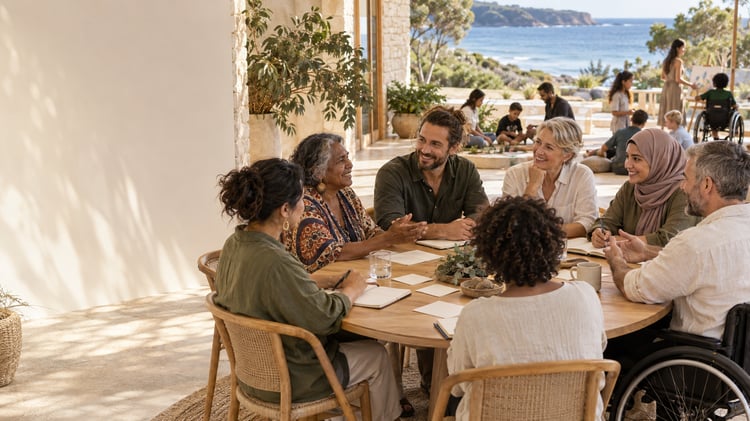
NEXIE IN is designed for people who want a structured way to understand and improve everyday environments, including:
- parents and carers using the learning for their own family;
- educators and education-support workers;
- early childhood and school teams;
- disability, community and early-support workers;
- practitioners working within their existing professional scope;
- supervisors, leaders and organisational teams;
- trainers and workforce-development professionals;
- future NEXIE facilitators and Neuropreneurs preparing for a separate authorised pathway.
The course is educational. The way a learner may use it depends on their role, qualifications, workplace authority, supervision and permissions.
-

The NEXIE IN implementation journey
ENTER
Clarify the setting, purpose, participants, responsibilities, consent, governance and desired outcomes.
OBSERVE
Notice patterns, participation and context without rushing to labels or conclusions.
UNDERSTAND
Consider people, relationships, experiences, environments and current capacity.
MAP
Identify strengths, pressures, supports, constraints and environmental influences.
ALIGN
Choose realistic priorities appropriate to role, evidence, setting and resources.
APPLY
Introduce agreed learning, strategies, resources or environmental changes within scope.
REFLECT
Review what changed, what remained difficult and what was learned.
INTEGRATE
Embed useful practice into routines, planning, communication, leadership and systems.
-

What is involved?
You will work through twelve downloadable lessons using the NEXIE learning movement:
Understand It -> Build It -> Rehearse It -> Review It -> Carry It Forward
Every lesson combines accessible learning with a practical asset you can add to your implementation portfolio.
The learning is designed for self-paced use and may also support an approved facilitated cohort or organisational pathway.
-

What you will develop
By working through the course, you will learn to:
- explain NEXIE IN and its professional boundaries;
- see participation across person, relationships and place;
- observe without labelling or diagnosing;
- separate facts, observations, perspectives, hypotheses and recommendations;
- build shared understanding and relational safety;
- examine environmental demands, access and supports;
- use PEDICure as a connected implementation lens;
- establish purpose, consent, governance and stop conditions;
- map capacity and pressure;
- choose proportionate priorities;
- design bounded environmental or practice changes;
- review intended and unintended impact;
- integrate useful practice into routines and systems;
- recognise when to continue, adapt, consult, refer or stop;
- distinguish personal learning from authorised professional or commercial application.
-

Resources included
Your course includes:
- twelve separate downloadable learner lessons;
- guided reflection and rehearsal activities;
- a Product Definition and Scope template;
- a Person-Participation-Place Map;
- a Source-Aware Observation Record;
- a Relationship and Shared Understanding Agreement;
- an Environment Compatibility Audit;
- a PEDICure Pathway Crosswalk;
- an Entry, Consent and Governance Brief;
- a Shared Understanding Map;
- a Capacity and Pressure Map;
- a Priority Decision Record;
- a Compatible Environment and Application Plan;
- a Reflection, Review and Integration Framework;
- an Implementation Readiness and Use-Rights Decision;
- professional-boundary, accessibility, cultural-safety and safeguarding prompts;
- knowledge checks and answer guidance;
- version-control and next-action records.
-

What outcomes can the learning support?
NEXIE IN is designed to support:
- stronger shared understanding;
- less reliance on reactive behaviour management;
- more compatible communication;
- improved relational and reflective practice;
- greater awareness of environmental influences;
- clearer roles and responsibilities;
- stronger stakeholder participation;
- earlier recognition of additional support needs;
- more consistent agreed approaches;
- better alignment between resources and needs;
- increased local capability.
These are intended educational and organisational outcomes, not guarantees. What occurs depends on the setting, participation, leadership, resources, implementation quality and the issues involved.
-

Professional scope and safeguards
NEXIE IN provides educational, reflective, developmental and organisational implementation.
It does not provide diagnosis, genetic or epigenetic testing, therapy, medical treatment, crisis response, formal workplace investigation, legal or financial advice, regulated behaviour support or guaranteed outcomes.
It does not replace:
- qualified professional judgement;
- approved curriculum or educational policy;
- workplace health and safety processes;
- safeguarding and mandatory reporting;
- human-resources or industrial processes;
- clinical assessment;
- regulated behaviour support;
- emergency and referral pathways.
All real-world application must follow the laws, policies, professional standards and governance of the relevant setting.
-

Prerequisites and access
There is no universal qualification prerequisite for personal learning.
Appropriate access depends on the intended use:
- families may use general learning for their own environment;
- employees and contractors work within an authorised operator's systems and role;
- organisations require appropriate leadership, governance and participant protections;
- independent or branded delivery requires a separate approved pathway and written rights.
You will need the ability to open PDF files and a safe place to store your learning portfolio. Use fictional or fully de-identified examples unless an authorised process specifically permits identifiable information.
-

Questions and answers
Is NEXIE IN one fixed program?
No. It is one structured implementation pathway that adapts to different natural environments. The principles remain consistent while activities, responsibilities and safeguards vary.
Is NEXIE IN a clinical intervention?
Not by default. Most pathways involve education, reflection, communication, environmental adjustment, planning and capability building.
Does NEXIE IN diagnose root causes?
No. It helps participants explore patterns and possible contributing conditions. Observations support better questions and planning, not diagnosis.
Does it use epigenetic scans or tests?
No. NEXIE IN does not provide genetic testing, epigenetic testing or wellbeing scans.
Can I classify a person from a colour-coded activity choice?
No. The 6Cs, LAMAHS and colour-coded resources may organise opportunities and reflective planning. They do not determine a fixed type, intelligence, diagnosis or Social Brain profile.
Can an organisation customise NEXIE IN?
Implementation can adapt to context, but protected NEXIE content cannot be modified, rebranded, reproduced or incorporated elsewhere without written rights.
Can I deliver NEXIE IN as my own service after this course?
Not automatically. Independent branded or commercial delivery requires the applicable capability, assessment, safeguards, activation and licence.
Does the course guarantee a result?
No. It supports a more structured and reflective implementation process. Outcomes depend on context and implementation.
Bring understanding into your environment
Learn to enter carefully, observe responsibly, understand in context, map what matters, align realistic priorities, apply bounded changes, reflect honestly and integrate what helps.
Access NEXIE IN when release access opens.