
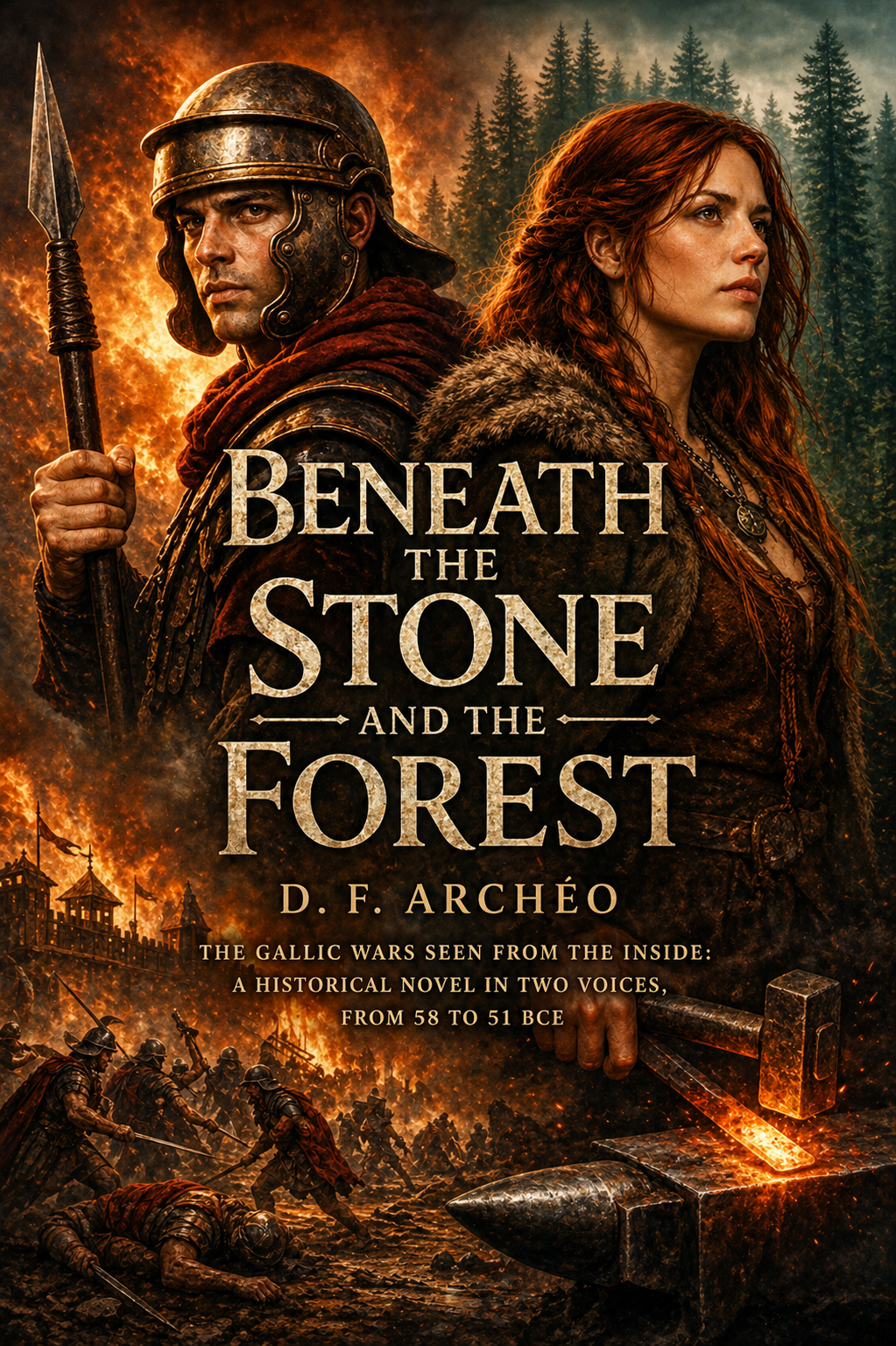
Beneath the Stone and the Forest
Beneath the Stone and the Forest The Gallic Wars seen from within — a novella in two voices, 58 to 51 BC.
58 BC. Caesar invades Gaul. History remembers his name.
This novella remembers the others.
Lucius is nineteen years old, a pilum in his hands and his feet in the mud of a land he doesn't understand. Vercinova forges iron in Gergovia, learns Latin in secret, and reads the enemy's reports before her own chiefs even suspect they exist.
They will never meet. They understand each other better than anyone.
Through their two alternating voices — the doubting Roman soldier, the Gaulish woman who resists through intelligence — Under Stone and Forest tells the Gallic Wars from below. From the mud of the ditches, the ramparts of a besieged oppidum, the silences of a family forge. Not Caesar's strategies. Not Vercingetorix's speeches. What is never written in the victory reports.
The question it raises, and that stays with you:
When a people loses its war, what remains? Its language. Its memory. And the stubborn people who refuse to let the victors name things in their place.
A historical novella. Two voices. No glorious heroes. Just two human beings caught in the machinery of an era — and what it costs to remain standing when History rolls over you.
EXCERPT:
The first thing you see of Gaul, from the Rhône, is the mist. Not the trees — though there are trees, masses of trees, forests that begin two hundred paces from the bank and apparently never end, according to what the scouts report. Not the warriors either, even though you know they are there, somewhere, watching from the shadow of the oaks. The first thing you see is the mist. It rises from the river in the morning, a cold grey vapour that erases outlines, that turns the reeds into ghosts, that gives the whole far end of the world the look of a place where borders have not yet been decided. My name is Lucius Caecilius Rufus. I am nineteen years old. My father grew spelt in Samnium. I have been a legionary of the Tenth for two and a half years, which means I have had time to learn to sleep on hard ground, to march thirty miles with twenty kilos on my back, and not to panic when the man in front of me takes a javelin in the back of the neck. This morning, we are waiting for the order to cross. ✦ The general is there, on his dapple-grey horse, looking at the river. It is Caesar. Everyone calls him that — not "the general," not "the consul," just Caesar, as if he had only one name and that name were enough to fill the available space. He is shorter than you imagine, when you hear him speak. But he speaks in a way that makes height irrelevant.