

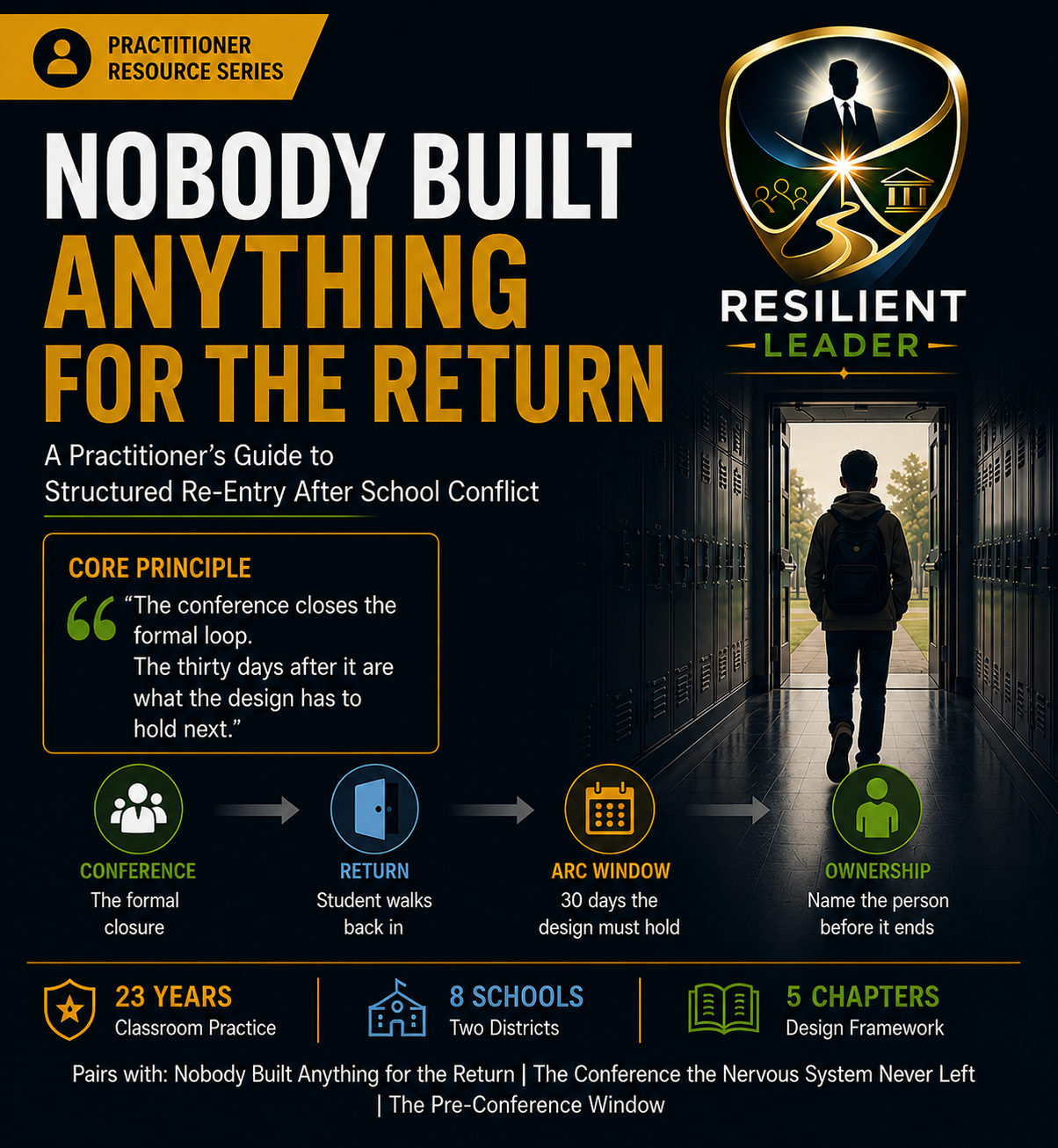










Nobody Built Anything for the Return: A Practitioner's Guide to Structured Re-Entry After School Conflict
The conference only manages to patch over the surface-level behavior. If nobody bothers to redesign the actual operational conditions the student is returning to, the exact same conflict loop is bound to run all over again.
Think about how this plays out on any given school day: a student gets kicked out of class, a quick conference happens down in the office, and everyone signs a piece of paper. Then, that student walks right back into the hallway. They step right back into the exact same desk, enter the exact same classroom environment, and look across the room at a teacher who is still emotionally processing the original disruption. The school system takes a collective breath, logs the file as resolved, and simply crosses its fingers hoping for a different outcome.
That is a major design mistake. Most schools treat a student's return as a passive calendar event rather than an active design opportunity. They constantly confuse a basic schedule resumption with actual relational re-entry. Resumption keeps the bells ringing and the roster moving, but it leaves the deep, underlying fractures completely untouched. Genuine re-entry completely changes the structural conditions a student walks back into.
Written straight from the trenches by a 23-year Title I school administrator and educator, this book exposes the missing infrastructure of the return window. It gives you a tactical, field-tested sequence to restructure the critical first 48 hours back, prep exhausted teachers, and systematically neutralize environmental triggers. Stop leaving the most volatile phase of school discipline to blind luck. It is time to build a re-entry sequence that actually breaks the cycle.
Who This Is For
- School Administrators & Deans who are exhausted from watching restorative circles yield temporary truces, only to have the same kid end up right back in their office five days later.
- Classroom Teachers who feel completely stranded or caught off guard when a student gets sent back to their room with zero warning, zero notes, or zero structural adjustments.
- School Counselors & Social Workers searching for explicit, behavior-based frameworks to guide a student's return rather than improvising on the spot.
What You Receive
- 7-Chapter Practitioner Sequence: A step-by-step operational roadmap detailing the hard relational realities and physical design requirements of student re-entry.
- The 48-Hour Window Blueprint: Actionable protocols mapping out the highest-stakes hours immediately following a student's return.
- The Five-Minute Student Check-In: A concrete, three-move private script using Acknowledgment, The Agreement, and The Ask to ground the student right before they cross the classroom threshold.
- Relational Gap vs. Safety Gap Framework: An objective metric to separate low-level trust repair from serious instances of physical or emotional harm that require explicit institutional protection.
- Documentation Language Shift Templates: Practical models showing how to transform standard records from static incident summaries into dynamic, 30-day monitoring logs.
- The Re-Entry Planning Toolkit (Bonus): A personal, non-compliance planning checklist detailing exact tasks for week one, week two, and structural diagnostic entries.
What It Pairs With
To engineer a highly durable, unyielding disciplinary framework across your building, this volume links natively with:
- The Room Trilogy (Before the Room & Inside the Room): Forming the complete core trilogy that tracks the full arc of student conflict from pre-meeting evidence architecture to live room facilitation.
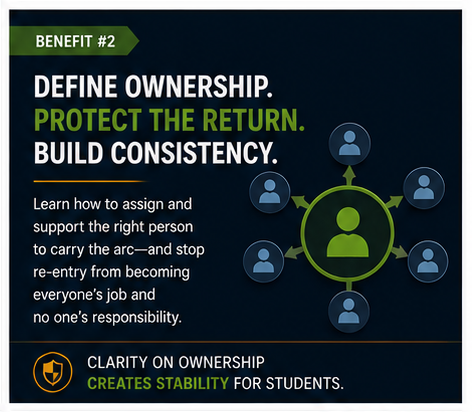
- Who Owns the Arc: For establishing explicit, named accountability metrics across the 30-day post-conference recovery window.
- The Conference the Nervous System Never Left: For building essential biological debrief loops and recovery structures for staff handling high-stress behavioral settings.