

NEXIE Method Step 5 — Correction
Turn understanding into a plan that can grow with the person
Twelve practical lessons in listening, planning, observing and adjusting support across the final PEDICure step.
Step 5 brings together what has been learned through Prevention, Education, Detection and Intervention. It asks: What needs to change in the plan, teaching, adult response, relationship or environment so this person can participate safely and develop?
Correction means reviewing the fit of support. Across twelve downloadable lessons, learners practise including the person and family in decisions, separating observations from assumptions, choosing small actions with clear owners, and checking whether those actions helped.

Turn understanding into a plan that can grow with the person
Learn how to bring NEXIE understanding into a shared support plan, check whether agreed actions are helping, and revise the plan when circumstances change. Twelve lessons cover person and family voice, evidence, the Six Cs, optional family observation, purposeful communication, linked plans, review and professional boundaries.
Step 5 is the Correction pillar of the NEXIE PEDICure pathway. It brings together what has been learned through Prevention, Education, Detection and Intervention and asks:
What needs to change in the plan, teaching, adult response, relationship or environment so this person can participate safely and develop?
Correction means reviewing the fit of support. It may involve teaching a developing capability, changing a task, making communication accessible, responding to an unsafe situation, or adjusting what adults and organisations do. The person’s identity, disability and way of being are not the things to correct.
In twelve connected lessons, you will learn to distinguish observation from interpretation, include the person and family in decisions, describe participation and strengths, consider several explanations for a difficulty, and choose small actions with clear owners. You will practise checking whether the action happened, listening to its effect, and deciding what the plan needs next.
This is Learn It education. The lessons use fictional examples and practice activities. Completing them does not provide an individual NEXIE assessment, approve a school or service plan, confer ARINI Apply It interventionist authority, or grant permission to deliver a NEXIE Productised Service commercially.
Choose a pricing plan
NEXIE PEDICure Hub Membership
A$49
per month
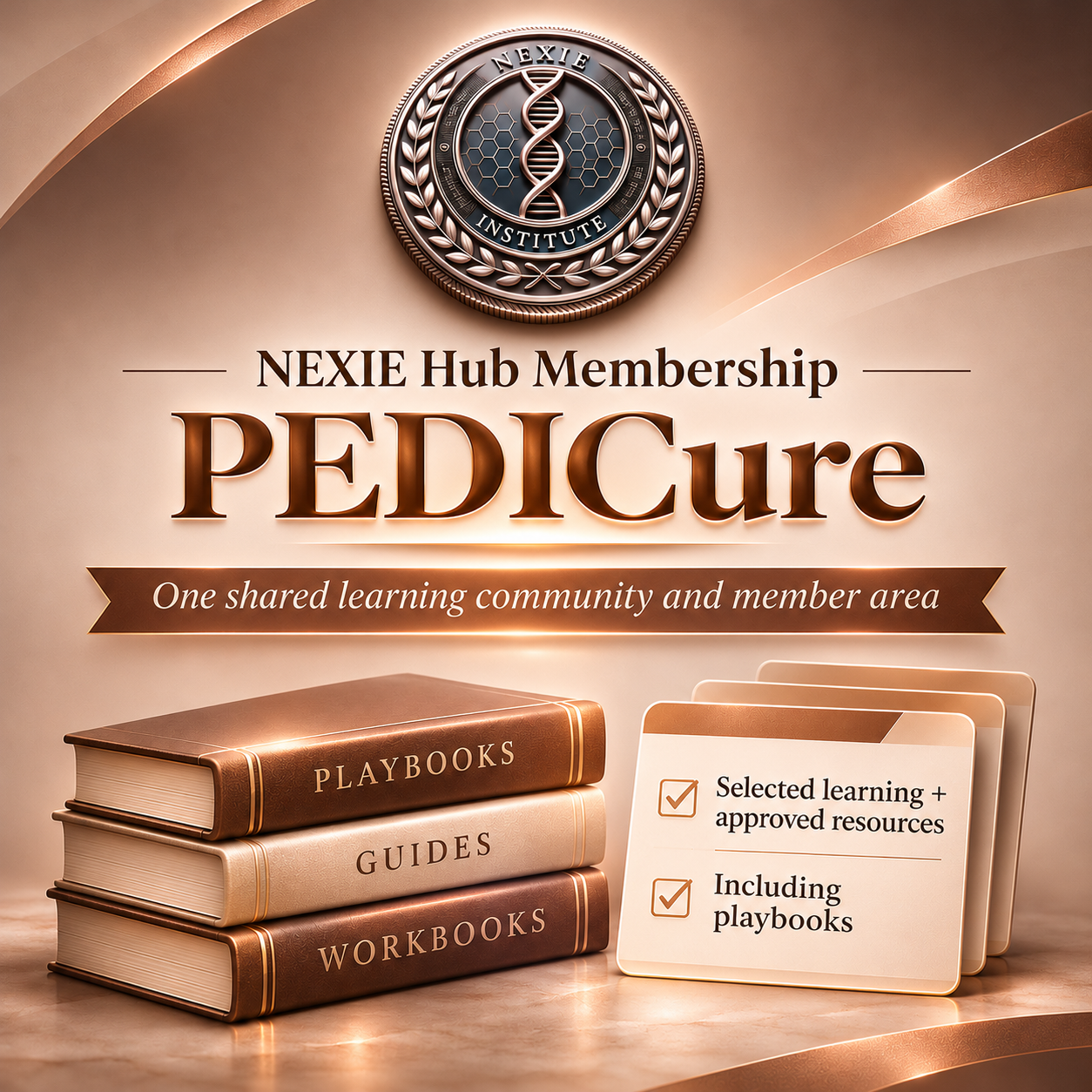
AUD $49/month. Includes the five NEXIE PEDICure learning steps—Prevention, Education, Detection, Intervention and Correction—ten guided Entry and Exit application lessons, the existing PEDICure and URE Application Playbooks (P01–P05, U01, Start Here and working records), and access to the shared NEXIE Hub. Build a practical five-step learning portfolio through LEARN IT → WAGOLL → BUILD IT → REVIEW. One selected pathway; subscription renews monthly until cancelled. Some advanced source content remains subject to final review.
Course curriculum
Lesson 1 — Correction Means Reviewing the Fit
Begin the final PEDICure step by understanding Correction as a review of the plan and its real-world fit. Bring forward relevant learning from Prevention, Education, Detection and Intervention, then distinguish a valued participation goal from a goal based only on reducing incidents. Practise writing one adult-owned adjustment and a clear review point.
Lesson 2 — The Person and Family in the Plan
Give the person’s own words, choices and communication preferences a distinct place in planning. Learn how family knowledge and setting observations can both be recorded without forcing agreement, and how to state consent and information-sharing limits. Practise keeping three perspectives visible in a fictional case.
Lesson 3 — Evidence Observation and Uncertainty
Separate what someone saw or heard from what they think it may mean. Identify the source and limits of a report, assessment result or hypothesis, and consider an alternative explanation. Practise responding to an immediate safety or access need while the wider cause remains uncertain.
Lesson 4 — Developmental Participation and the Six Cs
Explore Caring, Connection, Critical Thinking, Creative Problem Solving, Contribution and Creativity as opportunities that can appear in everyday activity. Notice what a person chose, what support was available and what was not observed. Practise describing participation without treating a toy colour or short play example as a Social Brain assessment.
Lesson 5 — Environment Relationships and Protective Responses
Examine what surrounds a response before deciding what support may help. Consider access, task demands, sensory conditions, relationships, safety, fatigue and possible protective meanings without assuming that behaviour proves a particular fear. Choose one proportionate adult or environmental change for review.
Lesson 6 — ECHOS Home Learning and Family Observation
Learn how an ordinary, family-chosen activity can help answer one question about participation. Practise recording what happened, the adult support available, the family’s account and one small adjustment. This optional home-learning example does not require video, assign developmental scores or confer permission to operate the ECHOS service.
Lesson 7 — CARIE and Shared Formulation
Use CARIE as an educational reflection structure to connect context, accounts and possible meanings. Learn to retain disagreement and evidence that does not fit a preferred explanation. Draft a short provisional understanding with a clear next question and an adult-owned action.
Lesson 8 — The Integrated Personalised Action Plan
Explore the working structure of one shared record for the person’s goals, strengths, access, evidence, supports, owners and reviews. Practise drafting an action line that pairs an opportunity to learn with an adult or setting adjustment. The lesson teaches a fictional plan exercise; formal plans still require their responsible owner’s approval.
Lesson 9 — Purposeful Communication and Rehearsable Scripts
Design short, respectful cues that make support easier to access. Pair the person’s optional words, gesture or visual cue with a clear adult action, then consider when rehearsal is welcome and when a script should be changed or discarded. No one is required to disclose, apologise or follow a generic colour-based script.
Lesson 10 — Linked Family and Educational Outputs
Understand the difference between the shared planning record and an Individual Education Plan, Behaviour Support Plan, family guide or classroom adjustment guide. Practise carrying an agreed action into a setting-specific document without presenting a tentative interpretation as a confirmed fact. Identify who owns approval and review.
Lesson 11 — Review and Correct the Plan
Check whether the agreed support was actually delivered and what changed for the person. Compare participation, safety, communication and unintended effects, including differences between settings. Practise documenting a decision to continue, adapt, stop, investigate or refer, with a reason, owner and next review date.
Lesson 12 — Professional Scope and Responsible Implementation
Bring Step 5 learning together with consent, child safety, privacy, complaints, handover and professional boundaries. Practise recognising when a concern requires the accountable provider’s safeguarding or referral pathway. Distinguish course learning from formal plan approval, protected ARINI Apply It functions and commercial NEXIE permission.
NEXIE Method Step 5 — Correction: Turn understanding into a plan that can grow with the person
-

Who this course is for
Parents and carers
Learn a practical way to describe what helps your child participate in ordinary routines and to contribute your knowledge when others are planning support. The course does not require you to assign a Social Brain profile, record your home, or make a developmental diagnosis.
Educators and support workers
Strengthen observation, family partnership, accessible teaching, adult responsibility and plan review within your role and your school or service procedures.
Practitioners and community professionals
Explore an evidence-aware planning framework while keeping consent, documentation, professional scope, consultation and referral visible.
Future Neuropreneurs
Understand how the fifth PEDICure step relates to a Productised Service, and how Learn It education differs from separately authorised ARINI Apply It capability and commercial permission.
Schools, services and organisations
Build shared language for participation-focused goals, linked outputs, consistent adult action and review that listens to the person and family.
-

What learners will develop
A clear understanding of Step 5 as a continuing review of the fit of support.
- Ways to carry relevant information forward from the first four PEDICure steps without waiting for every assessment before addressing safety or access.
- The ability to record person, family and setting accounts separately, with consent and information-sharing limits.
- A practical distinction between observations, reports, confirmed needs, working hypotheses and unanswered questions.
- An understanding of the Six Cs as opportunities for capability development, separate from the six Social Brain pathways.
- A way to consider environmental and relational conditions, and possible protective responses, without assigning a cause from behaviour alone.
- Experience with a bounded, optional family observation using everyday play or routines.
- A working model for goals, adult responsibilities, purposeful communication and linked setting-specific outputs.
- A repeatable review decision: continue, adapt, stop, investigate or refer.
- Awareness of safeguarding, privacy, AI data boundaries, plan approval and NEXIE authorisation requirements.
-

What is involved
Work through twelve lessons in sequence. Each guide includes a learning outcome, professional reading, a fictional case, a practice activity, five knowledge-check questions and a link to the next lesson. The second page of each PDF has space to record your own practice response and answers.
Use fictional situations for course activities. You do not need to submit a real child’s records, disclose a trauma history, upload video, complete an individual SYMBEB assessment or assign a colour to a person.
Learning elements and What it provides
Twelve learner PDFs
The full Learn It sequence as separate downloadable guides.
Fictional cases
Practice situations that show how context, voice and adult action affect a plan.
Practice activities
One bounded task per lesson to turn the teaching into a reviewable planning step.
Knowledge checks
Five questions in each lesson to consolidate meaning, safety and scope.
Progression- A clear path from understanding Correction to responsible implementation.
-

Resources included
- Twelve separate Step 5 learner guide PDFs.
- Fictional worked situations within the lessons.
- Printable practice and knowledge-check space in each guide.
- A course pathway that links each lesson to the next.
The professional master manuscript, controlled answer key, protected practitioner tools, individual assessment processes, facilitator instructions and current commercial delivery resources are not unrestricted learner downloads. Where needed, they are governed through the relevant provider, professional and NEXIE authorisation arrangements.
NEXIE PEDICure Step 5 Correction
-

The Step 5 journey
01
Bring forward what is known
Carry relevant learning from the first four PEDICure steps into a shared record.
02
Hear the person and family
Keep their accounts, priorities and choices visible beside setting observations.
03
Agree on a useful change
Choose a participation goal and name what an adult or environment will do.
04
Check what happenedRecord whether the support was delivered and what the person experienced.
05
Correct the plan
Continue, adapt, stop, investigate or refer, then set the next review.
-

Voice, evidence and participation
01
Voice
Ask what the person wants to keep or change, using a communication mode that works for them.
02
Family knowledge
Invite everyday examples and preserve the family’s account as its own evidence source.
03
Observation
Record what was seen and what support was available before proposing a meaning.
04
Capability
Notice opportunities to care, connect, think, solve problems, contribute and create.
05
Uncertainty
Keep several explanations open and record what needs to be checked next.
-

From learning to authorised application
01
Learn the method
Study twelve lessons using fictional cases and educational practice activities.
02
Work within your role
Apply appropriate everyday learning through your existing responsibilities and provider procedures.
03
Seek specialist input
Use qualified consultation, referral or safeguarding pathways when the situation requires them.
04
Access ARINI Apply It
Protected individual assessment and interventionist planning require separate capability and authorisation.
05
Operate with permission
Commercial delivery of a NEXIE Productised Service requires the applicable licence and approved resources.
-

Prerequisites and access
Step 5 follows the relevant NEXIE foundations in Prevention, Education, Detection and Intervention. Learners should understand Understanding Before Intervention, behaviour as information, the person’s participation and the influence of relationships and environment. The course builds on Step 4 learning but does not require a learner to submit a real case to practise.
Parents and carers may use the learning for reflection and informed conversations about their own child. Professionals remain within their qualifications, competence, employer policies and accountable service procedures. Access to this Learn It course is separate from any ARINI Apply It prerequisites, competency decision, supervised practice, NEXIE authorisation or commercial licence. This course is not nationally recognised training.
Professional scope and safeguarding
These lessons teach educational understanding and practice with fictional examples. They do not deliver a diagnosis, clinical screening, therapy, protected individual NEXIE assessment, final report or automatically approved support plan.
Where there is suspected harm, an allegation, bullying, unsafe treatment, an urgent health issue or an immediate access or safeguarding concern, use the relevant service procedure and qualified support without waiting for a NEXIE profile or the completion of the course. A reflective exercise does not replace incident or complaint handling.
No identifiable child, family, disability, health, trauma, allegation or safeguarding information — including recordings — should be placed in a general-purpose AI service. A future approved NEXIE system would require a defined consent, security, retention and human-review process.
-

Questions and answers
What does “Correction” mean here?
It means reviewing and adjusting the fit of the plan, adult support, teaching, relationship or environment as the person’s experience and evidence become clearer.
Is this a course about correcting a child’s behaviour?
It teaches how to understand participation, share responsibility for support and review what helps. The person’s identity or disability is not something the course aims to correct.
Can parents and carers access the lessons?
Yes. The lessons support learning and reflection. Parents can contribute knowledge of their child without performing a specialist assessment or purchasing a play kit.
Do I need to film my child or provide a real case?
No. The lesson activities use fictional cases. Home video is not required for the ECHOS home-learning example.
Will the course identify my child’s Social Brain or developmental stage?
No. A short play observation or colour-coded activity does not establish a Social Brain pathway or validated developmental stage.
Will I receive an individual action plan or report?
No. The learner guides teach the structure of planning using fictional examples. Individual assessments, reports and authorised planning, if appropriate, follow separate processes.
Can completing the course authorise me to write an IEP or Behaviour Support Plan?
No. The responsible school, provider or qualified professional approves and manages its own formal plans and duties.
Does Step 5 qualify me to provide ARINI Apply It or ECHOS services?
No. Interventionist application, protected assessment and commercial Productised Service delivery have separate capability, role, provider and NEXIE permission requirements.
What happens after I finish?
You can continue using the learning within your own role, revisit an earlier PEDICure step, or explore the appropriate Productised Service and authorised application pathways.
Make the plan work for the person — and keep checking that it does.
Step 5 completes the PEDICure learning sequence by connecting understanding to a shared, reviewable plan. It preserves person and family voice, makes adult responsibilities explicit and creates a way to learn from what happens next.