
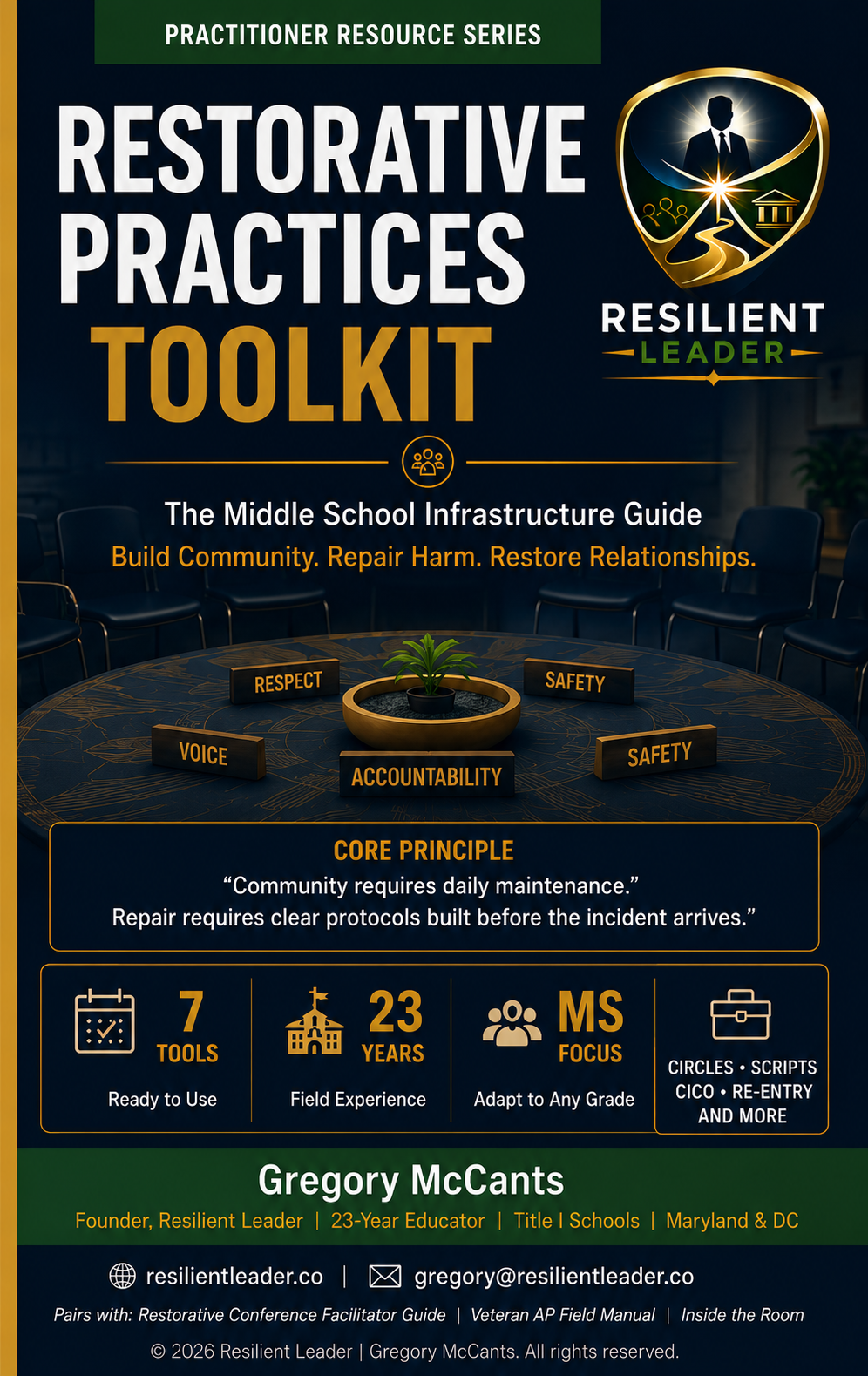


Restorative Practices Toolkit: The Middle School Infrastructure Guide
Community requires daily maintenance. Repair requires clear protocols built before the incident arrives.
Think about the standard restorative rollout that central offices love to mandate. A school district buys a series of generic professional development days, hands out an abstract text, and tells teachers to start sitting in circles. Then, a major behavior flare-up paralyzes a classroom on a Tuesday morning. The teacher defaults to the nearest punitive response because the building has never built the functional, ground-level process infrastructure required to hold what happens during the instructional block.
The school ends up managing a restorative performance. It checks a compliance box for the district, but it leaves the upstream relational fractures completely untouched.
We ask dedicated educators to run on pure, exhausted improvisation. They stay up typing out student management strategies or intervention plans at 10:00 PM because the system provided zero automated process shields.
The hard numbers prove why continuing down this path is a recipe for system collapse. Conversely, when schools replace individual heroics with strict infrastructure, the results are undeniable. A decade-long study by the University of Chicago Education Lab tracking major public school cohorts confirmed that implementing structured restorative practices caused out-of-school suspensions to drop by 18 percent, school-level arrests to plummet by 35 percent, and outside-school arrests to fall by 15 percent. Further, the Learning Policy Institute’s massive audit of 485 middle schools revealed that exposure to these structural frameworks directly boosted student standardized test scores across both ELA and mathematics.
Restorative justice is not a soft behavior management system built on good vibes. It is a strict relationship framework engineered for authentic student accountability rather than simple passive silence.
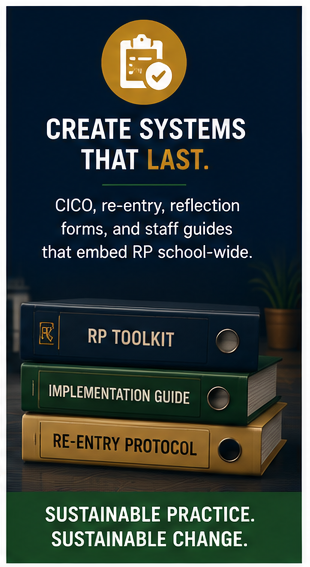
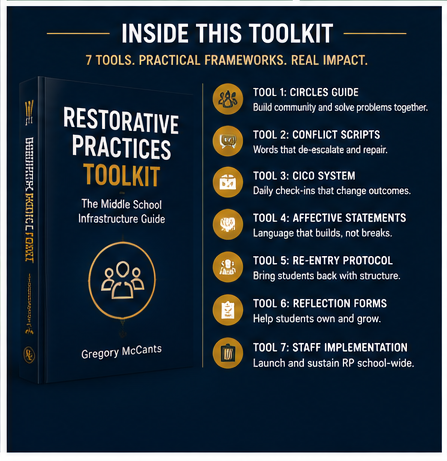
Written straight from the hallway trenches by a 23-year Title I classroom teacher, dean, and assistant principal, this toolkit strips away the fuzzy academic jargon. It delivers 7 immediate, plug-and-play tools to establish absolute environmental predictability from your homeroom entry routine to the high-stakes re-entry arc after a suspension. Stop chasing classroom chaos with reactive disciplinary measures. Build a structural foundation that protects your time and retains your students.
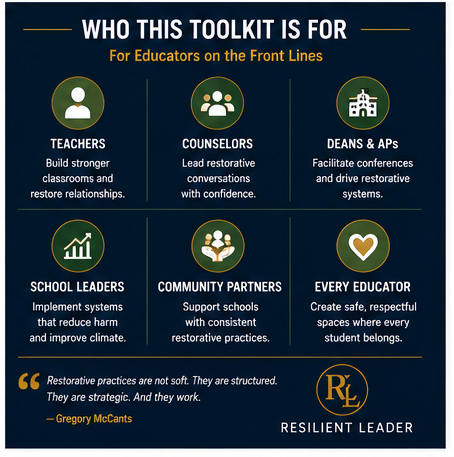
Who This Is For
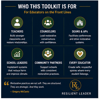
- Middle & High School Classroom Teachers who are exhausted by processing minor classroom disruptions and want an objective, unyielding relational layout to manage boundaries.
- Deans of Students & Culture Directors looking to stop the endless cycle of recycling student infractions by moving from punitive removals to systemic repair loops.
- MTSS Coordinators & Student Services Staff needing an evidence-backed, data-monitored Tier 2 intervention blueprint that integrates families without adding hours of paperwork.
What You Receive
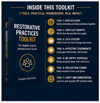
- The 5-Step Community & Problem Circle Protocol: Explicit procedural instructions tracking Opening, Norm-Setting, Rounds, Closing, and 24-Hour Reflection phases to build psychological safety before a crisis strikes.
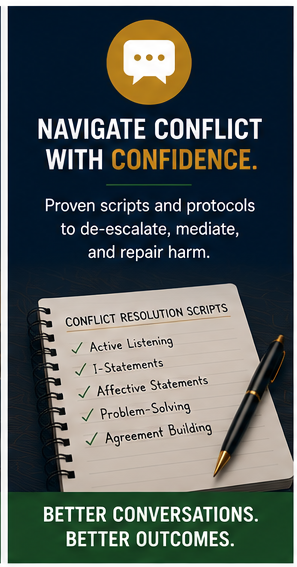
- The Conflict Language Swap Matrix: Tabular reference guides detailing exactly how to eliminate toxic, adversarial phrases like "You always do this" or "Go to the office" and install boundary-holding de-escalation tracks instead.
- The Restorative CICO Daily System: A complete Tier 2 relationship layout using a rapid 3-minute check-in/check-out script to reduce office disciplinary referrals by 30 to 60 percent.
- The "I" Statement Affective Formula: A precise communication blueprint (Specific Behavior + Felt Emotion + Structural Impact) to repair adult-student friction without generating defensiveness.
- The 7-Step Re-Entry Conference Protocol: A critical 10-to-15 minute transition guide that slashes the 30-day disciplinary referral recidivism rate by three factors for students returning from suspension.
- Student Pre-Conference Reflection Layouts: Non-punitive preparation sheets that securely capture student voice and emotion before a formal accountability circle convenes.
- The 4-Stage Schoolwide Implementation Blueprint: Chronological guidelines to launch restorative practice building-wide across a multi-month timeline while managing structural staff objections.
- The RP vs. Admin Behavior Categorization Matrix: An objective reference chart defining which classroom behaviors belong in restorative tracking arrays and which criteria mandate immediate administrative removal.
What It Pairs With
To construct an automated, legally defensible behavioral ecosystem across every room on your campus, this infrastructure guide links directly with:
- Restorative Conference Facilitator Guide: For scaling up these core toolkit criteria into an advanced manual packed with copy-and-paste facilitation scripts for high-activation rooms.
- Veteran AP Field Manual: For pulling advanced upstream documentation templates, legal risk management parameters, and fact-based writing matrices.
- The New Teacher Survival Guide: For exporting these exact middle school predictability structures directly to early-career frontline educators to prevent first-year burnout.